
Art practice — VAT & margin scheme

Art market VAT
& the margin scheme

Art market VAT is a specific tax regime combining a reduced rate (5.5%) on importation from third countries (French Tax Code art. 278-0 bis I), the standard rate (20%) on resale and the VAT margin scheme calculated on the difference between the sale price and the purchase price (French Tax Code art. 297 A and following). It applies to galleries, dealers, antique dealers, online platforms and private sellers. An incorrect characterisation exposes the taxpayer to tax reassessments, late-payment interest and, in serious cases, criminal sanctions.

Paris · Geneva · Marseille · Cannes · Lisbon
— In brief
What
VAT regime specific to the art market
For whom
Galleries, dealers, auctioneers, platforms, selling collectors
Key Tax Code articles
Art. 278-0 bis I (importation 5.5%), 297 A to 297 G (margin), 297 B (option for the total price)
Tax definition
French Tax Code annex II art. 98 A (exhaustive list)
Recommended action
Preventive audit of flows and of the margin option before any tax audit
— 01

Art VAT is a minefield where characterisation decides everything

The VAT regime for works of art rests on an exhaustive definition (French Tax Code annex II art. 98 A: paintings, drawings, engravings, original sculptures in limited editions, signed and numbered photographs, tapestries, unique ceramics, enamels on copper, etc.). Any item outside this list falls under standard-law VAT and loses eligibility for the margin scheme.

To this is added the option rule: the dealer may, transaction by transaction or globally, opt for VAT on the total price instead of the margin. The choice commits the documentation, the invoicing, the right to deduct and the cash flow over several financial years.

The firm structures VAT arrangements for galleries, dealers, auctioneers, platforms and selling collectors, and defends taxpayers under audit (VAT, DGFiP, customs).

— 02

The four VAT regimes applicable to the art market

01

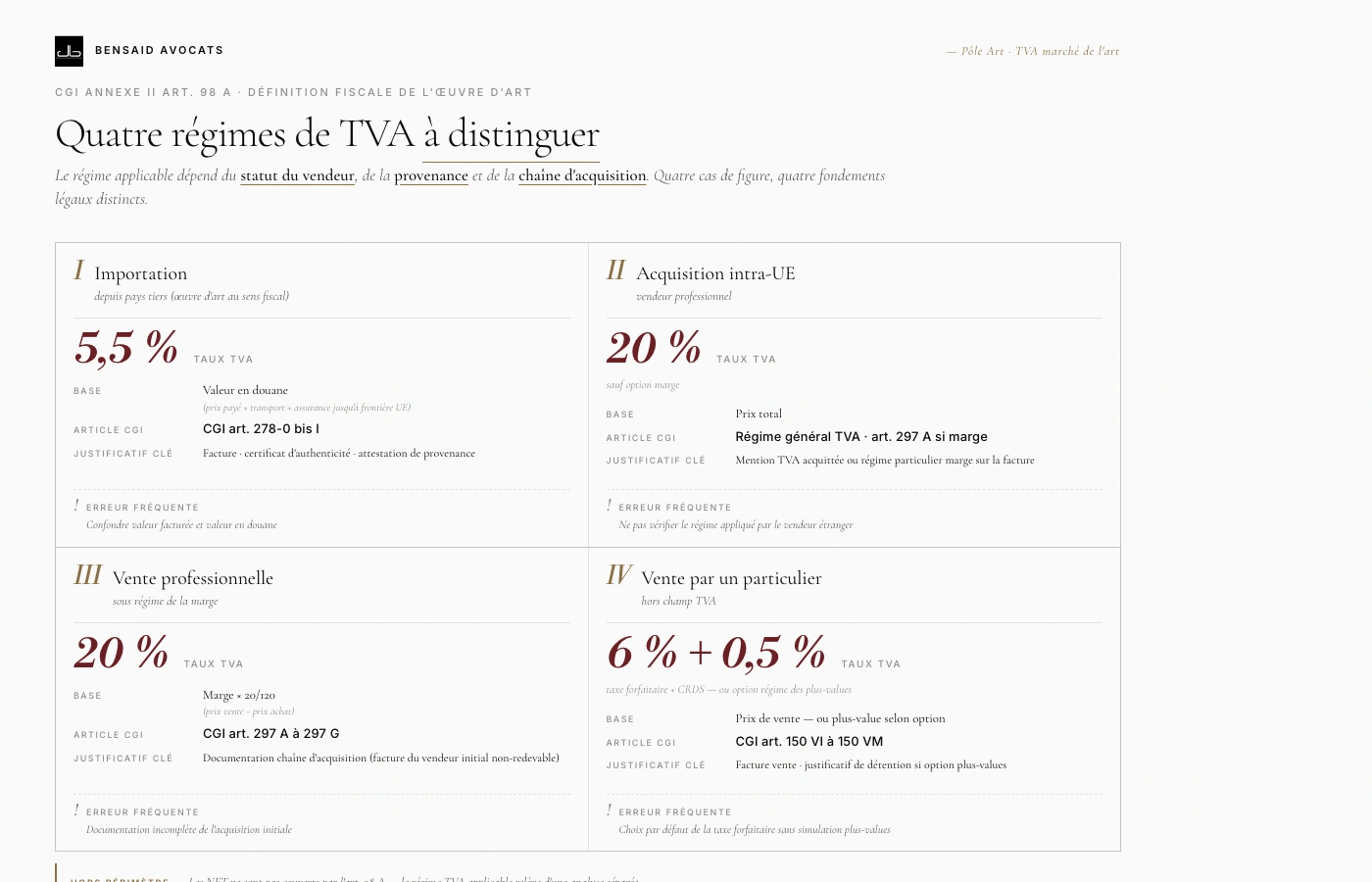
Importation from a third country

Application of the reduced rate of 5.5% to the customs value where the item matches the tax definition of a work of art (French Tax Code art. 278-0 bis I).

  • Third country = outside the EU (Switzerland, USA, United Kingdom post-Brexit, etc.)
  • Customs value = price paid + transport costs + insurance up to the EU border
  • Required supporting documents: invoice, certificate of authenticity, proof of provenance
02

Intra-Community acquisition

Application of the standard rate (20%) unless the seller applies the margin scheme in their own country.

  • Mandatory mention: special margin scheme or VAT paid
  • Attention to reverse charge and the intra-EU trade declaration
  • Risk of double taxation in the event of divergent characterisation
03

VAT margin scheme

VAT calculated on the margin realised by the professional seller (difference between sale price and purchase price) at the standard rate of 20%, where the item was acquired from a non-taxable person or from another dealer under the same regime (French Tax Code art. 297 A).

  • Global margin or transaction by transaction
  • No VAT stated on the client invoice
  • Rigorous documentation of the acquisition chain
04

Sale by a private individual

Outside the scope of VAT. Possible application of the flat-rate tax on precious objects (French Tax Code art. 150 VI to 150 VM) at the rate of 6% + 0.5% CRDS, or option for the capital-gains regime.

  • Flat-rate tax = by default, without demonstrating the acquisition price
  • Capital-gains option = exemption after 22 years of holding
  • A choice that is often strategic depending on age and latent gain
— 03

The VAT margin scheme: what to master in practice

The margin scheme is the cornerstone of the taxation of art dealers. Its correct application requires mastering four operational points.

1. Eligibility conditions

The item must be a second-hand good, a work of art, a collectors' item or an antique (French Tax Code art. 297 A I). The initial seller must be a non-taxable person (a private individual, a dealer under the exemption regime, another dealer applying the margin scheme within the EU).

2. Calculating the margin

Margin = sale price incl. tax – purchase price. The VAT charged on the margin is calculated by applying the margin coefficient (rate / 1+rate). At the 20% rate, VAT = margin × 20/120.

3. Global margin (French Tax Code art. 297 B)

An option allowing the margin to be calculated over an entire period (month, quarter, financial year) rather than transaction by transaction. Useful for high-volume dealers with heterogeneous margins. Minimum commitment of 2 years.

4. Documentation

Each acquisition must be traced: seller's invoice, mention of the regime applied, seller's identity, acquisition price. Any gap exposes the taxpayer to a VAT reassessment on the total sale price in the event of an audit.

— Matrix

The 4 VAT regimes applicable to the art market

Matrix of the 4 art market VAT regimes: importation from third countries (5.5%), intra-EU acquisition, VAT margin scheme (French Tax Code art. 297 A), sale by a private individual (flat-rate tax French Tax Code art. 150 VI).
Tax definition of a work of art: French Tax Code annex II art. 98 A. © Bensaid Avocats.
— 04

Our experience with market participants

The firm advises galleries, auction houses, dealers, online platforms and collectors on securing their VAT flows, the margin / total-price option, the documentation of acquisition chains, imports from Switzerland, the United States and the United Kingdom, and defence under tax audit.

Our dual bar France · Switzerland is an operational advantage: we structure the Geneva · Paris flows (free port regime, importation, transit), we advise French-Swiss dealers on characterising their permanent establishment, and we coordinate the VAT analysis with customs taxation and the circulation of cultural goods.

We act upstream (preventive audit, structuring) and downstream (litigation, settlements, hierarchical appeals, judicial appeals before the administrative court and the administrative court of appeal).

— Frequently asked questions

Art VAT in practice

Which works fall within the tax definition?

Annex II to the French Tax Code, art. 98 A, provides an exhaustive list: hand-painted pictures, original drawings, limited-edition engravings, original sculptures in an edition of 8 (12 for posthumous casts), signed and numbered photographs in 30 copies, hand-made tapestries from original designs, unique ceramics, enamels on copper, etc. NFTs and digital works are not covered by this definition and fall under standard-law VAT.

A work bought in Switzerland and imported into France: what VAT rate?

5.5% on the customs value if the item matches the tax definition (French Tax Code art. 278-0 bis I). The import declaration is made through the standard customs procedure; VAT is due on release for consumption. For purchases in a free port (Geneva, Luxembourg), VAT is only due when the item leaves the customs warehouse for a Member State.

Margin scheme or VAT on the total price: how to choose?

The margin is by default more advantageous for the final client (invisible VAT) but does not allow deduction. VAT on the total price with the option (French Tax Code art. 297 B) is useful where the buyer is themselves a taxable person and wishes to deduct, or where the margin is small and the VAT on the total price is lower. An impact study transaction by transaction is essential.

What sanctions apply in the event of incorrect characterisation?

VAT reassessment on the total sale price (and not on the margin), late-payment interest at 0.20% per month, a 40% surcharge in the event of deliberate default (French Tax Code art. 1729), and even criminal proceedings for fraudulent evasion of tax if the amounts at stake are significant (French Tax Code art. 1741).

Must an online marketplace selling art apply the VAT margin scheme?

The platform is generally a transparent intermediary; the applicable regime depends on the underlying seller. Since the 2021 «VAT e-commerce package», platforms may be deemed to be seller-buyer in certain cross-border B2C scenarios (French Tax Code art. 256 II bis), with significant consequences for characterisation.

Can a private individual apply the margin scheme?

No. The margin scheme is reserved for taxable dealers (art dealers, auctioneers, second-hand dealers). A private individual reselling a work falls either under the flat-rate tax (6%) or under the regime of capital gains on movable property by option (French Tax Code art. 150 VL).

What are the common errors in art market VAT?

Four recurring errors: (1) applying the margin scheme to an item acquired from a taxable liable person (invalid regime, VAT reassessment on the total price); (2) importing at 5.5% an item outside annex II art. 98 A (NFTs, contemporary series furniture, decorative objects do not qualify); (3) omitting the intra-EU trade declaration for acquisitions from Belgium, Italy or Germany; (4) absence of proof of provenance for the Geneva free port (the French authorities reassess at the point of actual importation).

Global margin or margin transaction by transaction: which to choose?

The margin transaction by transaction is the default regime, simple to document but ill-suited to high-volume dealers with heterogeneous margins. The global margin (French Tax Code art. 297 B II) calculates the margin over an entire period (month, quarter, financial year), useful when some transactions are at a loss and offset others with a high margin. Minimum commitment of 2 years, prior declaration mandatory. Often to be combined with strict analytical accounting to avoid rejection of the option in the event of an audit.

Do NFTs and digital works benefit from the art regime?

No. The tax definition of a work of art (French Tax Code annex II art. 98 A) is exhaustive and lists only physical media (pictures, sculptures, signed and numbered photographs in 30 copies, etc.). NFTs, purely digital works and artistic tokens fall under standard-law VAT (20%) in France. The tax characterisation of a hybrid work (numbered signed video, generative art on a physical medium) must be analysed case by case: a prior audit avoids reassessments.

Cité par

A VAT operation to structure or defend?

A confidential first exchange, preventive audit, structuring or defence under tax audit.