Art practice — International circulation

Import & export
of works of art

The import and export of works of art in France fall under a triple set of rules: (1) an export certificate for cultural goods (Code du patrimoine art. L.111-2) and an EU licence (Regulation (EC) 116/2009) on departure; (2) a customs declaration with 5.5% VAT on import (CGI art. 278-0 bis I); (3) a lawful-provenance check under Regulation (EU) 2019/880 and the international conventions (UNESCO 1970, UNIDROIT 1995). An incorrect characterisation exposes the parties to seizure, customs penalties, or even nullity of the transaction.

Paris · Geneva · Marseille · Cannes · Lisbon
— In brief
What
Customs, tax and heritage regimes for the international circulation of works
For whom
Galleries, auction houses, collectors, specialist shippers, foundations
Key texts
Code du patrimoine art. L.111-2 ; Regulation (EC) 116/2009 ; Regulation (EU) 2019/880
Certificate lead time
4 months (failing which, tacit certificate)
Recommended action
Provenance audit + upstream structuring of every Geneva · London · New York flow
— 01

Three legal layers overlap at every movement

Moving a work of art means answering three questions at the same time: (1) is the item a national treasure whose departure is prohibited or subject to authorisation (Code du patrimoine art. L.111-1)? (2) Which customs and VAT regime applies to the operation (import, export, re-export, inward processing)? (3) What is the lawful provenance and the compliance with the international conventions protecting cultural goods?

A single one of these three layers handled poorly triggers a major risk: refusal of the export certificate, blocking at customs, seizure for lack of lawful provenance, VAT reassessment, or even criminal proceedings (Code du patrimoine art. L.114-1 et seq.).

The firm secures these flows for galleries, auction houses, collectors, foundations and specialist shippers, in France and internationally, with a Paris · Geneva · London · New York coordination.

— 02

The four regimes for the circulation of works

01

Export certificate

A mandatory document to take out of French territory a cultural good exceeding the thresholds per category (for example, a painting over 50 years old and over EUR 150,000).

  • Processing time: 4 months (failing which, tacit certificate)
  • Refusal possible if the work is characterised as a national treasure, leading to a buy-back procedure or a temporary ban
  • Validity 20 years (renewable)
02

EU export licence

Beyond the French certificate, this is required to leave EU territory from France (Regulation (EC) No 116/2009).

  • Annex I of the Regulation lists 15 categories and thresholds
  • Issued by the competent DRAC
  • Systematic coordination with the French certificate
03

Import from third countries

A reinforced regime since Regulation (EU) 2019/880: an import licence for certain sensitive categories, an importer's declaration for others.

  • Lawful provenance to be demonstrated (from the country of origin or a third country for 5+ years)
  • Reinforced control for antiquities, archaeological goods and religious heritage
  • Gradual operational implementation (ICG system)
04

Special customs regimes

Temporary admission, inward processing, transit, customs warehousing: regimes useful for exhibition, restoration, auction sale or storage in a free port.

  • Temporary admission: exhibition + restoration without payment of VAT
  • Free port (Geneva, Luxembourg): VAT suspension until release for consumption
  • Discharge: justify the exit or the release for consumption
— 03

France · Switzerland · EU coordination: 5 operational cases

Circulation along Paris ↔ Geneva ↔ London ↔ New York requires precise coordination of the customs, tax and heritage regimes.

1. Purchase in Geneva to Paris

Import from a third country: customs declaration, 5.5% VAT on the customs value (CGI art. 278-0 bis I), provenance supporting documents, attention to the tax characterisation of the work (annex II art. 98 A).

2. Sale from Paris to New York

French export certificate + EU licence + export declaration. National-treasure check. Coordination with the taxation of the disposal (special regime or capital gains).

3. Geneva free port (long-term storage)

VAT suspension as long as the work remains in the free zone. Prepare the exit strategy (local sale, import into France/EU, transfer to another free port). Vigilance on the reporting obligations in France if the holder is a French tax resident.

4. Loan for exhibition (museum, fair)

Temporary-admission regime, State guarantee (law of 8 August 1994), nail-to-nail insurance, loan agreements. Deadlines and formalities: 2 to 4 months.

5. Restoration abroad

Outward-processing regime: temporary export for restoration, return with added value taxed only on the restoration gain. Rigorous documentation of the departure value.

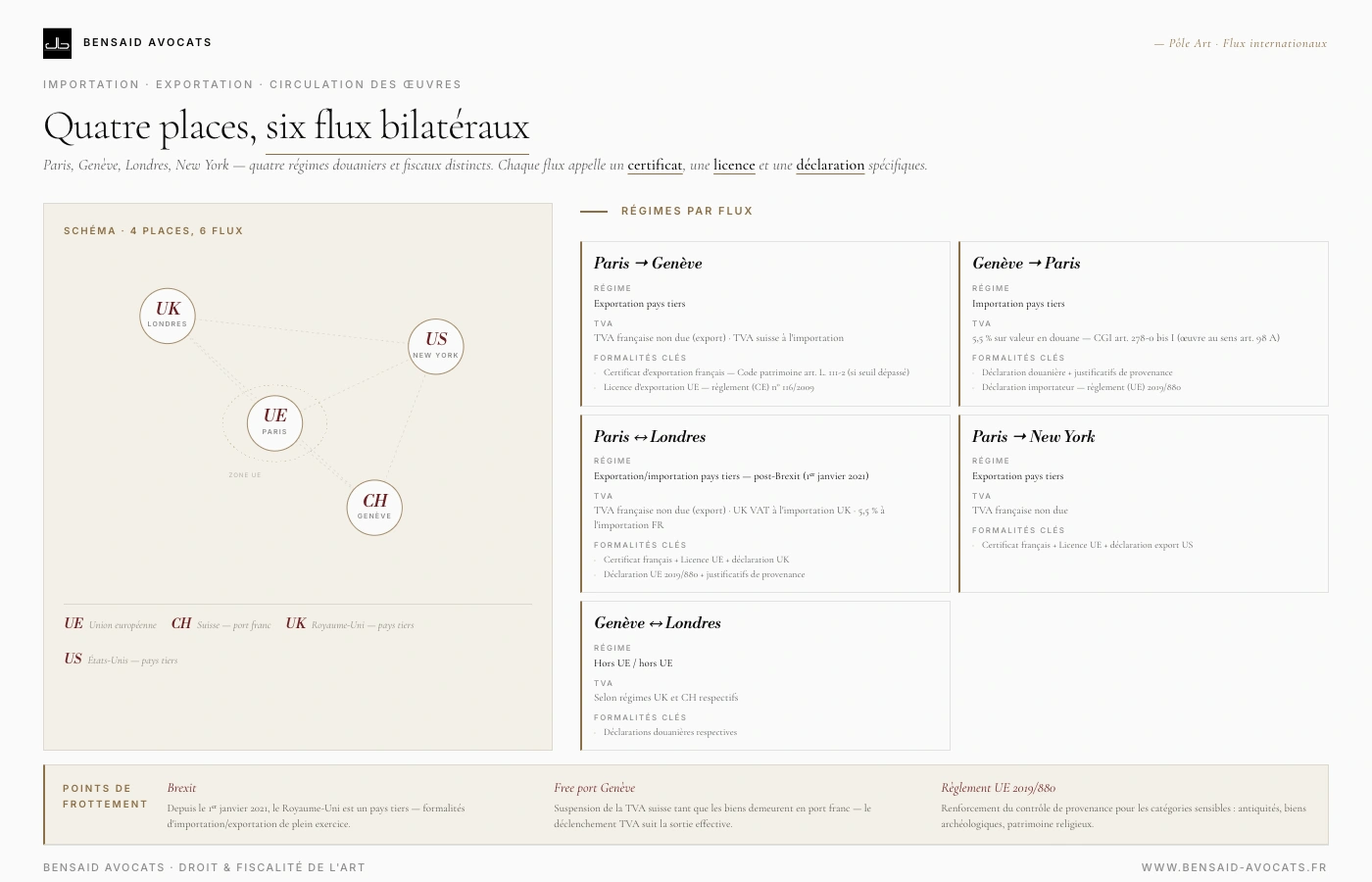
— Map of flows

Paris ↔ Geneva ↔ London ↔ New York

Map of the 6 international flows of works of art between Paris, Geneva, London and New York: customs regimes, applicable VAT, export certificates Code du patrimoine art. L.111-2 and Regulation (EU) 2019/880.
Points of friction: Brexit (UK = third country since 2021), Geneva free port (VAT suspension), Regulation (EU) 2019/880 (provenance). © Bensaid Avocats.
— 04

Our experience with galleries, auction houses and shippers

The firm regularly advises galleries, auction houses, international collectors and specialist shippers on cross-border operations involving works of art: preparing export-certificate files, handling refusals and buy-back procedures, securing provenance chains, structuring free-port operations (Geneva, Luxembourg), and defence in the event of a customs seizure.

Our dual France · Switzerland bar admission is an operational advantage here: we coordinate directly with the Swiss cantonal authorities, we structure the Paris · Geneva · London flows and we work in a network with New York and London lawyers on transatlantic transactions.

We act both upstream (audit of provenance chains, structuring of operations, pre-acquisition advice) and in litigation (appeals against certificate refusals, customs litigation, defence in seizure procedures under the cultural-goods regulation).

— Frequently asked questions

Moving a work of art safely

What are the thresholds for the French export certificate?

The thresholds vary by category (Code du patrimoine, annex). Examples: paintings over 50 years old and over EUR 150,000, sculptures over 50 years old and over EUR 50,000, photographs over 50 years old and over EUR 15,000, archives over 50 years old with no value threshold. Any departure above these thresholds requires the certificate (which may be refused if the item is a national treasure).

What happens if the export certificate is refused?

The work is characterised as a national treasure. The State has 30 months to make a purchase offer at the international value of the item (Code du patrimoine art. L.121-1). If no offer is made or if the offer is refused by the owner, the certificate is issued. The 30-month period can be used strategically to negotiate (patronage, dation in payment (payment in kind), partial sale).

What is the difference between the French certificate and the EU licence?

The French certificate authorises departure from French territory (to the EU or to a third country). The EU licence is required to leave the territory of the European Union, in addition to the certificate. For a sale from Paris to New York: both are needed. For Paris to Geneva: French certificate + EU licence (Switzerland is outside the EU).

Is the Geneva free port a tax haven?

No. It is a customs free zone (Swiss territory, outside Swiss customs) where VAT and customs duties are suspended as long as the goods remain there. Holding goods there is lawful, but it does not exempt the owner from the tax obligations in their country of residence (wealth reporting, possible wealth tax on precious stones, etc.). Transparency is now the rule.

What should be done if a work is seized at customs for lack of provenance?

Immediate action: (1) challenge the protective measure within the time limits (10 days for the suspension application), (2) reconstruct the provenance chain (invoices, inheritances, archives), (3) negotiate with customs on the characterisation (lawful import, length of holding, exclusion from the regulation). Without a rapid defence, the work may be confiscated for the benefit of the Treasury.

What obligations apply to specialist shippers?

Shippers (DSV, Bovis, Crown, etc.) are jointly liable for the customs regularity of the operations (Customs Code). They rightly require complete files: certificate, licence, customs value, provenance supporting documents, insurance. An incomplete file leads to refusal to take on the shipment or to critical delays.

What are the frequent mistakes in the international circulation of works?

Four major mistakes: (1) an under-valued customs declaration on import (VAT recovery + customs fines + risk of a fraud characterisation); (2) omission of the export certificate for works exceeding the threshold per category (seizure on departure or subsequent litigation); (3) undocumented provenance for antiquities leaving a source country (refusal of release for free circulation under Regulation (EU) 2019/880); (4) confusion between temporary admission and free circulation (VAT payable if the work is not re-exported within the discharge time limits).

How does the Geneva free port work in practice?

The Geneva free port (Ports Francs et Entrepôts de Genève SA) is a customs free zone on Swiss territory. Goods are stored there under a regime of VAT and customs-duty suspension. Exit is possible to: (a) internal Switzerland, with Swiss VAT payable on release for consumption; (b) the European Union, with import and 5.5% VAT in France; (c) another third country, with re-export without friction. The reporting obligations in France (the owner's tax residence) remain due. Since 2017, the identity of the owner and the nature of the item are recorded in the Swiss register, ending absolute secrecy.

Does Regulation (EU) 2019/880 apply to all imported works?

No. Regulation (EU) 2019/880 targets cultural goods created or discovered outside the EU, and distinguishes: (a) a mandatory import licence for archaeological goods and fragments of dismembered monuments (annex part B), always required; (b) an importer's declaration for most other categories (annex part C), a lawful-provenance declaration + value over EUR 18,000. Modern and contemporary works of art created in the EU are excluded. The ICG system (centralised interface) is being rolled out gradually.

Cité par

A cross-border operation to secure?

A confidential first exchange: provenance-chain audit, certificate preparation or defence in the event of a seizure.