
Art practice — Transfer

Transfer of a collection
of works of art

The transfer of an art collection refers to all the legal and tax mechanisms that allow a collection to leave the private estate of a collector or an artist, towards their heirs, family or a lasting structure. It draws on the splitting of ownership (French Tax Code art. 669, 1133), staged gifts (French Tax Code art. 779), a contribution to an endowment fund, dation in payment (payment in kind) (French Tax Code art. 1716 bis) and the exemption for property listed as a historic monument (French Tax Code art. 795 A). A successful transfer is prepared 5 to 15 years before death.

Paris · Geneva · Marseille · Cannes · Lisbon
— In brief
What
Legal architecture for a collection leaving the private estate
For whom
Collectors, heirs of artists, wealth-holding families
Main tools
Splitting of ownership, gift-partition, dation, endowment fund, historic-monument exemption
Key Tax Code articles
Art. 669, 779, 1133, 1716 bis, 795 A
Anticipation
5 to 15 years before death
— 01

A collection is not transferred like financial wealth

An art collection combines three features that make it unique in succession terms: a discretionary valuation (expert estimates, volatile markets, individual price levels), a structural illiquidity (auction sale means delay and discount), and an emotional weight bearing on preserving the coherence of the whole.

Without anticipation, the inheritance produces three risks: inheritance tax exceeding the available liquidity, forced dispersal of the collection through an emergency sale, and family conflicts between co-heirs with differing tastes for the works.

The firm builds transfer architectures over 5 to 15 years, combining gifts with splitting of ownership, dations in payment, endowment funds, foundations, contributions to companies, and cross-border tax strategies (tax residence, treaties, exit tax French Tax Code art. 167 bis).

— 02

Five complementary transfer tools

01

Gift with splitting of ownership

A gift of the bare ownership to the children, with the donor keeping the usufruct (and the enjoyment of the collection).

  • Tax calculated on the value of the bare ownership (French Tax Code art. 669)
  • Free reconstitution when the usufruct ends (French Tax Code art. 1133)
  • Renewable every 15 years (tax look-back on gifts)
02

Gift-partition

Allows the value of the works to be fixed on the day of the gift, avoiding disputes over the value on the day of death.

  • Tax and civil stability (Civil Code art. 1078)
  • Coordination with direct-line allowances
  • A key tool for coherent collections to be preserved
03

Contribution to an endowment fund or a foundation

The collection leaves the private estate for a lasting structure, a philanthropic and tax tool.

  • Patronage tax reduction (French Tax Code art. 200 and 238 bis)
  • Perpetuation of the collection's coherence
  • See our cluster Foundation & endowment fund
04

Dation in payment (payment in kind)

Settlement of inheritance or gift tax by handing over a major work to the State (French Tax Code art. 1716 bis).

  • A solution for collections rich in major pieces
  • Preserves the heirs' liquidity
  • See our cluster Dation
05

Exemption for property listed as a historic monument

Full tax exemption on property listed or registered as a historic monument, subject to an agreement to present it to the public (French Tax Code art. 795 A).

  • Renewable three-year agreement
  • Minimum public availability
  • Coordination with historic-monument taxation
— 03

Anticipating the succession: 5 workstreams to carry out during one's lifetime

A successful transfer is prepared 5 to 15 years before death. Here are the 5 workstreams the firm carries out systematically.

1. Valued and legal inventory

A complete mapping: works, provenance, certificates, estimated values (two experts), title deeds (invoices, gifts, inheritances), ongoing loans, deposits in a free port. A prerequisite for any scheme.

2. Matrimonial regime & statutory regime

Checking the matrimonial regime: characterisation of the works (separate, community, jointly owned), consequences on the liquidation. Possible adaptation (change of regime, amended marriage contract, gift between spouses).

3. Splitting-of-ownership strategy

Calibration of the right moment (donor's age = usufruct/bare-ownership scale), selection of the works to be split as a priority, coordination with allowances renewable every 15 years.

4. Family governance

Family charter, shareholders' agreement (if a holding company), endowment-fund articles, right of first refusal between co-heirs, exit mechanisms. Anticipates the trade-offs between heirs with differing tastes.

5. Tax liquidity strategy

Early identification of liquidity sources for future tax: life insurance, instalment payment French Tax Code art. 1717, dation, loan secured on a work, sale of part of the collection. Avoids the emergency sale.

— Decision tree

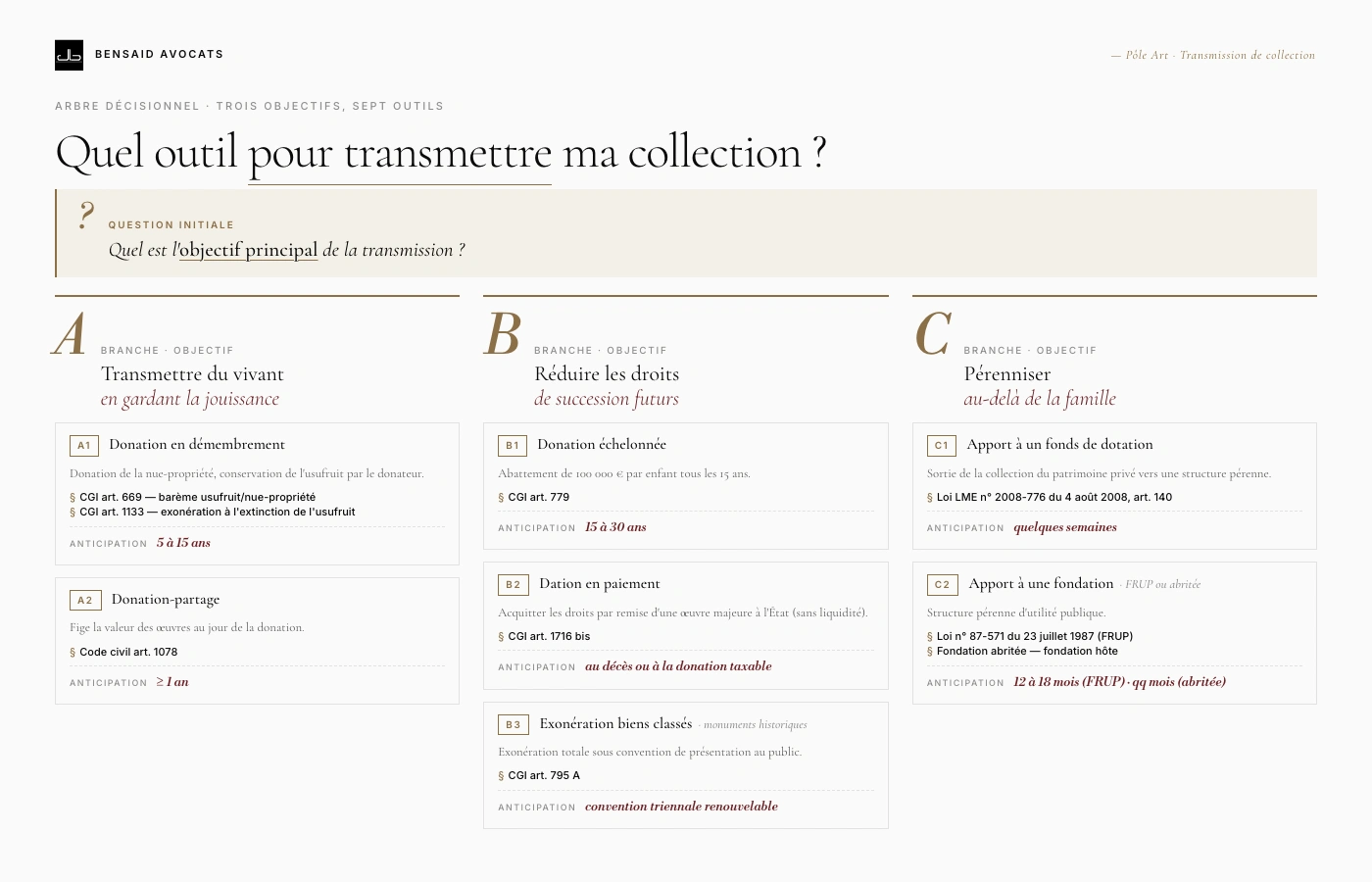
Which tool to transfer an art collection?

Three-branch decision tree to choose the tool for transferring a collection: splitting of ownership (French Tax Code art. 669, 1133), gift-partition, dation (French Tax Code art. 1716 bis), staged gift (French Tax Code art. 779), historic-monument exemption (French Tax Code art. 795 A), endowment fund, foundation.
Any scheme generally combines 2 or 3 tools. © Bensaid Avocats.
— 04

Our experience of collectors' and artists' successions

The firm is used to artists' and collectors' successions and assists, in the strictest confidence, prestigious successions involving collections of paintings, sculptures, photographs, decorative arts and tribal arts. We never name our clients: discretion is the first rule of wealth practice.

This experience gives us a fine understanding of the pitfalls: valuation challenged by the tax authorities, recharacterisation of a disguised gift, conflicts between co-heirs, coordination with the moral rightholders for artists' successions (moral right, resale right, archives, studios).

We work in a network with notaries specialising in artistic wealth, accredited experts, curators and leading auctioneers, in Paris, Geneva and London. For artists' successions, we also structure the governance of the studios, the management of the archives and the museum-presence strategy.

— Frequently asked questions

Transferring a collection without squandering it

What is the tax cost of a succession involving an art collection?

Works are taxed at their market value on the day of death. The direct-line succession scale ranges from 5% to 45% above the 100,000 € allowance (French Tax Code art. 779). For a 5 M€ collection passed to an only child, the tax comes close to 2 M€, hence the urgency of anticipation.

How can the dispersal of a coherent collection be avoided?

Three levers: the gift-partition (Civil Code art. 1078) which fixes the attributions; the family endowment fund which takes the collection out of the private estate while keeping family governance; and the joint-ownership agreement (Civil Code art. 1873-1), which is renewable.

What if the heirs lack the liquidity to pay the tax?

Four combinable options: instalment payment (French Tax Code art. 1717, up to 10 years), dation in payment (payment in kind) (French Tax Code art. 1716 bis), a bank loan secured on other assets, the sale of part of the collection (through an auction strategy or a private treaty sale).

What is the 5% furniture flat rate?

For the succession return, household furniture (ordinary furniture) may be valued at a flat rate of 5% of the gross estate (French Tax Code art. 764). This flat rate does not apply to works of art, collectors' items or antiques, which must be valued individually at their market value.

How does the transfer interact with a tax residence in Switzerland?

Swiss tax residence at the time of death changes the tax connecting factor of successions. But for works located in France, transfer duty remains due in France (French Tax Code art. 750 ter). The interaction with the 1953 France-Switzerland treaty (currently being renegotiated) and the possible cantonal inheritance tax must be studied in advance.

What is specific about an artist's succession?

Three particular issues: the management of the moral right (perpetual, inalienable, transferable to the heirs), the collection of the resale right (post-mortem resale of works, 70-year term), the preservation of the archives and the studio (often gathered within an endowment fund or a foundation), and the long-term museum-presence strategy.

What are the common mistakes in transferring a collection?

Four recurring mistakes: (1) no valued inventory ahead of death (the heirs discover an unmanageable succession, a forced sale at a loss); (2) a gift without splitting of ownership when the donor wished to keep the enjoyment (loss of tax optimisation); (3) overlooking the marital dimension (a wrongly characterised matrimonial regime, works to be reallocated at the liquidation); (4) refusing to plan the liquidity for the tax, leading to the forced dispersal of a coherent collection. Each mistake is prevented by a wealth audit 5 to 15 years before death.

How is a collection valued for the succession return?

The valuation is at the market value on the day of death (French Tax Code art. 666). Three accepted methods: (1) a public sale within 2 years of death (value retained = the hammer price), (2) an adversarial appraisal by two accredited experts (the value retained is the average), (3) valuation by the notary for lower-value pieces. An under-valuation exposes the taxpayer to a reassessment with an 80% surcharge in the event of concealment (French Tax Code art. 1729 c).

Does the Dutreil pact apply to art collections?

No, the Dutreil pact (French Tax Code art. 787 B) is reserved for shares in an operating company. A collection held directly is not eligible. However, a prior contribution of the collection to a company (SCI, dedicated SAS) may, under strict conditions, open the way to the characterisation of an operating activity (gallery, dealer) and therefore to Dutreil. The arrangement must be analysed case by case, with a risk of abuse of tax law if the company has no real economic substance.

Cité par

A collection to be transferred under the best conditions?

A confidential first exchange to map the tools suited to your situation and build a timeline over 5 to 15 years.

Jonathan Bensaid, avocat fondateur

Written by

Me Jonathan Bensaid, avocat fiscaliste, fondateur du cabinet Bensaid Avocats, inscrit aux Barreaux de Paris & Genève.