Article — Wealth taxation & collections

Income tax & VAT on buy-and-resell operations — collectors

The ruling of the Paris Administrative Court of Appeal, 17 Oct. 2024, no. 23PA00612 reclassifies as a commercial activity the resale, by a collector, of 60 bottles of Pétrus over three years, giving rise to income tax (industrial and commercial profits, BIC) under article 34 of the French Tax Code and to VAT (article 256 of the Tax Code). The boundary between private wealth management and an undisclosed activity shifts: the limitation period then extends to 10 years and penalties may reach 80%.

Paris · Geneva · Marseille · Cannes · Lisbon
— 01

Legal framework of income tax and VAT on buy-and-resell

Article 34 of the French Tax Code classifies as industrial and commercial profits (BIC) the profits derived from the exercise of a commercial profession. Under article L. 110-1 of the Commercial Code, this includes the purchase of goods with a view to their resale, whether movable or immovable property, carried out on a habitual basis and with a speculative intent.

As regards VAT, article 256 of the Tax Code subjects to turnover taxes the supplies of goods and services made for consideration by a taxable person acting as such. Article 256 A defines the concept of taxable person: any person who independently carries out an economic activity, whatever its legal status.

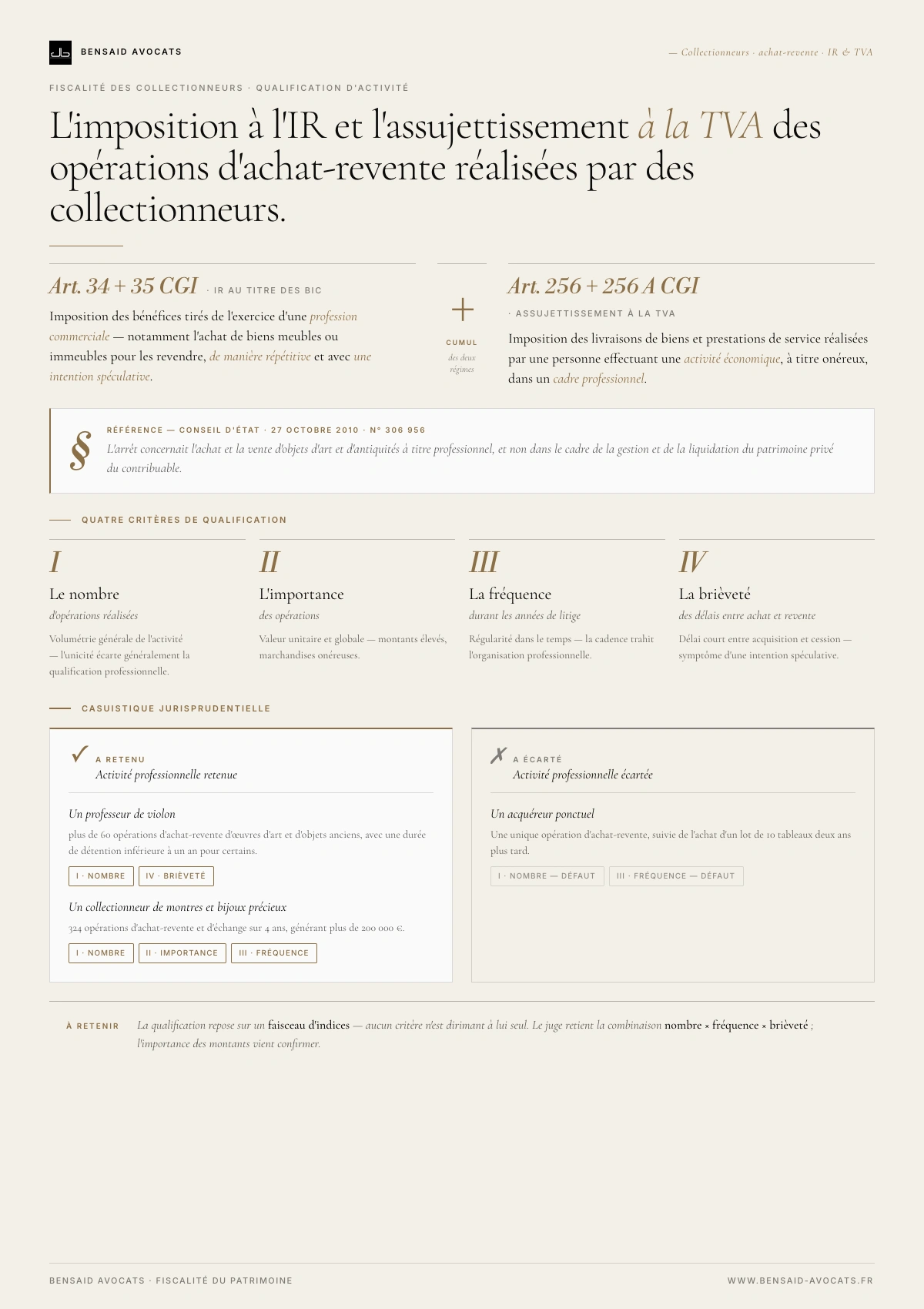
The case law (Conseil d'État, 27 Oct. 2010, no. 306956) has established four criteria to distinguish private wealth management from a commercial activity: the number of operations carried out, the size of the transactions, the frequency over the years in dispute, and the short intervals between purchases and resales. No single criterion is decisive on its own; it is their combination that reveals the speculative intent.

— 02

The Paris Court of Appeal ruling of 17 October 2024 — the Pétrus case

01

The facts — 60 bottles over three years

Over the 2011-2013 financial years, a collector resells 60 bottles of Pétrus from his personal cellar. The tax authorities reclassify the operation as an undisclosed commercial activity.

  • 2011: 6 bottles — purchase 3,750 € excl. tax / resale 12,000 €
  • 2012: 6 bottles — purchase 3,150 € excl. tax / resale 14,400 €
  • 2013: 48 bottles — purchase 18,720 € excl. tax / resale 72,000 €
  • Total: 60 bottles resold, ~98,400 € in proceeds
  • Identified professional buyer — a wine merchant
  • Resales at prices multiplied by 3 to 4 compared with the purchase

02

The classification adopted by the Court

The Paris Court of Appeal confirms the position of the tax authorities: the operation exceeds the management of private wealth. Combined application of the four Conseil d'État criteria.

  • Immediate resales when the bottles could have been kept
  • Selectivity — only the Pétrus bottles are resold
  • Reinvestment of the profits in the purchase of new bottles
  • Multiplied prices — a commercial margin is established
  • Professional buyer — a structured resale channel
  • Conclusion: habitual commercial activity with speculative intent
03

Tax consequences — income tax, VAT and penalties

The reclassification triggers a combination of reassessments: income tax as BIC, retroactive liability to VAT, application of the ten-year limitation period and surcharges for undisclosed activity.

  • Income tax as BIC on the margins realised
  • VAT reassessment on all resales (Tax Code art. 256)
  • Limitation period extended to 10 years (undisclosed, unreported activity)
  • 80% surcharge applicable (Tax Procedure Book art. 1728, 1°, c)
  • Late-payment interest at the statutory rate (0.20% per month)
  • Criminal risk where fraud is established (Tax Code art. 1741)
04

The private-wealth / commercial-activity boundary

The ruling sets a dividing line for collectors: what was tolerated as wealth reallocation tips into a commercial activity as soon as habit and speculation appear.

  • An isolated sale, even at a high capital gain, remains private
  • Repetition plus short holding cause the tipping point
  • The identification of a resale channel (dealer) aggravates matters
  • The reinvestment of profits is a strong signal
  • Useful reference: the regime for capital gains on movable property (Tax Code art. 150 UA)
  • A preventive audit is recommended for active collections
— 03

Practical implications for collectors

Wine, watches, cars, art, NFTs — the Pétrus analysis grid applies to any collection sold in successive lots.

Beyond wine: a transposable analysis grid

The reasoning of the Paris Court of Appeal is transposable to any collection — watches, collector cars, works of art, wine, spirits, instruments, and even certain NFTs or rare digital objects. As soon as habit, short holding, identification of a professional buyer and reinvestment appear, the risk of reclassification exists. 2025 case-law confirmation: the tax authorities do not hesitate to use their right of communication with intermediaries (judicial officers, dealers, platforms) to identify repeated sales, and the 80% surcharge for undisclosed activity is regularly applied. Three lines of action are called for.

Three preventive lines of action

Audit of the disposals portfolio

Mapping of disposals over the last 10 years (given the ten-year limitation period for undisclosed activity): frequency, average holding period, identity of buyers, margins realised. Diagnosis of the reclassification risk.

Structuring and traceability

Keeping rigorous wealth documentation (origin, dates, prices, reasons for disposal). For active collections, a review of an ad hoc structure (civil company, holding) that secures the applicable tax regime.

Voluntary regularisation

Where the risk is established, voluntary regularisation before any audit makes it possible to significantly reduce the surcharges (from 80% down to 10-40%) and to avoid the criminal dimension. The 2025 commentary (notably Alexis Fournol, Apr. 2025) confirms that the tax authorities assess matters on a case-by-case basis, with no numerical threshold, hence the importance of an individualised defence conducted with a tax lawyer.

— 05

Authors — François Ouairy & Hana Aabadli

Article co-authored by François Ouairy, partner in charge of the Paris office (wealth taxation, real-estate taxation, VAT), and Hana Aabadli, associate. The firm is recognised by Best Lawyers® 2026 in Tax Law and by Leaders League (VAT, real-estate & wealth taxation).

  • BIC (Tax Code art. 34)
  • VAT (Tax Code art. 256, 256 A)
  • Acts of commerce (Commercial Code L. 110-1)
  • Conseil d'État, 27 Oct. 2010, no. 306956
  • Paris Court of Appeal, 17 Oct. 2024, no. 23PA00612
  • Undisclosed activity — 10-year limitation
  • Gains on movable property (Tax Code art. 150 UA)
  • Best Lawyers® 2026
  • Leaders League
— 04

Diagrams — Classification criteria & timeline of the ruling

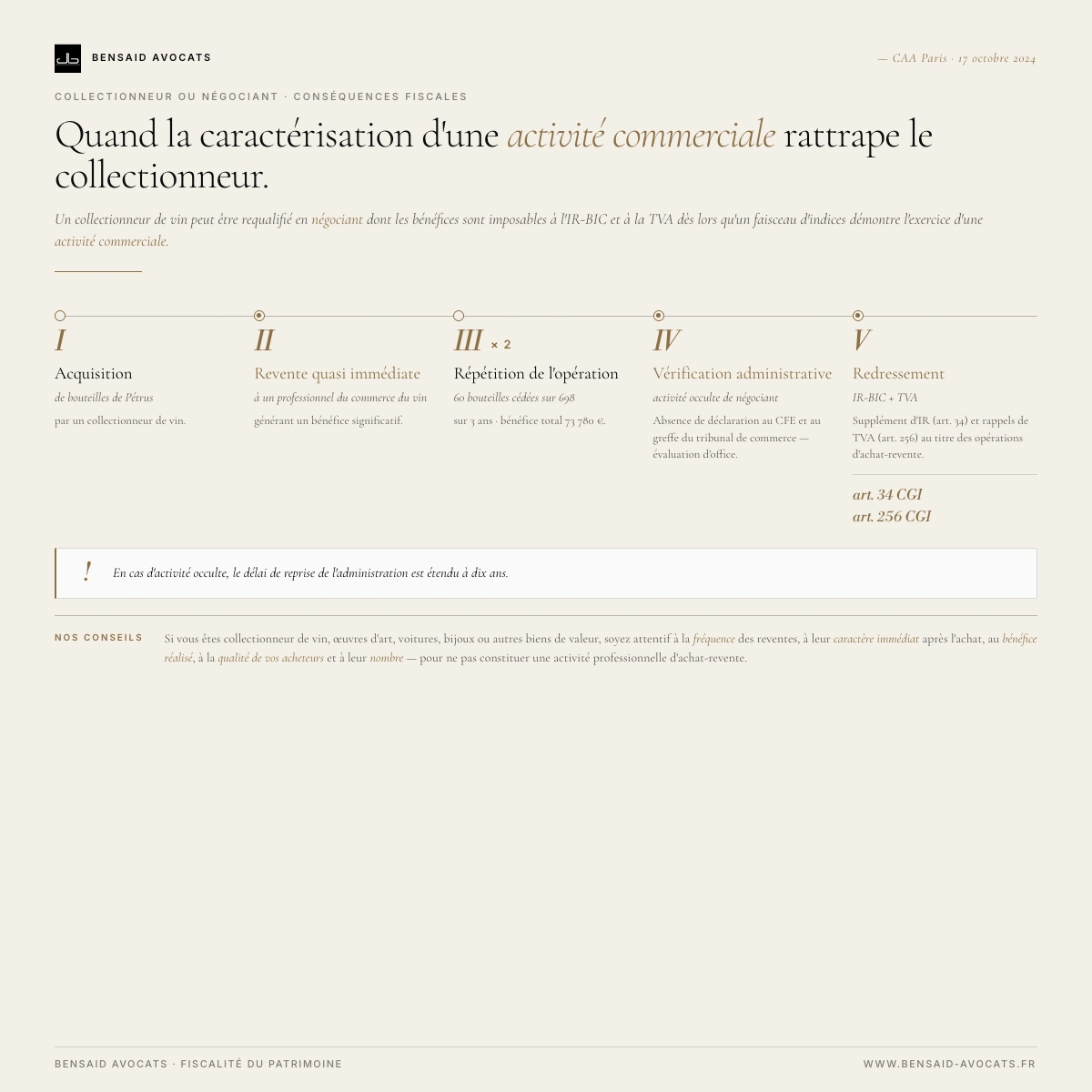
Visualisation of the four case-law criteria (Conseil d'État 2010) and of the timeline of the Pétrus resales at the origin of the Paris Court of Appeal ruling of 17 October 2024.

Diagram of criteria for classifying a commercial activity for collectors — number, size, frequency, short holding (Conseil d'État 2010)
The four case-law criteria (Conseil d'État, 27 Oct. 2010, no. 306956) applied to the disposal of collectors' items: number of operations, size of transactions, frequency over the years in dispute, short intervals between purchase and resale.
Diagram of the Pétrus case, Paris Court of Appeal 2024 — 60 bottles resold 2011-2013, reclassification as commercial activity, income tax BIC VAT
Timeline of the Pétrus case (Paris Court of Appeal, 17 Oct. 2024, no. 23PA00612): 60 bottles resold over 2011-2013, reclassification as a commercial activity, liability to income tax (BIC) and VAT, ten-year limitation period and 80% surcharge.
— 06

Frequently asked questions — Buy-and-resell & collections

From how many disposals does one become a trader in the eyes of the tax authorities?

There is no statutory numerical threshold. The court applies the four criteria of the Conseil d'État (27 Oct. 2010): number, size, frequency and short holding. In the Pétrus case, 60 bottles over 3 years were enough for reclassification; in other matters, lower volumes have also been accepted where there was speculation and habit.

Is an isolated sale at a high capital gain taxed as a commercial activity?

No. An isolated disposal, even at a high capital gain, in principle falls under the regime for capital gains on movable property (Tax Code art. 150 UA), taxed at 19% plus social levies, with an allowance for the holding period. It is repetition and habit that cause the shift to BIC.

What is the difference between private wealth and a commercial activity?

Private wealth implies a long holding, an absence of speculative intent at purchase, and occasional, unorganised disposals. A commercial activity, by contrast, is characterised by habit, short holding, the identification of a resale channel (dealer, merchant) and the reinvestment of profits in new acquisitions intended for resale.

What is the limitation period for undisclosed, unreported activity?

The reassessment period is extended to 10 years (instead of 3 years in principle) where the tax authorities establish the existence of an undisclosed activity, that is, a commercial activity that has not been reported and not identified by a business-formalities centre. The applicable surcharge is 80% (Tax Procedure Book art. 1728, 1°, c).

Does the Pétrus reasoning apply to watches, cars and works of art?

Yes. The reasoning is transposable to any collection — watches, collector cars, works of art, instruments, and even certain NFTs or digital objects. The specific regimes (the flat-rate levy of 6.5% on precious metals and objets d'art, Tax Code art. 150 VI) give way once the commercial activity is established.

How can one guard against reclassification?

Three levers: 1. Audit of the disposals portfolio over the last 10 years. 2. Rigorous wealth documentation (origin, dates, reasons). 3. Where appropriate, an ad hoc structure (civil company, wealth-holding company) or voluntary regularisation before any audit, which makes it possible to significantly reduce the surcharges.

What VAT rate applies on reclassification as a dealer since 2025?

Since 1 January 2025, under Directive (EU) 2022/542, VAT on works of art is harmonised at a single reduced rate of 5.5% (supply by the author, importation, supplies by a taxable dealer under certain conditions). For other collectors' items (wine, watches, cars), the standard rate of 20% applies on reclassification. The second-hand goods dealer regime (Tax Code art. 297 A), the VAT margin scheme, may be sought where its conditions are met.

What is the VAT position for NFTs?

The BOFIP ruling of 14 May 2025 (BOI-RES-TVA-000140) settles the matter: the VAT treatment of NFTs is assessed on a case-by-case basis, according to the underlying good or service to which the token gives access. The NFT is not itself the object of the transaction; it is the good (digital work, certificate, right, access) that determines the applicable regime. The Pétrus grid (habit, frequency, short holding) remains fully transposable to repeated NFT resales.

Cité par

Collection disposals — exposure to assess?

Set out the context (nature of the items, volume of disposals over 10 years, identity of buyers, margins) to map the reclassification risk and choose between preventive structuring, voluntary regularisation or litigation defence. A first exchange within 24 hours.

Jonathan Bensaid, avocat fondateur

Written by

Me Jonathan Bensaid, avocat fiscaliste, fondateur du cabinet Bensaid Avocats, inscrit aux Barreaux de Paris & Genève.