Analysis · 2026 Finance Act — Art. 235 ter C, French Tax Code

Wealth-holding company tax 2026

An annual 20% tax on luxury assets held by non-operating wealth-holding companies. The Finance Act for 2026 (art. 7) creates, under the new article 235 ter C of the French Tax Code, an annual tax assessed on the fair market value of yachts, aircraft, passenger vehicles, precious metals and collectible wines held through corporate structures. Entry into force: financial years ending on or after 31 December 2026. Preventive restructuring should be considered without delay.

Analysis by François Ouairy · Tax lawyer · Paris · 23 March 2026
— 01

The essentials in 30 seconds

The Finance Act for 2026 (article 7) creates, under the new article 235 ter C of the French Tax Code, an annual 20% tax on the fair market value of luxury assets not allocated to a genuine economic activity and held by wealth-holding companies.

The tax targets companies with a preponderance of passive income (more than 50% of revenue) in which an individual holds at least 50% of the voting or financial rights, directly or indirectly. Taxed assets include yachts, aircraft, passenger vehicles, precious metals and collectible wines. Real estate, cash and financial assets are excluded from this specific tax.

The tax applies to financial years ending on or after 31 December 2026. Its effect can be confiscatory (an art collection worth EUR 12 million generates EUR 2.4 million in annual tax). A constitutional challenge (QPC) is likely. Bensaid Avocats assists UHNW families in securing their holding companies, managing restructurings and defending their position before the administrative courts.

— 02

Origins, scope and concrete impact

01

1. Legislative origins

From a 2% proposal to a 20% tax: a change of nature, not merely of rate.

  • Finance bill tabled on 14 October 2025: a 2% tax on all non-operating assets (including cash and financial assets)
  • Juvin amendment (31 October 2025): scope narrowed to luxury assets, rate multiplied tenfold to 20%
  • Adopted through article 49.3 of the French Constitution
  • At 20% per year, the tax absorbs the entire value of an asset within 5 years
  • Potentially confiscatory effect, at the heart of the constitutional debate
02

2. Companies within scope

Two cumulative criteria qualify a company as a wealth-holding company under the statute.

  • Preponderance of passive income: > 50% of revenue consisting of dividends, interest, rents, royalties and capital gains
  • Control by an individual: at least 50% of voting or financial rights (directly or indirectly)
  • Broad, extraterritorial scope: French AND foreign structures, as soon as they hold assets located in France
  • Offshore structures (Luxembourg, Cayman Islands) are not spared
  • Listed companies and regulated funds (OPCI, SCPI) in principle excluded
03

3. Luxury assets subject to the tax

A targeted base: only assets not allocated to a genuine economic activity.

  • Yachts and pleasure craft not operated commercially
  • Aircraft not used for regular commercial transport
  • Passenger vehicles not required for the business activity
  • Collectors' items and antiques (including works of art)
  • Precious metals (gold, silver, platinum)
  • Collectible wines and spirits
  • Excluded: cash, securities / funds / life insurance, real estate (even for personal enjoyment)
04

4. Concrete impact: worked examples

The effect is arithmetic and relentless: no overall cap mechanism is provided.

  • EUR 50m holding company with an EUR 8m yacht + EUR 12m jewellery + EUR 3m precious metals → EUR 23m base → EUR 4.6m per year in tax
  • Modest holding company with EUR 2m works of art + EUR 0.5m collectible car → EUR 500,000 per year
  • Full absorption of the asset's value within 5 years, whatever its value
  • No credit against the company's corporate income tax or the principal's personal income tax
  • Capital gains remain taxable under the ordinary regime upon disposal
  • Cumulates with IFI (real-estate wealth tax) with no offset mechanism
— 03

4 restructuring strategies before 31 December 2026

None of these strategies is tax-neutral: a cost/benefit analysis is essential.

A narrow window: four avenues to examine

As the tax applies to financial years ending on or after 31 December 2026, the timetable for restructuring is tight. Four avenues deserve consideration, each of which must be secured against the risk of abuse of law (article L. 64 of the French Tax Procedure Code). A hasty restructuring can cost more than the tax itself.

Four strategies to weigh

1 — Transfer to personal ownership

Moving the luxury assets out of the holding company into private ownership removes the tax base. The transfer constitutes a distribution in kind subject to the 30% flat tax (PFU). The one-off cost of the transfer should be compared with the recurring cost of the annual tax. For works of art, it restores the IFI (real-estate wealth tax) exemption (art. 965, French Tax Code).

2 — Allocation to a genuine economic activity

A yacht operated under commercial charter, or works of art displayed in a gallery open to the public, may fall outside the scope of the tax. The tax authorities will scrutinise the genuineness of the operation: an ancillary or sham activity will not suffice.

3 — Gift of the bare ownership of the shares

Anticipating the transfer of wealth through a gift with split of ownership (usufruct/bare ownership) reduces the base for gift tax. It does NOT remove the tax: the holding company remains liable as long as it holds the luxury assets. A complementary strategy, not a substitute.

4 — Dissolution or demerger of the holding company

A demerger into two entities (operating business / personal assets) under the favourable merger regime (art. 210 A, French Tax Code). It must be justified by an economic rationale distinct from tax optimisation alone. The risk of abuse of law is real and must be measured precisely before any implementation.

— 05

Lead counsel — François Ouairy

François Ouairy, partner admitted to the Paris Bar, assists UHNW families and their advisers with the audit of wealth-holding companies, the quantification of the tax burden, the implementation of secured restructuring strategies, and the preparation of a constitutional challenge (QPC) or litigation strategy. Recognised by Best Lawyers® 2026 in Tax Law and by Leaders League®.

— 04

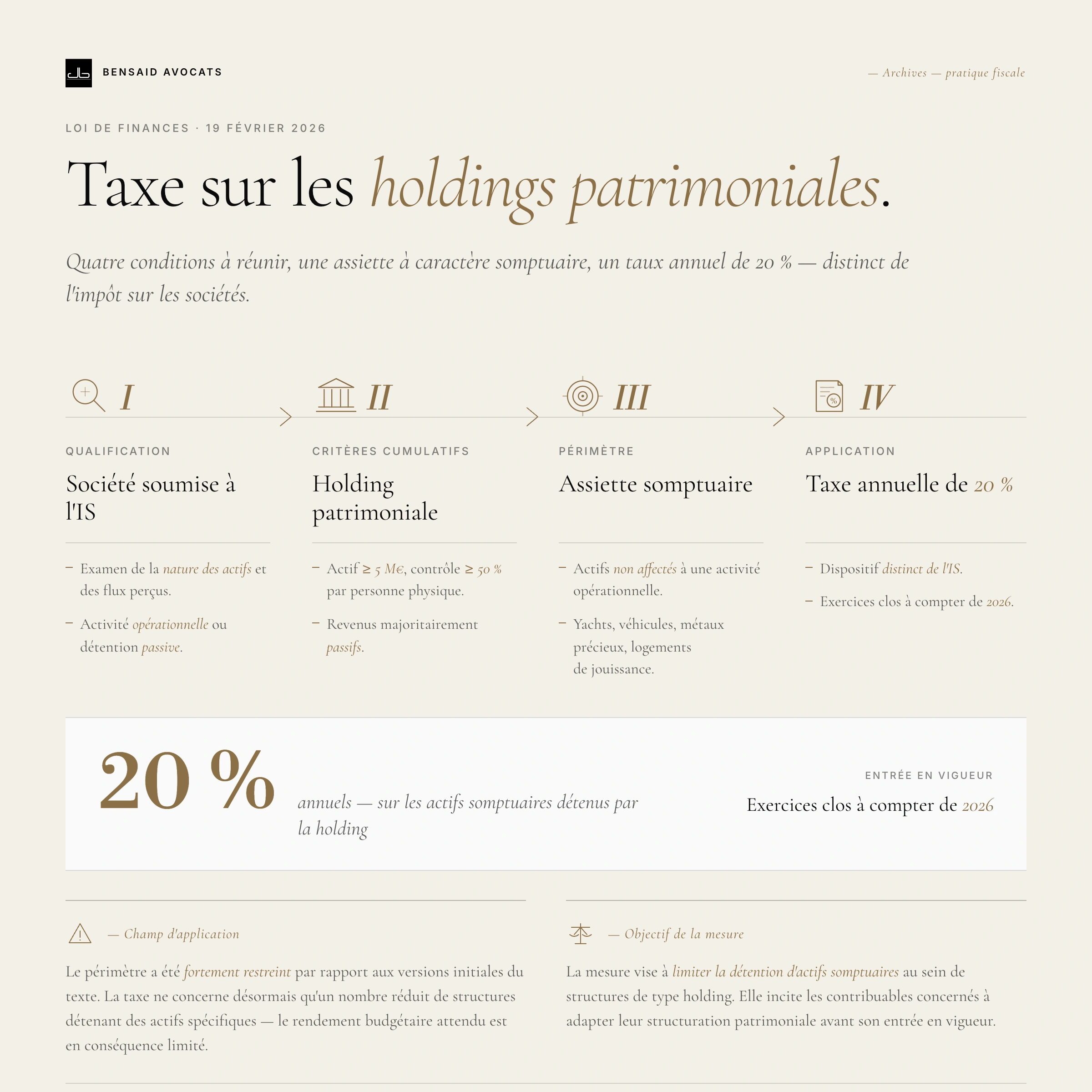
Summary diagram of the regime

Conditions of application, targeted ownership chain and main exit strategies under article 235 ter C of the French Tax Code.

Diagram of the 2026 wealth-holding company tax (art. 235 ter C, French Tax Code): companies within scope, luxury assets, restructuring
Wealth-holding company tax 2026 (art. 235 ter C, French Tax Code): companies within scope, taxed assets, restructuring strategies. Bensaid Avocats / François Ouairy.
— 06

Q&A — Key points for UHNW families

Does the tax apply to foreign structures holding assets in France?

Yes. The scope of article 235 ter C of the French Tax Code covers any company, French or foreign, as soon as it holds luxury assets located on French territory. Classic offshore arrangements (Luxembourg, Cayman Islands) offer no protection.

Are works of art exempt, as they are under the IFI (real-estate wealth tax)?

No. The IFI exemption provided for in article 965 of the French Tax Code does not apply to this specific tax. An art collection held through a holding company, once tax-neutral, now bears an annual 20% levy on its fair market value, which radically alters the ownership analysis.

Is the tax deductible from corporate income tax?

The statute provides for no specific deductibility. Nor can it be credited against the principal's personal income tax. The accounting and tax treatment of this charge within the holding company should be validated with your adviser for each financial year.

What is the filing and payment timetable?

The filing procedures had not yet been specified by decree as at the date of publication. The tax will probably be assessed at the close of the financial year, based on a fair market value declared by the company. Implementing regulations are expected by summer 2026.

Can a constitutional challenge (QPC) suspend the application of the tax?

A QPC does not automatically suspend the tax obligation. Even where proceedings are under way, the tax remains due until the Constitutional Council has ruled. The legal strategy must be combined with a cash-flow management approach and active restructuring.

Is the risk of constitutional censure serious?

A 20% rate applied annually to fair market value, rather than to income, raises serious questions under the principle prohibiting confiscatory taxation (article 13 of the 1789 Declaration of the Rights of Man). A partial censure (limited to certain assets or subject to a cap) is plausible. Our advice: do not rely on the QPC alone; pursue an active restructuring strategy in parallel.

Cité par

Audit your holding company before 31 December 2026

Present your structure (corporate form, assets held, valuation, governance) so the firm can quantify the exposure to the tax and define a secured restructuring strategy.

Jonathan Bensaid, avocat fondateur

Written by

Me Jonathan Bensaid, avocat fiscaliste, fondateur du cabinet Bensaid Avocats, inscrit aux Barreaux de Paris & Genève.