Banking & Finance practice, Real-estate fiducie

Real-estate fiducie

As a tax law firm in Paris, BENSAID Avocats supports banks, debt funds, property companies, family offices, developers and property traders in setting up real-estate fiducie transactions, security fiducie over buildings or SCI shares, real-estate management fiducie, holding transactions, structured refinancing and asset segregation in complex operations, with absolute tax rigour (VAT, transfer duties, corporate tax).

Paris · Geneva · Marseille · Cannes · Lisbon
01

The fiducie in the service of structured real estate

The real-estate fiducie is a contractual tool arising from articles 2011 to 2030 of the Civil Code. It allows the temporary transfer of ownership of a building (or of shares in a real-estate company) to a fiduciary, who holds it in a separate pool of assets for the benefit of one or more beneficiaries, for a purpose of security, management or transfer. The fiducie offers an enforceable asset segregation and a sought-after tax neutrality: no transfer duties on creation in most cases, transparency for VAT and corporate tax.

Our lawyers act across the whole cycle: structuring and negotiation of the contract, coordination with bank pools and intercreditor agreements, securing the tax treatment (VAT, transfer duties, corporate tax, 3% tax), operational monitoring, management of events of default (realisation of the security fiducie), liquidation and retransfer to the beneficiary or sale to a third party.

The firm is one of the few practitioners on the market to combine fiducie and real-estate taxation expertise at the highest level, which makes it possible to optimise the whole transaction: see our page fiduciary lawyer and our page fiducie and complex financings.

02

Areas of intervention

01

Real-estate security fiducie

Setting up security fiducies over buildings or SCI shares in structured financings and development transactions. See our dedicated site fiduciesurete.com.

  • An effective substitute for the mortgage in structured financing and real-estate development transactions.
  • Extra-judicial realisation in the event of default, appropriation by the fiduciary or sale, without recourse to real-estate seizure proceedings.
  • Absolute protection against the settlor's insolvency proceedings.
  • Coordination with bank pools and intercreditor agreements.
  • Coordination with rechargeable mortgages, pledges and ancillary security.
  • Full methodology and reference precedents on fiduciesurete.com.

02

Real-estate management fiducie

Structuring management fiducies for holding transactions, complex family assets and investment vehicles.

  • Holding of buildings between acquisition and use by the final recipient.
  • Co-investment structures and fiduciary club deals.
  • Management of complex undivided ownership or estates undergoing succession liquidation.
  • Protection of vulnerable beneficiaries (minors, protected adults) within a wealth-planning approach.
  • Coordination with SCIs, OPPCI and real-estate FPCI vehicles.
03

Taxation of the real-estate fiducie

Securing tax neutrality and anticipating the consequences for VAT, transfer duties, corporate tax and the 3% tax.

  • Transfer duties for consideration: neutrality on creation in most configurations (French Tax Code art. 668 bis et seq.).
  • VAT: transparency of the fiducie assets, treatment of incoming and outgoing transactions.
  • Corporate tax: taxation at the level of the settlor (French Tax Code art. 223 V to 223 VG).
  • 3% tax, interaction with the classification of the fiduciary and the reporting obligations: see our page 3% tax.
  • IFI: the value remains within the settlor's taxable assets.
04

Structured financings

Coordination of the real-estate fiducie with bank financing transactions and the debt market.

  • Coordination with syndicated loans, club deals and private debt funds.
  • Coordination with financial covenants and security agents.
  • Refinancing, securitisation and assignment of backed receivables.
  • Securing ancillary deeds: account pledges, Dailly assignment, trademark pledges.
  • See our analyses real-estate security fiducie 2026 and fiducie and complex financings.
05

Realisation & events of default

Securing extra-judicial realisation mechanisms in the event of default by the settlor or the secured debtor.

  • Conditions and terms of extra-judicial realisation (Civil Code art. 2372-3 and 2488-3), diagrams commented on fiduciesurete.com.
  • Interaction with the settlor's insolvency proceedings, resilience of the security fiducie.
  • Adversarial valuation of the building held in fiducie and appointment of experts.
  • Coordination with competing creditors and any court-appointed administrator.
  • Post-realisation disputes: restitutions, balancing payment, challenges.
06

Comparison & choice of security

A comparative analysis between security fiducie, mortgage, pledge and the lender's privilege.

  • Security fiducie vs mortgage: cost, realisation time, resilience to insolvency proceedings.
  • Fiducie over SCI shares, an effective alternative to a mortgage over the building itself.
  • Comparison of the French fiducie vs the Swiss fiduciaire: see our comparative analysis.
  • Choice between Civil Code art. 2488-1 (buildings) and 2372-1 (movables, including shares).
  • A tailored recommendation depending on the transaction profile and the lender's appetite.
03

Six typical real-estate fiducie situations

From securing a financing to the reorganisation of real-estate assets spread across several countries: six real-estate fiducie cases, in France and internationally.

Six ways to use the fiducie on real estate

The real-estate fiducie does not answer a single situation. Here are six frequent cases (security, holding, management, international reorganisation) handled by the firm. Each is a deliberately generic archetype; your matter calls for its own analysis.

01. Real-estate assets spread across several countries

A business owner, resident abroad, holds real-estate assets spread across around ten countries, each asset in its own silo: a separate local company, bank, loan and succession regime. The firm interposes a parent structure (fiducie, Swiss or Luxembourg holding, or trust depending on the jurisdiction, often in a France-Switzerland cross-border architecture) that restores the coherence of a single asset to the portfolio: consolidated refinancing, isolation, transfer through a single vehicle, overall steering, without losing control of it.

02. Substituting the mortgage in a structured financing

A lender wants stronger security than a mortgage on a high-stakes transaction. The security fiducie isolates the building in a separate pool of assets, enforceable against the settlor's insolvency proceedings, and opens an extra-judicial realisation, without real-estate seizure proceedings.

03. Holding a building between acquisition and final destination

An asset is acquired on behalf of a third party or a future project. A management fiducie ensures its holding: neutral ownership, framed governance, organised restitution at term, without commingling with personal assets.

04. Securing an undivided ownership or a pending succession

Family real-estate assets are frozen by undivided ownership or an unliquidated succession. The management fiducie entrusts the assets to a fiduciary, protects the beneficiaries (including vulnerable ones) and streamlines administration until the matter is resolved.

05. Securing over company shares rather than over the building

Rather than a mortgage over the building, the security is taken over the shares of the SCI that holds it. The fiducie over shares (Civil Code art. 2372-1) gives the lender the same protection while simplifying rental and legal management.

06. Financing a development transaction or a prestige asset

A developer or property trader must finance, within a constrained timeframe, the acquisition of a prestige asset or the launch of a transaction. The firm sets up a security fiducie offering the lender a security that is immediately legible and quickly realisable, unlocking bridge financing on terms a mortgage alone would not have allowed.

What the firm settles from the outset

Whatever the case, two points are decided first: the arrangement remains reversible (it does not constitute a gift) and the taxation of the contribution is assessed jurisdiction by jurisdiction. In France, capital gains benefit from a deferral, but registration duties remain due; the location of the parent structure and the tax domicile govern the whole.

Discuss your situation →

Dedicated site

A platform dedicated to the security fiducie

To go further, the firm has developed a site dedicated to the real-estate security fiducie, bringing together methodology, commented diagrams and in-depth analyses.

04

Lead counsel, Jonathan Bensaid & François Ouairy

Jonathan Bensaid, founding partner, is one of the reference practitioners in France on the real-estate fiducie and structured financings. He acts across all types, security fiducie, management fiducie, holding transactions, and coordinates French and foreign bank pools. François Ouairy, Best Lawyers 2026 in Tax Law and strongly recognised by Leaders League, secures the tax aspects of transactions (real-estate VAT, transfer duties, corporate tax, 3% tax); his expertise is particularly recognised on transactions combining fiducie and real-estate taxation.

  • Best Lawyers 2026, Tax Law
  • Leaders League, strong recognition
  • Security fiducie Civil Code 2488-1
  • Structured financings
  • Extra-judicial realisation
  • FR · CH · LU coordination
Visuals

Real-estate fiducie diagrams & visuals

Synthetic representations of real-estate fiducie transactions, parties to the contract, event of default. Click to enlarge.

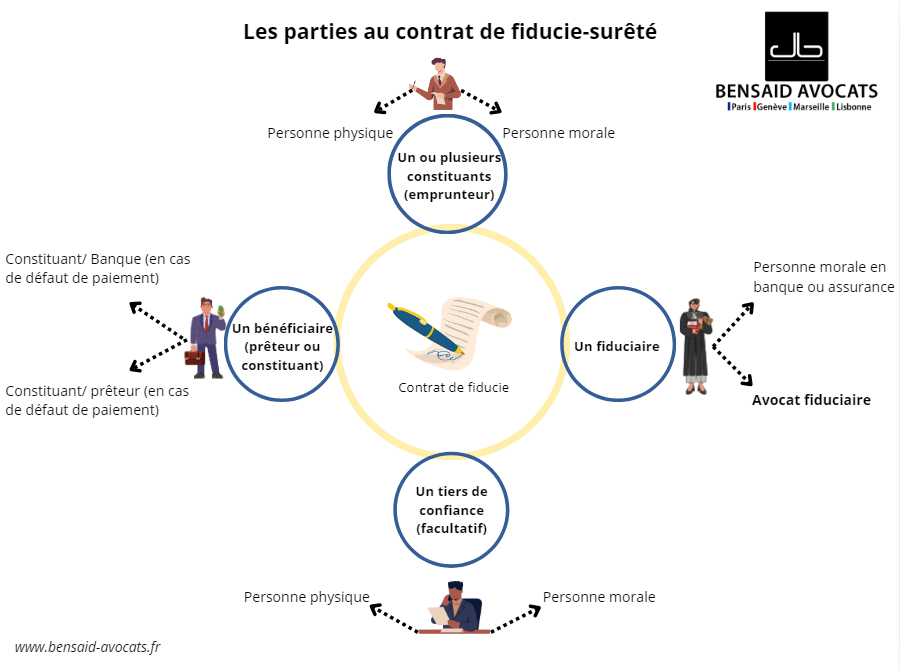
Real-estate security fiducie, parties to the contract (settlor, fiduciary, beneficiary).
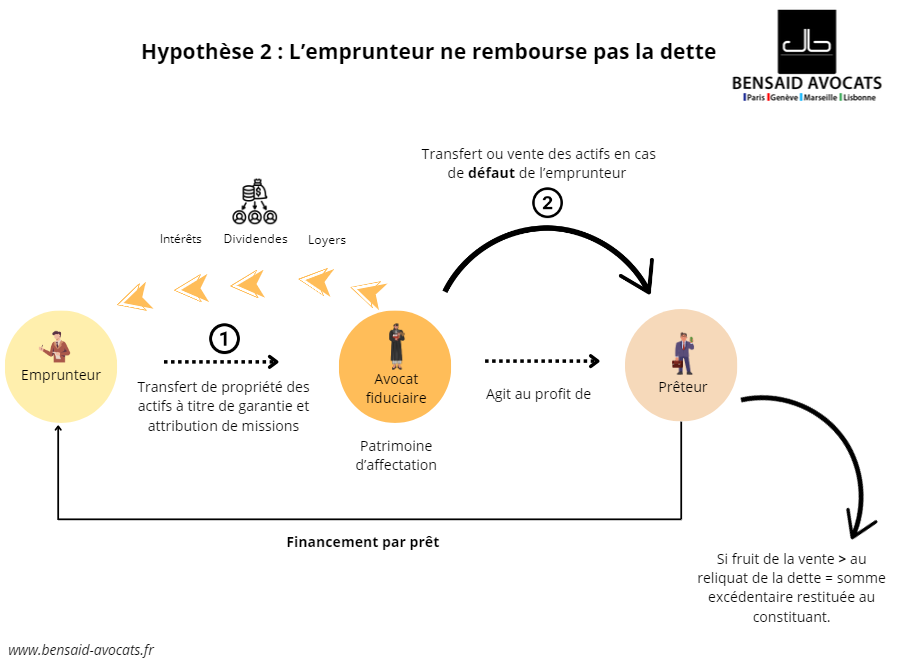
Real-estate fiducie, event of default and extra-judicial realisation.
05

Recent publications

A selection of the firm's analyses on the real-estate fiducie, structured financings and the taxation applicable to fiduciary transactions.

06

Frequently asked questions

What is the real-estate fiducie?

The real-estate fiducie is the operation by which a settlor temporarily transfers ownership of a building (or of shares in a real-estate company) to a fiduciary who holds it in a separate pool of assets, for a purpose of security, management or transfer for the benefit of one or more beneficiaries. Governed by articles 2011 to 2030 of the Civil Code, it offers an enforceable asset segregation, a sought-after tax neutrality and an extra-judicial realisation mechanism in the event of default.

What are the advantages of the security fiducie compared with a mortgage?

The security fiducie has three major advantages over the mortgage: (i) fast extra-judicial realisation in the event of default, appropriation or direct sale by the fiduciary, without real-estate seizure proceedings; (ii) resilience to the settlor's insolvency proceedings, the asset held in fiducie, isolated in a separate pool of assets, escapes the creditors' common pledge; (iii) tax neutrality on creation, no transfer duties for consideration in most configurations. The cost of creation is, however, higher than a conventional mortgage. Detailed comparisons on fiduciesurete.com.

Is the real-estate fiducie tax-neutral?

Yes, in most configurations. On creation, the transfer of assets into the fiducie in principle triggers neither transfer duties for consideration (French Tax Code 668 bis et seq.) nor a taxable capital gain at the level of the settlor. The fiducie assets are transparent for VAT and corporate tax, taxation remaining at the level of the settlor (French Tax Code art. 223 V to 223 VG). On liquidation or retransfer, the return to the settlor is also neutral. A case-by-case analysis remains essential, in particular as regards the IFI and the 3% tax.

Can a fiducie be set up over SCI shares?

Yes. The fiducie can cover any type of asset, directly held buildings or shares in real-estate companies (SCI, real-estate SAS, SCPI). The fiducie over SCI shares is frequently used because it offers the same advantages as the fiducie over the building itself while simplifying rental and legal management. The applicable legal regime is that of the fiducie over movable assets (Civil Code art. 2372-1 et seq.), distinct from the direct real-estate fiducie (art. 2488-1 et seq.).

How is a security fiducie realised in the event of default?

In the event of default by the secured debtor, the security fiducie allows the fiduciary to transfer ownership of the asset to the beneficiary, or to sell it to a third party, according to the terms provided in the contract. The value of the asset is determined by adversarial valuation. The fiduciary applies the proceeds against the secured claim; any surplus (balancing payment) returns to the settlor. This realisation takes place without prior recourse to the court and withstands the settlor's insolvency proceedings, which is the main strength of the mechanism.

Who can act as fiduciary in France?

The capacity of fiduciary is reserved to professionals: credit institutions, investment firms, insurance companies, pension institutions, the Public Treasury, the Banque de France, lawyers (Civil Code art. 2015). The choice of fiduciary is crucial: it must offer the solvency, operational rigour and legal coordination required by the transaction. BENSAID Avocats supports both settlors and fiduciaries in setting up the structures.

What is the duration of a fiducie?

The fiducie is entered into for a fixed term, which may not exceed 99 years from its creation (Civil Code art. 2018). In practice, the duration is set according to the purpose: the term of the financing for a security fiducie, the term of the holding or management mandate for a management fiducie. On expiry, the asset returns to the beneficiary (or to the settlor in the absence of default). An early liquidation is always possible by agreement of the parties.

How does the real-estate fiducie interact with the 3% tax?

The 3% tax (French Tax Code art. 990 D to 990 H) taxes legal entities holding French real estate. The fiduciary may be regarded as the entity liable, but practice favours a transparency analysis tracing back to the settlor or the beneficial owners, in particular in order to benefit from the 990 E 4° exemption through an undertaking to disclose the shareholding. Compliance with the reporting obligations (form 2746) is essential: see our page 3% tax.

Cité par

A real-estate fiducie transaction to structure?

A confidential initial consultation, with no obligation. We reply within 48 business hours.