Art practice — Lasting structures

Foundation & endowment fund
serving a collection

The foundation and the endowment fund are the four principal French legal vehicles for perpetuating an art collection beyond the private sphere: the public-interest foundation (law of 23 July 1987), the sheltered foundation, the corporate foundation (law of 23 July 1990) and the endowment fund (LME law of 4 August 2008). The choice depends on the philanthropic objective, the scope of activity, the statutory flexibility sought and the interplay between France and Switzerland for cross-border estates.

Paris · Geneva · Marseille · Cannes · Lisbon
— In brief
What
4 legal vehicles to perpetuate a collection beyond private wealth
For whom
Collector families, individual patrons, philanthropic companies
Key texts
1987 law (public-interest foundation), 1990 law (corporate), LME 2008 law (endowment fund)
Minimum capital
15,000 € (endowment fund) to 1.5 M€ (public-interest foundation)
Firm advantage
Combined FR/CH architectures thanks to the dual Paris & Geneva bar admission
— 01

The right vehicle is the one that aligns objective, governance and taxation

Too many philanthropic projects fail through a poor initial choice: a foundation that is too heavy for a project still taking shape, an under-funded endowment fund that struggles to operate, a sheltered foundation that dilutes the family name. The structure is not a technical detail: it shapes governance over 30 years, the founder's taxation, the capacity to receive gifts and bequests, and the brand image.

Each architecture has its own logic: the public-interest foundation is the standard for lasting projects with broad reach (initial capital 1.5 M€, approval by the Conseil d'État, prefectural oversight); the sheltered foundation under a host foundation is more flexible and quicker; the corporate foundation answers a corporate patronage project over 5 renewable years; the endowment fund is the most flexible tool, created by a simple declaration to the prefecture, with no minimum capital (except 15,000 € for a fund not endowed at inception).

The firm builds the appropriate structure, including within a France–Switzerland logic, and supports its implementation, its governance and the coordination with individual and corporate patronage.

— 02

Four structures to perpetuate a collection

01

Public-interest foundation (FRUP)

The reference standard for a large-scale and lasting philanthropic project.

  • Initial capital: 1.5 M€ recommended (variable by project)
  • Procedure: approval by decree of the Conseil d'État (12-18 months)
  • Prefectural oversight and board opinion
  • Extended legal capacity: to receive gifts, bequests, real estate
02

Sheltered foundation

A foundation without its own legal personality, hosted by a host foundation (e.g. Fondation de France).

  • No approval procedure
  • No minimum capital
  • Delegated governance but control over projects
  • Management fee charged by the host foundation
03

Corporate foundation

A tool dedicated to corporate patronage over a multi-year programme.

  • Capital: 150,000 € minimum over 5 years
  • Creation: prefectural authorisation
  • Term: 5 renewable years
  • Limit: may not receive public gifts or bequests
04

Endowment fund

The most flexible tool, created by declaration to the prefecture, without approval or minimum capital (15,000 € if not endowed at inception).

  • Creation within a few weeks
  • Capacity to receive gifts, bequests, donations
  • Governance fully defined by the by-laws
  • The ideal tool for family and wealth projects
— 03

France · Switzerland: choosing the vehicle to fit the situation

Our dual France · Switzerland bar admission allows us to compare the legal vehicles on each side of the border and to choose the best-suited architecture, or even to combine two structures (one French and one Swiss) when the estate and the beneficiaries are cross-border.

Swiss foundation (Stiftung)

Governed by art. 80 et seq. of the Swiss Civil Code. Created by public deed, no minimum capital (50,000 CHF recommended), federal or cantonal supervision. Widely used for international estates; strong international recognition (notably in Liechtenstein, Luxembourg and Belgium).

French endowment fund + Swiss foundation

A combined architecture: a French endowment fund for projects in France (museums, exhibitions, grants) and a Swiss foundation for the conservation of the works and international governance. It allows taxation to be optimised in each jurisdiction.

Individual patronage — FR/CH interplay

French tax reduction: 66% of the gift within the limit of 20% of taxable income (French Tax Code art. 200). In Switzerland, deduction of the gift within cantonal limits (5 to 20% of taxable income depending on the canton). Coordination is possible for mixed tax residents.

Liquidation and dissolution

Crucial to anticipate: where do the assets go on dissolution? The Swiss foundation allows contractual flexibility; the French endowment fund requires the transfer to another structure pursuing a similar purpose (LME 2008 law).

— Comparative table

The 4 French philanthropic vehicles compared

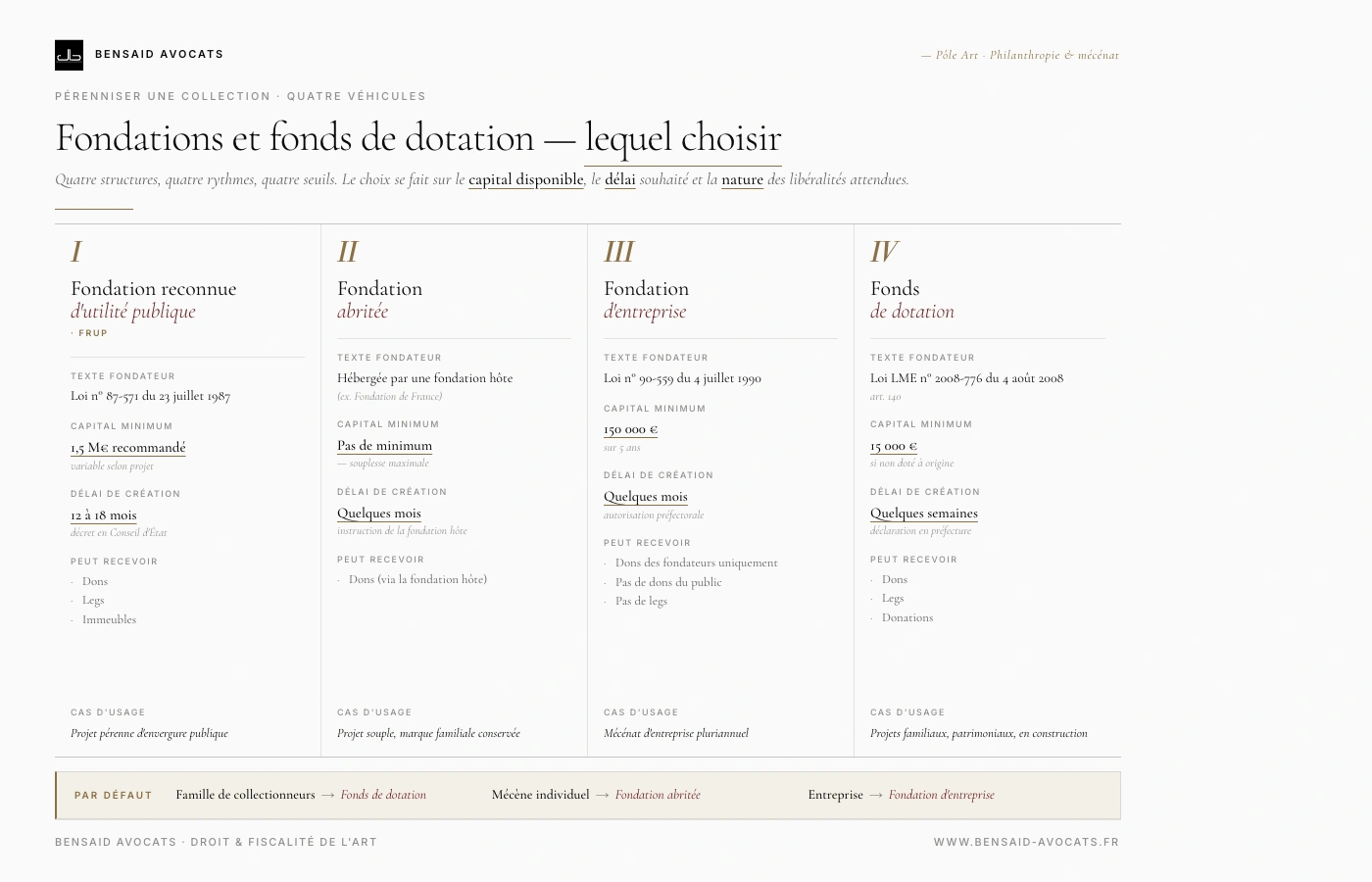
Comparative table of the 4 French philanthropic vehicles: public-interest foundation (1987 law), sheltered foundation, corporate foundation (1990 law), endowment fund (LME 2008 law). Capital, creation time, legal capacity, use cases.
Default choice by profile: family to endowment fund, individual patron to sheltered foundation, company to corporate foundation. © Bensaid Avocats.
— 04

Our experience — we create and operate an endowment fund

We regularly create endowment funds and foundations for collectors, families, artists and companies wishing to perpetuate an artistic heritage or a philanthropic project. This operational practice gives us a precise reading of the pitfalls: by-laws that are too rigid, unbalanced governance, under-funding, incomplete tax coordination, conflicts with heirs.

The firm also runs its own endowment fund, the Fonds de dotation Bensaid Avocats, which supports projects of general interest. This internal experience gives us an operational understanding of a fund's daily running: reporting, governance, relations with beneficiaries, annual tax compliance, coordination with the statutory auditors.

Our dual France · Switzerland bar admission allows us to offer a full range of solutions according to the situation: a classic French foundation, an endowment fund, a sheltered foundation, an autonomous Swiss structure or a combined FR/CH architecture. We coordinate with notaries, statutory auditors, wealth managers and supervisory authorities.

— Frequently asked questions

Choosing and operating a lasting structure

Endowment fund or foundation: which to choose for my collection?

The endowment fund is generally preferable for family, wealth or emerging projects: statutory flexibility, quick creation (a few weeks), no minimum capital (except 15,000 € if not endowed at inception), fully controlled governance. The public-interest foundation is favoured for projects of public scale, over the very long term, that justify approval by the Conseil d'État. For a family collection intended to pass to future generations: an endowment fund in 80% of cases.

What tax benefits are there for the donor?

For an individual: an income tax reduction of 66% of the gift within the limit of 20% of taxable income (French Tax Code art. 200). Beyond that, carry-forward over 5 years. A reduction of the wealth tax (IFI) is possible up to 75% under certain conditions (French Tax Code art. 978). For a company: a corporate tax reduction of 60% of the gift within the limit of 0.5% of turnover (French Tax Code art. 238 bis). Contribution of a work of art: valued at market value, subject to expert appraisal.

Can the endowment fund sell works from the collection?

Yes, unless the by-laws provide otherwise. The sale of a work included in the initial endowment may be restricted by the by-laws (inalienability clause). The sale of a work acquired by the fund with its own resources is unrestricted, subject to compliance with the statutory purpose. Any sale must be the subject of a board decision and rigorous accounting traceability.

What governance for a family endowment fund?

A board of at least 3 members (LME 2008 law). The by-laws are entirely free: one may provide for a family college, an independent experts college, a beneficiaries college, quorum, majority and co-optation rules. The chair may rotate or be hereditary. The by-laws must anticipate family conflicts over 30 to 50 years.

What are the operating costs of an endowment fund?

Creation: 5,000 to 15,000 € (lawyer, notary, by-laws, declaration). Annual operation: 10,000 to 50,000 € depending on activity volume (statutory auditors mandatory if resources exceed 10,000 €/year, accounting services, governance costs, communication). An initial endowment of 500,000 € to 1 M€ is recommended to ensure operational viability.

What happens to the fund on dissolution?

The LME law (2008) requires the transfer of the assets to another structure pursuing a similar purpose (another fund, foundation, or public-interest association). The by-laws designate the beneficiary structure or the designation mechanism. The assets never revert to the founders or heirs. This rule is fundamental and shapes the choice between an endowment fund and alternative structures (a Swiss foundation, for example).

What are the common mistakes in creating a philanthropic structure?

Five recurring mistakes: (1) initial under-funding (a fund without operating capital cannot finance its missions and falls dormant); (2) by-laws that are too rigid, preventing adaptation to family or regulatory changes over 30 years; (3) unbalanced governance between family and independent third parties (risk of challenge by the supervisory authorities); (4) confusion between philanthropic purpose and wealth management (a fund is not a pure tax-avoidance vehicle); (5) the absence of a communication and reporting plan (an invisible fund raises neither gifts nor partnerships).

How to coordinate a French foundation with a structure in Switzerland?

Three architectures frequently used by cross-border estates: (a) a French foundation for the activity in France (museum, exhibitions, grants) plus a Swiss foundation for conservation internationally and family governance; (b) a French endowment fund backed by a Swiss foundation in which the collection remains held; (c) a Liechtenstein foundation for complex estates (enhanced privacy, but mandatory tax transparency towards French tax residents, with reporting to the French tax authorities). Our dual Paris & Geneva bar admission allows us to structure these architectures directly.

Can the founder continue to use the contributed works?

Yes, under conditions. On a contribution in full ownership, personal use becomes impossible (except for a loan formalised by agreement with consideration). On a contribution with split ownership (bare ownership to the fund, usufruct retained), the founder may keep the enjoyment until death, a frequent solution for collectors wishing to display works at home while securing the transfer. Note: the patronage tax reduction is due only on the value of the bare ownership (French Tax Code art. 200 bis), not on the total market value.

Cité par

A foundation or endowment fund project to structure?

A confidential first exchange: comparison of the possible architectures, tax simulation, creation timetable.