
Art practice — Dation in payment

Dation in payment
of a work of art

Dation in payment (payment in kind) is an exceptional procedure provided for by article 1716 bis of the French Tax Code, which allows transfer duties for no consideration (inheritance, gift), partition duties or the IFI to be settled by handing over to the State a work of art, a book, a collector's item or a document of high artistic or historical value. Subject to an interministerial approval (Bercy & Culture), it calls for a perfectly coordinated wealth, tax and museum strategy.

Paris · Geneva · Marseille · Cannes · Lisbon
— In brief
What
Settlement of transfer duties by handing over a work to the State
For whom
Heirs, donees, co-owners of a collection
Key Tax Code article
Art. 1716 bis (Malraux Act 1968)
Timeframe to anticipate
6 to 24 months of review
Recommended action
Pre-qualification of the work with a tax lawyer before filing
— 01

An exceptional procedure that is prepared like a transaction

Dation in payment is not a routine method of settlement. Governed by article 1716 bis of the French Tax Code and its implementing decree (decree no. 70-1046 of 12 November 1970), it falls within the sovereign power of approval: the State, on the opinion of an interministerial commission, accepts or refuses the transfer of a work. That opinion is conditioned on the artistic, historical or scientific interest of the proposed asset.

The main issue is therefore not legal but strategic: identifying the work whose museum value will justify approval, negotiating its discharge value (rarely equal to the market value), and articulating the dation with other tools (deferred payment under Tax Code art. 1717, temporary gift, dismemberment of ownership) in order to optimise the liquidity of the estate or of the IFI.

The firm intervenes at every stage: preliminary valuation, assembling the file, dialogue with the Direction des Musées de France and the commission, negotiation of the discharge value, securing the civil consequences among co-heirs.

— 02

Which taxes can be settled by dation?

01

Inheritance duties

The most frequent use case: an heir receives a major work and lacks the liquidity to pay the duties.

  • Application filed within 6 months of the death together with the inheritance declaration
  • Suspends the enforceability of the duties until the decision
  • The work offered is not necessarily the one received in the estate
02

Gift duties

Allows an early transfer to be organised while settling the duties by handing over a work from the donor's or the donee's assets.

  • A strategy complementary to dismemberment and to the shared gift
  • Of interest to collectors wishing to transfer during their lifetime
  • Articulation with the allowances (100,000 € / parent-child, etc.)
03

Partition duties

In the case of an estate or matrimonial joint ownership over a collection, dation can settle the partition duties (2.5%).

  • A solution for joint ownership among collectors
  • Avoids the forced break-up of a coherent collection
  • Articulation with the joint-ownership agreement (5 years, renewable)
04

Real-estate wealth tax (IFI)

Since 2018, works of art are in principle outside the scope of the IFI; dation remains useful to settle any residual IFI debts or in the ISF/IFI transition.

  • Residual cases: old ISF reassessments, ongoing litigation
  • Combination with other routes (deferred payment, loan against a work)
  • Anticipating a possible evolution of the IFI towards a broadened ISF
— 03

Approval procedure: the 5 key stages

From the decision to offer a work to the effective extinction of the tax debt, the process lasts 6 to 24 months and requires close coordination among advisers.

1. Pre-qualification of the work

Assessment of the probable museum interest (artist, provenance, condition, rarity), choice of the most strategic work within the collection, first estimate of value.

2. Assembling the file

Legal memorandum, independent expert appraisal (ideally two experts), photographs, historical documentation, certificates of authenticity, provenance attestations, evidence of the tax debt.

3. Filing and review

Filing with the Direction générale des Finances publiques (DGFiP). Joint review with the Direction des Musées de France and possible contradictory appraisals.

4. Commission opinion

The interministerial approval commission issues an opinion on the interest and the discharge value. The approval decree, signed by the competent ministers, constitutes acceptance.

5. Assignment and extinction

Effective handover of the work to the designated museum institution, signature of the assignment record, extinction of the debt up to the approved discharge value.

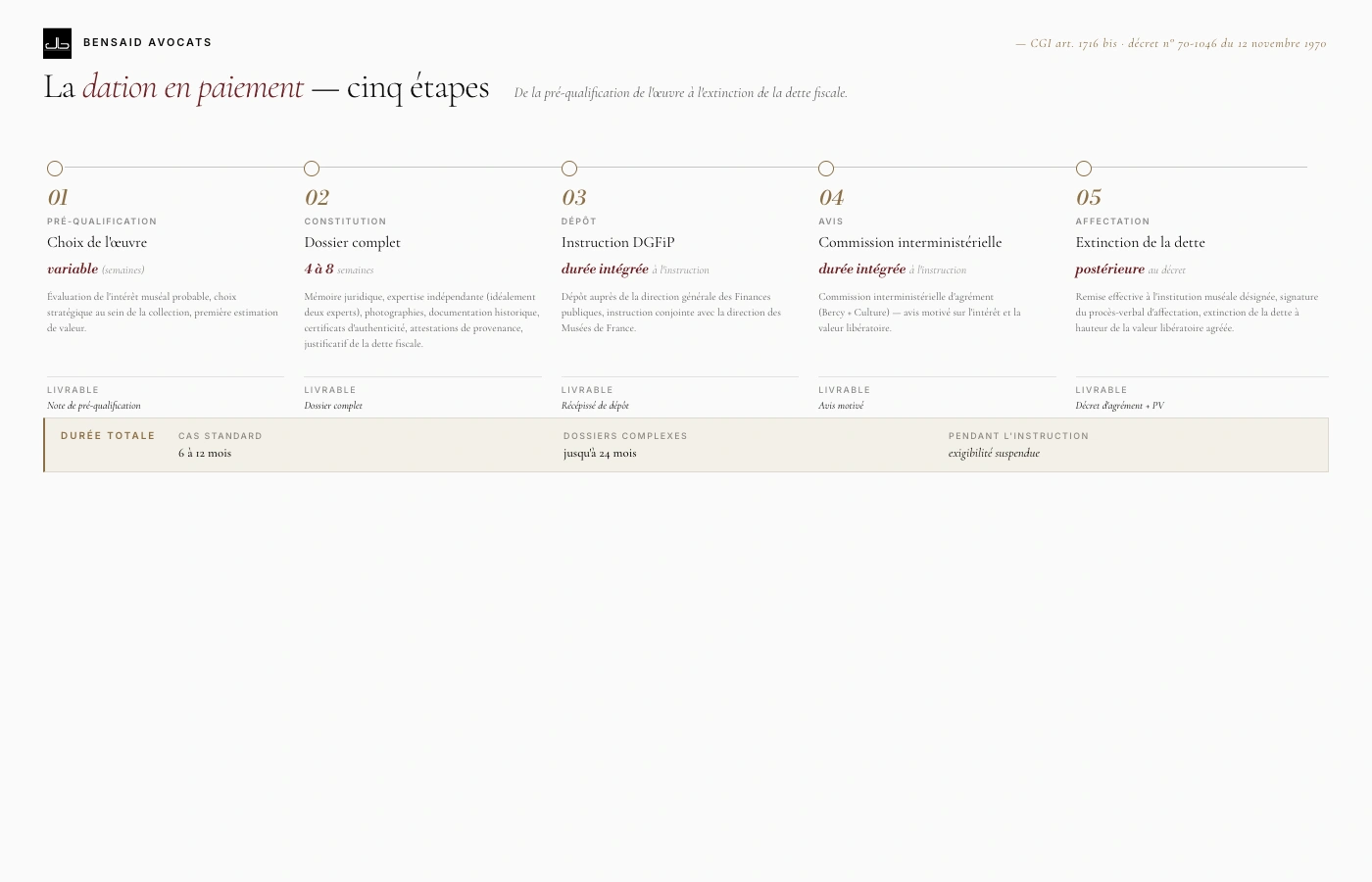
— Diagram

The 5 stages of the dation-in-payment procedure

Timeline of the 5 stages of the dation-in-payment procedure (Tax Code art. 1716 bis): pre-qualification, assembling the file, filing with the DGFiP, commission opinion, museum assignment.
Approval procedure Tax Code art. 1716 bis — total duration: 6 to 12 months (up to 24 months for complex files). © Bensaid Avocats.
— 04

Our experience in dation matters

The firm is familiar with the dation procedure and has, in recent years, handled one of the most significant dation transactions conducted for a private client: legal structuring, negotiation of the discharge value with the tax authorities, articulation with the other succession tools and coordination with the museum institution of assignment.

This practice gives us a precise understanding of the signals that guide the commission's opinion: the quality of the museum file, the consistency of the choice of work relative to the debt to be cleared, the ability to highlight the public heritage interest, and anticipation of objections.

We work in a network with independent experts, leading auctioneers and curators of national and regional museums, which allows us to quickly pre-qualify the viability of a file and to calibrate the strategy ahead of filing.

— Frequently asked questions

Everything you should know before proposing a dation

Which assets can be proposed for dation?

Works of art, old books, collector's items, documents of high artistic or historical value (manuscripts, scores, archives). Real estate located in a protection zone (Act of 4 August 1962) may also be proposed. The asset must present a characterised artistic, historical or scientific interest.

What is the difference between market value and discharge value?

The market value is the market price; the discharge value is the value adopted by the commission to extinguish the tax debt. They may diverge: the commission takes into account the museum interest, the rarity for French public collections, but also sometimes a discount or an increase depending on budgetary trade-offs.

What happens if the discharge value is lower than the tax debt?

The taxpayer pays the balance by the usual means. It is possible to combine the dation with a deferred payment (Tax Code art. 1717), a corporate sponsorship tax credit (Tax Code art. 238 bis-0 A for companies) or a bank loan secured on other works in the collection.

Can a dation application be withdrawn?

Yes, until the approval decree is signed. Withdrawal is advisable if the discharge value proposed by the commission is deemed too far from the market value, or if an alternative strategy becomes more advantageous.

Can a work held under dismembered ownership be proposed for dation?

Yes, but this requires an express agreement between the bare owner and the usufructuary, a prior consolidation of the rights, and a tax articulation with the consequences of the reunification. The transaction is built in advance, ideally several months before the death giving rise to the duties.

What is the average time between filing and acceptance?

6 to 12 months on average for a standard file, up to 24 months for complex files (works of disputed attribution, high value requiring budgetary trade-offs). The enforceability of the duties is suspended during the review.

What are the frequent mistakes to avoid in a dation file?

Three recurring pitfalls in dation files: (1) initial overvaluation of the work (the commission systematically corrects downwards, creating an unanticipated liquidity shortfall); (2) under-documentation of provenance (incomplete chain of acquisition, missing certificates of authenticity, no independent contradictory appraisal); (3) choice of a work without characterised museum interest for French public collections (predictable refusal by the commission). A rigorous upfront pre-qualification helps rule out these 3 risks.

Is dation compatible with other tax mechanisms?

Yes, dation is frequently combined with other tools: deferred payment (Tax Code art. 1717, up to 10 years for duties exceeding the discharge value); sponsorship tax reduction for part of the value if the work is first given and then transferred to the State; prior dismemberment between bare owner and usufructuary to optimise the taxable base. The combined structuring is analysed case by case according to the composition of the collection and the tax profile of the heirs.

What becomes of the work after the dation?

The work is assigned to a museum institution designated by the approval decree (national or regional museum, or sometimes a département). It enters the French public collections and becomes inalienable within the meaning of the Act of 4 January 2002. The institution of assignment is chosen according to consistency with its existing collections and its conservation capacity. The transferring taxpayer may, in certain cases, negotiate the mention of their name on the work's display label.

Cité par

A dation project to structure?

A confidential first exchange to assess the feasibility of the dation and identify the best-suited wealth strategy.