International taxation · Permanent establishment

Permanent establishment in France

Tax risk, international audit and reassessment. Whether a foreign company has a permanent establishment in France is now a central question of international taxation: it determines whether that company may be taxed in France on all or part of its profits, and it feeds a growing body of litigation as the tests for the dependent agent evolve, as the analysis turns to the economic role played in France in the conclusion of contracts, and as it becomes necessary to distinguish between a corporate-income-tax permanent establishment and a VAT permanent establishment.

Paris · Geneva · Marseille · Cannes · Lisbon
— 01

Permanent establishment in France: what are we talking about?

In international taxation, the permanent establishment is the concept used to determine whether a foreign company may be taxed in France on the profits attributable to its French activity. Two levels must be distinguished: French domestic law, which reasons around the business operated in France, and tax treaties, which give precedence to the notion of permanent establishment.

Where a tax treaty applies, France may in principle tax the profits of a foreign enterprise only if that enterprise carries on its activity in France through a permanent establishment. The mere existence of income linked to the French market is not enough: a sufficient tax nexus to French territory is still required.

The analysis must always begin with the relevant bilateral treaty, the definition of permanent establishment adopted and the developments arising from the OECD model, from BEPS and, where applicable, from the Multilateral Instrument (MLI). The subject concerns international groups, digital structures, financing entities, service companies and any foreign enterprise operating in France without a formally acknowledged presence.

— 02

Tests for characterising a permanent establishment

01

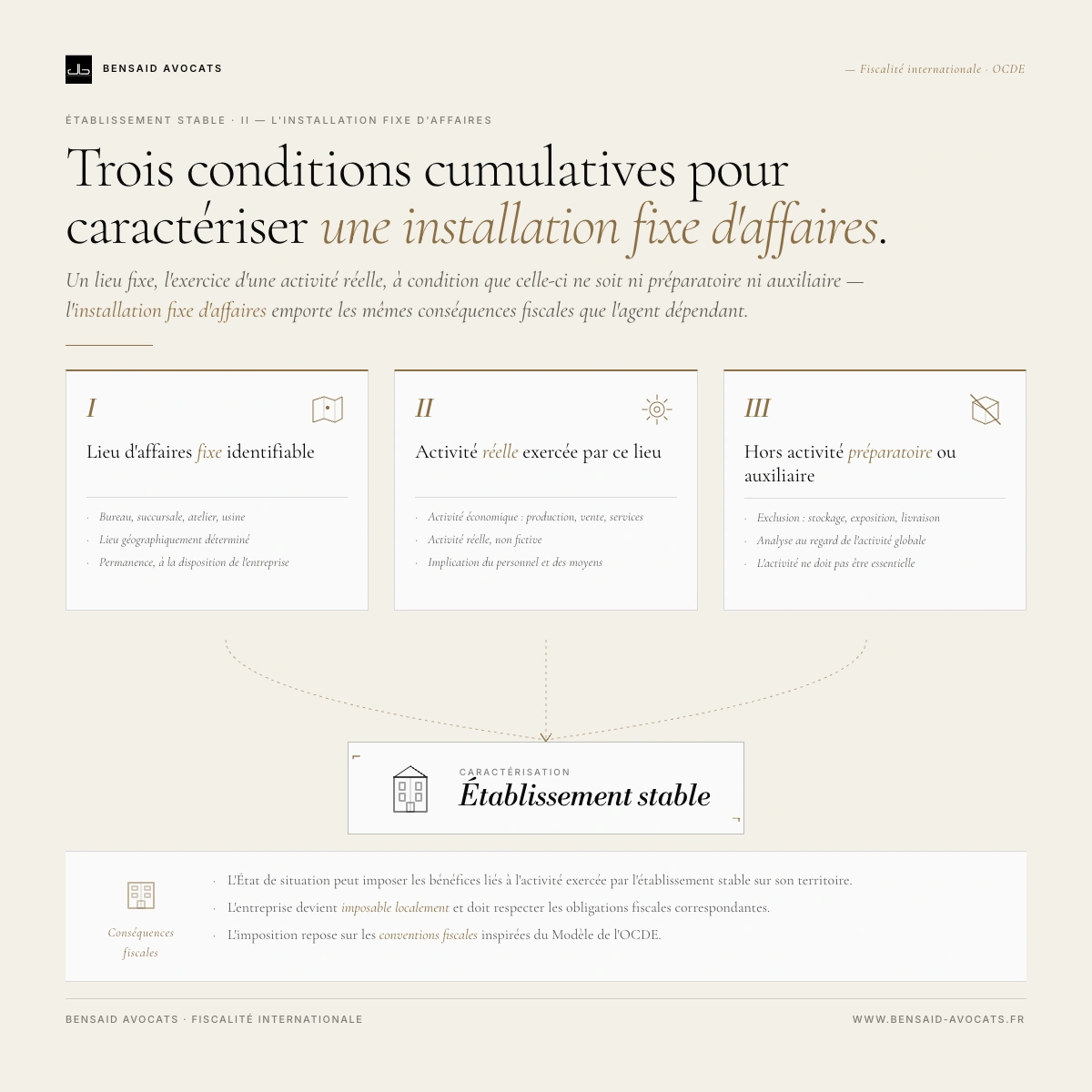
Test no. 1 — Fixed place of business

The first ground of characterisation: office, premises, construction site, infrastructure or physical presence displaying a certain degree of permanence.

  • Identifiable physical presence
  • Durable character
  • Own activity carried on in France
  • A function going beyond the merely auxiliary
  • The review must never be purely formal: check whether the foreign company actually controls the means used in France

02

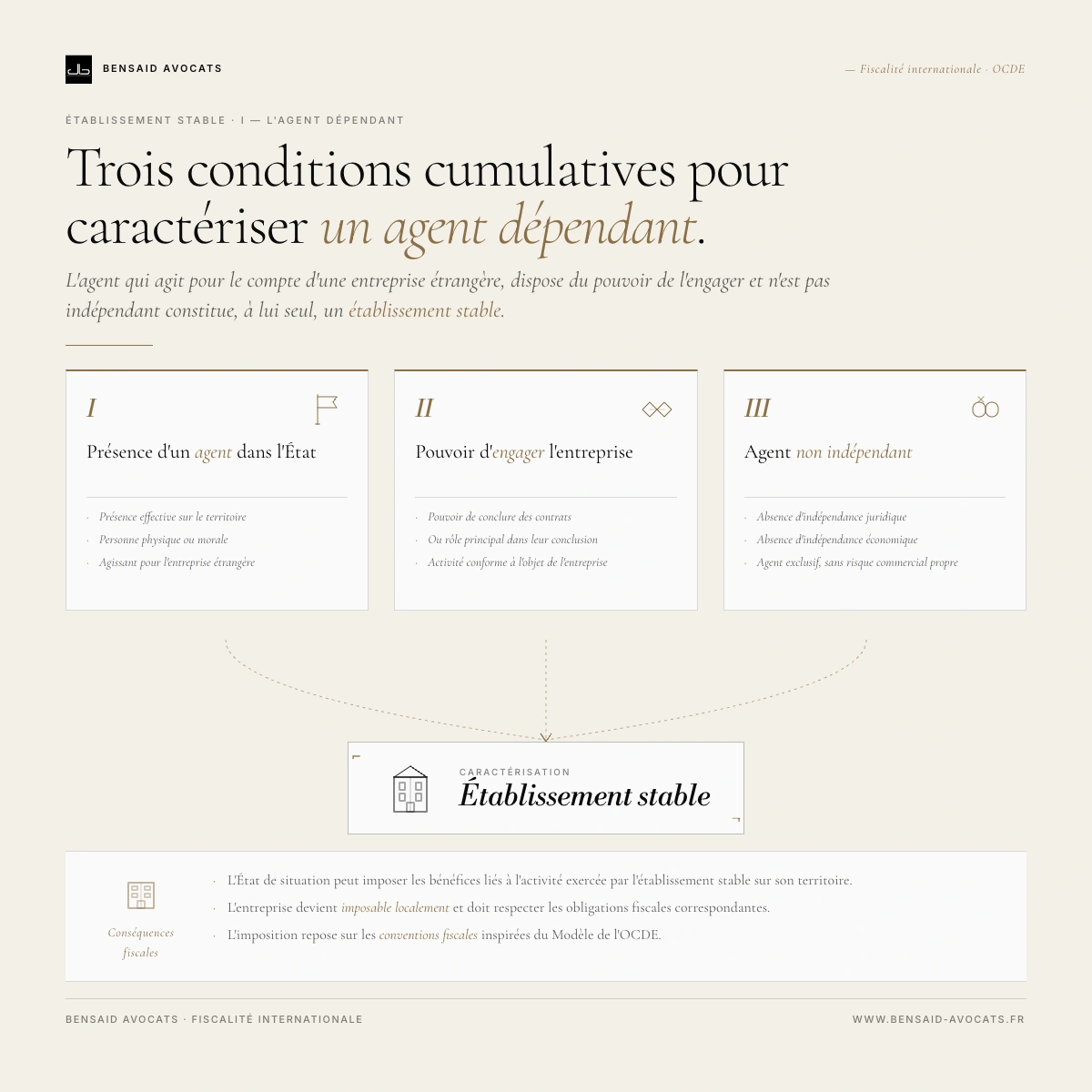
Test no. 2 — Dependent agent

The real battleground of litigation. The debate is no longer confined to the formal signing of contracts: who plays the leading role in their conclusion?

  • Who canvasses French clients
  • Who negotiates the essential terms
  • Who actually “makes” the sale
  • Is the foreign approval real or purely formal?
  • This is where the permanent-establishment risk for many structures is now concentrated
03

Case law — Google then Conversant

A shift in the centre of gravity: from the legal power to bind towards the economic reality of the role played in France.

  • Google case: importance of the legal power to bind the foreign company
  • Conversant ruling: refocusing on economic reality
  • Question no. 1: who signs?
  • Question no. 2 (new): who decides, who negotiates, who actually brings about the conclusion?
  • It increases the exposure of groups whose contractual documentation understates the French commercial substance
04

Limits — Preparatory or auxiliary activities

A relative protection. Some functions do not characterise a permanent establishment, but the exception must be handled with caution.

  • Storage, purchasing, gathering of information
  • Preparatory or auxiliary activities
  • Once the French activity becomes significant, the protection may disappear
  • Or where it forms part of a broader coherent whole
  • A French subsidiary ≠ a permanent establishment of the foreign company, but re-characterisation remains possible if the French means serve the foreign company
— 03

CIT / VAT permanent establishment · International tax audit

Two essential distinctions: never confuse a CIT permanent establishment with a VAT permanent establishment, and anticipate the defence in the event of a reassessment.

CIT / VAT distinction — a frequent pitfall

The CIT permanent establishment is a mainly treaty-based concept that governs the taxation of profits (fixed place of business or dependent agent). The VAT permanent establishment is an autonomous concept of VAT law that determines the place of supply and the person liable (sufficient human and technical resources). A VAT registration in France does not, by itself, prove the existence of a permanent establishment within the meaning of the tax treaties — and the reverse is equally true.

Three lines of defence

Challenging the very principle of the permanent establishment

Demonstrate that the treaty tests are not met: no fixed place of business, no dependent agent within the meaning of the Conversant ruling, or an activity limited to preparatory/auxiliary functions. This is the first line of defence.

Debate on the attribution of profits

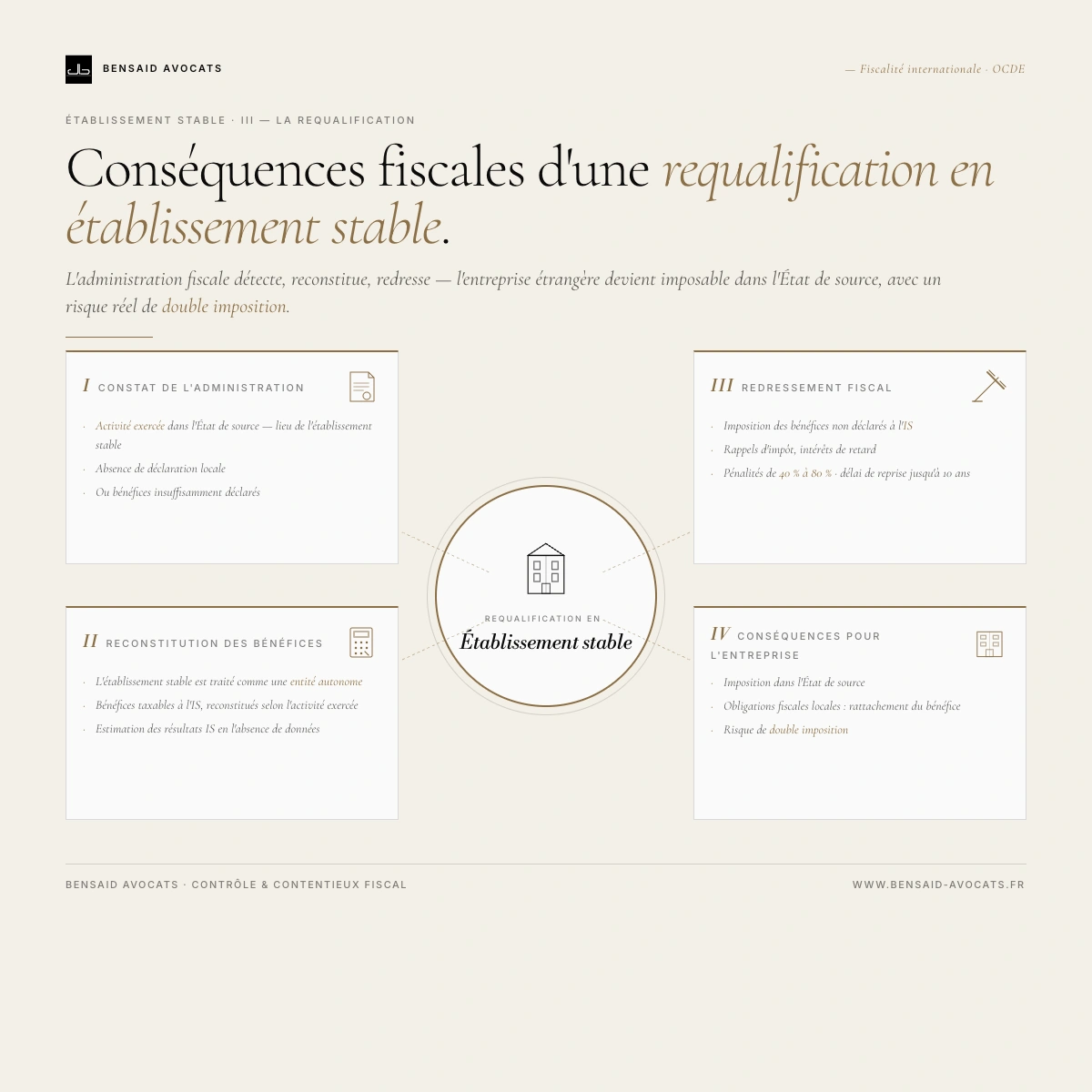
If a PE is admitted, challenge the reconstruction method adopted by the authorities: attribution of functions, assets, risks and value. Significantly reduce the reassessment even where the characterisation is confirmed.

Litigation on concealed activity and reassessment periods

The authorities may seek to invoke a concealed activity in order to extend the reassessment period (10 years) and apply the 80% surcharge. The defence turns on the authorities' knowledge and the formal regularity of the operations carried out in France.

— 05

Lead counsel — Maître François Ouairy

Maître François Ouairy, partner in charge of the Paris office, acts at three levels on the notion of permanent establishment: preventive audit (review of the international structuring, contracts, flows and French substance), assistance in international tax audits (preparation of responses, securing positions, alignment with the group's documentation), and litigation defence (challenging the principle of the permanent establishment, the role of the dependent agent, or the attribution of profits). Recognised by Best Lawyers® 2026 in Tax Law.

— 04

Understanding the permanent establishment in France at a glance

Three diagrams to visualise the main qualification tests, the role of the dependent agent and the tax consequences of a re-characterisation in the event of an international tax audit.

Fixed-place-of-business diagram — tests for characterising a permanent establishment in France
Fixed place of business — tests for characterising a permanent establishment where there is a physical presence in France.
Dependent-agent permanent-establishment diagram — Google and Conversant case law, negotiation and conclusion of contracts
Dependent agent — analysis of the role played in France in the negotiation and conclusion of contracts (Google / Conversant case law).
Permanent-establishment re-characterisation diagram — CIT and VAT reassessment, interest, surcharges, reassessment periods
Tax consequences of a re-characterisation — CIT and VAT reassessment, interest, surcharges and reassessment periods.
— 06

Frequently asked questions on the permanent establishment in France

Can a foreign company be taxed in France without a French subsidiary?

Yes. A subsidiary is not required. A fixed place of business or a dependent agent may be enough, depending on the applicable treaty and the reality of the operations.

Is simply having a salesperson in France enough?

No, not automatically. One must analyse their real role in the negotiation, decision and effective conclusion of contracts. The Conversant case law refocused the debate on economic reality, not the formal signature.

Does a French VAT number prove the existence of a permanent establishment?

No. VAT registration is not, by itself, sufficient, either for VAT or, a fortiori, for treaty-based CIT purposes. These are two autonomous concepts.

Can one have a VAT permanent establishment without a CIT permanent establishment?

Yes. The applicable tests are not identical and any automatic equation must be avoided. The VAT definition requires sufficient human and technical resources, whereas the treaty-based CIT definition rests on the fixed place of business or the dependent agent.

Which structures are the most exposed?

Commercial organisations where the French teams play a decisive role, commissionaire models, certain digital structures, construction sites and certain cross-border services.

When should you consult a lawyer?

Before a reorganisation, at the opening of an international tax audit, or as soon as a debate arises over the French substance, the dependent agent or the attribution of profits. The defence is built upstream.

Cité par

Permanent establishment, tax audit or reassessment?

If you are facing a permanent-establishment risk in France, an international tax audit or a reassessment targeting a foreign company, the firm can assist you with the analysis, the structuring of the defence and the challenge to the adjustments.