Jerusalem treaty of 31 July 1995 · in force since 1996

France-Israel tax treaty: olim residence, pensions and tax credit

The 1995 treaty determines which State taxes each item of income between France and Israel, and how double taxation is relieved. Private pensions, social security pensions included, are taxable only in the country of residence; the disposal of a shareholding of at least 10% remains taxable in the company's State, capped at 18%; an oleh hadash exempt in Israel remains an Israeli resident for treaty purposes.

Paris · Geneva · Marseille · Cannes · Lisbon

How does the France-Israel tax treaty prevent double taxation?

The treaty signed in Jerusalem on 31 July 1995, in force on 18 July 1996 and applicable to income from 1997, first determines the State of residence (Article 4), then allocates to each State the right to tax each category of income.

A person who has moved to Israel and is still tied to France is resident of both States. Article 4(2) breaks the tie in this order: permanent home, centre of vital interests, habitual abode, nationality; if nationality does not settle it, the two tax authorities agree between themselves. The Israeli ten-year exemption for new immigrants does not remove Israeli resident status: the Toulouse administrative court of appeal so held on 13 October 2022.

For a French resident, income taxable in Israel, or taxable only in Israel, is also included in the French tax base, and France grants a tax credit (Article 23). The credit takes two forms. For dividends, interest, royalties, capital gains under Article 13(1) and (2), directors' fees and artistes' income, among others, it equals the tax paid in Israel, capped at the corresponding French tax. For other income (salaries, rents, business profits), it equals the corresponding French tax, provided the recipient is subject to Israeli tax on that income: the income is not taxed a second time, but it counts towards the rate applied to other income.

France-Israel tax treaty of 31 July 1995, Articles 4 and 23, and consolidated version with the Multilateral Instrument (MLI), texts published on impots.gouv.fr; CAA Toulouse, 13 October 2022, No. 20TL22832.

— In brief
Text
Treaty of 31 July 1995, with no protocol, in force on 18 July 1996, modified by the MLI, in force for France and Israel on 1 January 2019
Taxes covered
Income tax, corporate tax, payroll tax and wealth tax; Israeli income tax, real estate capital gains tax and property tax
Method
Tax credit against French tax
Watch point
Occupied Palestinian territories excluded according to the French tax authorities; mutual agreement procedure within three years
— The treaty, article by article

The rules that come up in our cases

  • Residence (Article 4). A person is resident of a State if liable to tax there by reason of domicile, residence or a similar criterion, but not if taxed there only on local-source income. In case of dual residence, the tie-breakers apply in order: permanent home, centre of vital interests, habitual abode and nationality; for a dual national, where none of these settles the matter, the two authorities decide by mutual agreement.
  • Territorial scope. The French tax authorities consider that the treaty does not apply in the occupied Palestinian territories: individuals residing in Israeli settlements, businesses established there and activities carried on there are not eligible. When processing claims, the French national directorate for non-residents (DINR) checks the address on the tax residence certificate (form 5000) and rejects the claim in that case (ministerial answer No. 04404, JO Sénat, 4 June 2026).
  • Dividends (Article 10). The State of the paying company may levy at most 15% of the gross amount; 5% where the beneficial owner is a company holding directly or indirectly at least 10% of the capital throughout a 365-day period including the payment date (holding period added by the MLI, disregarding changes of ownership resulting directly from a merger or division); 10% where, in that same case, the paying company is Israeli and pays out of profits taxed in Israel below the normal rate. For an individual resident in Israel, the French domestic withholding rate is 12.8% (Article 187 of the French Tax Code, CGI), below the treaty cap. The matching credit increased by ten points for certain Israeli dividends ceased to apply in July 2003, as it was not extended.
  • Interest and royalties (Articles 11 and 12). Withholding capped at 10%, reduced to 5% for interest on credit sales of equipment or goods and on loans granted by a credit institution; exemption for public interest and loans guaranteed by Coface or its Israeli counterpart. A business may elect to be taxed on the net amount of interest. Copyright royalties on a literary, artistic or scientific work, films excluded, are taxable only in the recipient's State, and disposals of royalty-generating property follow Article 12, not Article 13.
  • Real estate (Articles 6 and 13(1)). Income from real estate is taxable only in the State where the property is located; real estate gains are taxable there. Since the MLI, the same applies to gains on shares or interests which, at any time during the 365 days preceding the disposal, derived more than 50% of their value from real estate in that State: the sale by an Israeli resident of shares in a French SCI deriving more than half of its value from French real estate therefore remains taxable in France.
  • Substantial shareholdings (Article 13(2)). An unusual clause: the disposal of shares forming part of a holding of at least 10% (25% for a family company, owned at least 50% by the transferor and relatives) held at any time during the twelve months preceding the disposal is taxable in the company's State, the tax being capped at 18% of the gain. The treaty does not create the tax: on the French side, a non-resident is taxed only if their rights, together with those of their spouse, ascendants and descendants, exceeded 25% of the profits during the last five years, at 12.8% for an individual (Article 244 bis B CGI). The two sets of conditions are cumulative: the domestic threshold is measured on profit rights over five years, the treaty threshold on capital over twelve months. Other gains are taxable only in the transferor's State of residence.
  • Employment and independent services (Articles 14 and 15). Salaries are taxable where the employment is exercised, except for assignments not exceeding 183 days in any twelve-month period, paid by a non-resident employer and not borne by a local permanent establishment. An independent professional's fees are taxable in the other State if they have a fixed base there or stay there 183 days or more in the tax year.
  • Permanent establishment (Article 5). A building site is one only beyond twelve months, and an insurance company has one as soon as it insures local risks through a dependent representative. The Paris administrative court held that the Paris office of an Israeli car-rental company, whose staff merely took bookings without signing contracts, was not a permanent establishment (TA Paris, 16 November 2004, No. 98-17691, Sté Eldan Transports Ltd).
— Pensions: the residence rule

A French pension paid in Israel is in principle no longer taxable in France

Private and social security pensions (Article 18). Subject to public pensions, pensions, annuities and similar remuneration are taxable only in the recipient's State of residence. The text does not single out social security schemes: the basic pension and the Agirc-Arrco supplementary pensions of a retiree living in Israel fall under Israeli tax alone, whatever treatment Israel applies to them. Article 18 provides that such pensions and annuities "are taxable only in that State", the State of residence of the recipient (text in the atlas). To be relieved of French withholding tax, Israeli residence must be evidenced, in particular by the residence certificate certified by the Israeli tax authorities that the French authorities may require (Article 25(5)).

Public pensions (Article 19(2)). Pensions paid for services rendered to the State, a local authority or a public body are taxable only in the paying State. The exception, taxation in the State of residence, applies only if the retiree is resident of and a national of the other State without being a national of the paying State. A former French civil servant who became Israeli while remaining French, living in Tel Aviv, therefore remains taxed in France on the public pension.

Contributions to a scheme of the other State (Article 24(5)). Contributions paid by a resident of one State to a pension scheme established in the other may give rise to tax relief in the State of residence, if its competent authority accepts the scheme as generally corresponding to a recognised scheme, and for six years at most.

— Before the courts

Five decisions on the residence of people who moved to Israel

Disputes almost always turn on the same point: does the person who says they have left France have their home, their interests and their tax liability in Israel? The administrative courts of appeal answer on the facts. The five decisions below are administrative court of appeal judgments; to our knowledge, the Conseil d'État has not ruled on residence under this treaty.

  • An exempt oleh hadash remains an Israeli resident. Retirees living in Israel, temporarily exempt from any tax on income from abroad but legally liable to Israeli tax on income that may arise there, are Israeli residents within the meaning of Article 4(1). The court first finds their tax domicile in France under domestic law; the treaty then removes French taxation of their private pensions from French pension funds, which are no longer taxable in France from the date they settled (CAA Toulouse, 13 October 2022, No. 20TL22832).
  • A home in Israel and a resident card are not enough. A taxpayer who owned a home in Tel Aviv and had held an Israeli resident card since 2013 remained resident in France: he had declared his residence in Paris in all his returns, kept homes in France and showed no professional income in Israel. The treaty did not prevent French taxation of all his income (CAA Paris, 29 June 2026, No. 25PA00562).
  • The centre of vital interests follows income, assets and personal ties. A taxpayer who lived partly in Israel kept his home in France, where he normally lived; even assuming he was also an Israeli resident, the centre of his vital interests remained in France, the source of most of his income, notably retirement pensions (CAA Paris, 20 October 2023, No. 22PA00816).
  • Liability to Israeli tax must be proved. Taxpayers who claimed to be Israeli residents for 2015 and 2016 produced only a sole-trader certificate issued in 2021 and a tax form not shown to have been filed: insufficient proof of liability to Israeli tax for those years, while they kept their domicile in France (CAA Paris, 14 September 2026, No. 25PA02201).
  • Local taxes do not make a resident. A French-Israeli dual national who owned property in Israel and paid only local taxes on it there is not an Israeli resident within the meaning of the treaty: liability must arise from domicile, residence or a similar criterion, not from owning property alone (CAA Paris, 29 September 2011, No. 09PA06460).
— Olim, leaving France and estates

After aliyah: residence, exit tax and estates

  • The date of aliyah does not settle residence on its own. France treats a person as tax resident as soon as the home or main place of stay, the main professional activity or the centre of economic interests is in France: one criterion is enough (Article 4 B CGI). If Israel also treats you as resident, Article 4(2) of the treaty breaks the tie: the permanent home first, then, if you have one in each State, the centre of vital interests, meaning the closest personal and economic ties. The decisions cited above show that income, a home or personal ties left in France outweigh a resident card or a flat in Tel Aviv.
  • An oleh hadash remains an Israeli resident. The temporary exemption of foreign income is an Israeli rule. The Toulouse administrative court of appeal held that individuals temporarily exempt from any tax on income from abroad, but legally liable to Israeli tax on income that may arise in Israel, are Israeli residents within the meaning of Article 4 (CAA Toulouse, 13 October 2022, No. 20TL22832). The treaty therefore applies: France loses the right to tax income the treaty reserves to the State of residence and keeps the income it allocates to France (real estate, substantial shareholdings, dividends within the caps).
  • The exit tax towards Israel does not carry an automatic deferral. Israel is not on the list of non-EU States giving access to the automatic payment deferral for transfers from 1 January 2025 (form 2074-ETD guidance, 2026 edition). A taxpayer within the scope of Article 167 bis CGI must therefore expressly request the deferral by filing form 2074-ETD within the ninety days before the transfer, appoint a tax representative in France and offer guarantees. Our guide aliyah and French tax sets out the timetable.
  • No treaty on estates and gifts. The 1995 treaty covers only income and wealth. Its Article 24(6) merely extends to gifts and bequests made to the State of Israel and to Israeli non-profit bodies active in science, the arts, culture, education or charity the French exemptions granted to their French equivalents, under French law conditions; the absence of Israeli gift or inheritance tax is treated as an exemption. For the rest, see our page France-Israel inheritance and gift tax.
  • Wealth. The treaty covers the former wealth tax (ISF), and its Article 2 extends it to similar taxes introduced after signature. Real estate located in France, held directly or through a real estate company, remains taxable in France (Article 22): an Israeli resident remains liable to the French real estate wealth tax (IFI) on French real estate above the threshold.
— The tax credit in practice

What a French resident's return must show

  • Two separate calculations. For dividends, interest, royalties, gains under Article 13(1) and (2), fees taxed in Israel because of a 183-day stay, directors' fees and artistes' income, the credit equals the Israeli tax actually and definitively borne under the treaty, capped at the corresponding French tax. For other income, it equals the corresponding French tax, provided the recipient is subject to Israeli tax on that income.
  • The rate to use. For income taxed under the progressive scale, the corresponding French tax is computed by applying to that income the average rate resulting from the ratio between the tax due on total income and that total income; for income taxed at a flat rate, by applying that rate.
  • Excess Israeli withholding. For interest and royalties, where the tax paid in Israel exceeds the corresponding French tax, the taxpayer may refer the case to the French competent authority, which may allow the excess against French tax on other foreign-source income.
  • Anti-abuse rule. Since the MLI, a treaty benefit is denied if it is reasonable to conclude that obtaining it was one of the principal purposes of an arrangement or transaction, unless granting it is in accordance with the object and purpose of the treaty. Article 28 already allowed both authorities to deny benefits by mutual agreement in case of abuse.
  • Mutual agreement procedure (Article 25). Where taxation is not in accordance with the treaty, the case is presented to the competent authority of the State of residence within three years of the first notification of the action concerned, irrespective of domestic remedies.
— What you need to understand

A 1995 treaty, read with the 2019 rules

The 1995 treaty replaced the treaty of 20 August 1963. It has never been renegotiated, but the BEPS Multilateral Instrument, in force for both States on 1 January 2019 (effective for withholding taxes from 2019 and, for other taxes, for periods beginning on or after 1 July 2019), has modified it: a general anti-abuse rule, a 365-day minimum holding period for the reduced dividend rate, and a new wording of the real estate company clause. Reading the old text alone leads to mistakes.

Its application turns on facts the treaty does not settle: the actual residence of an oleh hadash, the location of the home, whether a pension is public or private. The tax authorities audit these points, and the decisions in the section "Before the courts" show how the courts assess them.

— Who is concerned

Six situations where the treaty changes the outcome

Families preparing aliyah

Leaving France sets the date from which the treaty allocates taxing rights, and may trigger the exit tax.

Olim hadashim

Exempt in Israel on foreign income for ten years, they remain Israeli residents for treaty purposes.

Retirees between the two countries

Basic and supplementary pensions and civil service pensions follow two opposite rules.

Owners of French real estate

Rents, gains and shares in a French SCI remain taxable in France, whatever the country of residence.

Shareholders and directors

Dividends, disposals of shareholdings, directors' fees, Israeli companies taxed at reduced rates.

Businesses and investors

Permanent establishment, interest, royalties, technology and investment funds.

— Diagram

Aliyah and tax residence, from before departure to the tie-breaker

French domicile before departure, taxation in the year of departure, then the treaty criteria when both States regard themselves as the State of residence.
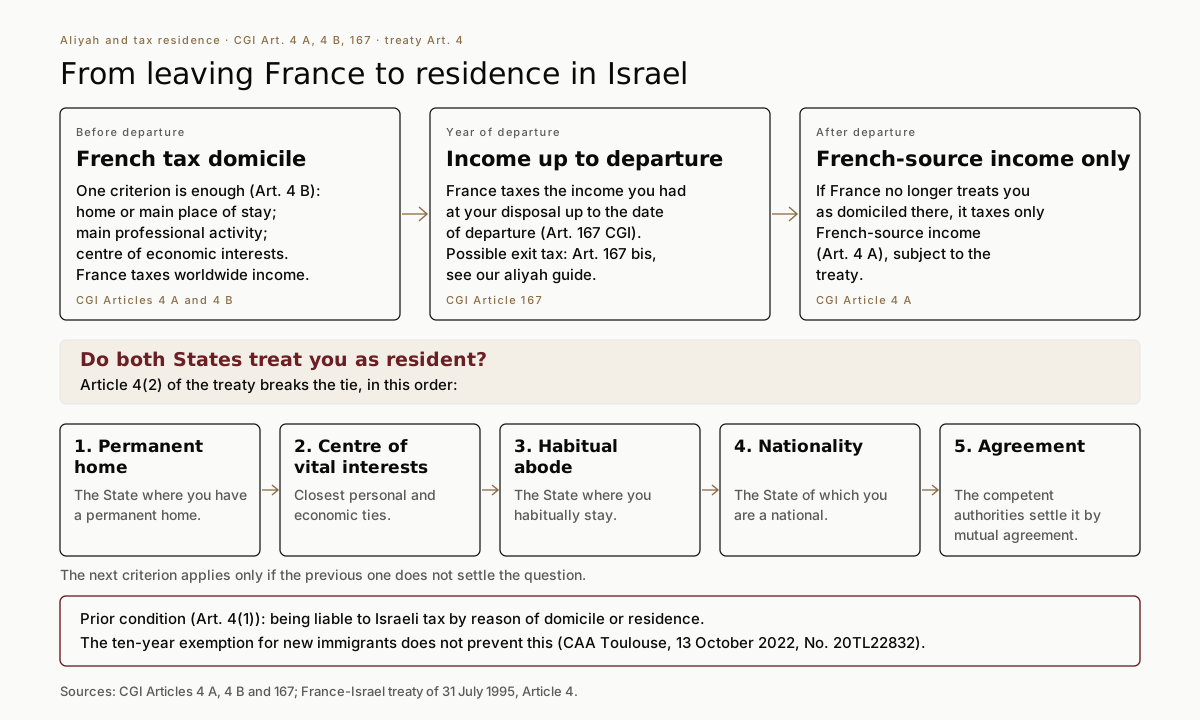
Diagram of tax residence on aliyah: before departure, France treats the person as tax resident if the home, the professional activity or the centre of economic interests is in France; in the year of departure it taxes income received up to the departure date; after departure it taxes French-source income only; if both States treat the person as resident, Article 4(2) of the treaty applies in order the permanent home, the centre of vital interests, the habitual abode, nationality, then agreement of the competent authorities.
Tax residence of a family moving to Israel: French domicile under Article 4 B CGI, taxation in the year of departure (Article 167 CGI), then the criteria of Article 4(2) of the treaty when both States regard themselves as the State of residence. The Israeli ten-year exemption does not remove Israeli resident status (CAA Toulouse, 13 October 2022, No. 20TL22832).
— Frequently asked questions

What clients ask us about the France-Israel treaty

I made aliyah and receive a French basic pension and an Agirc-Arrco pension: where am I taxed?

In Israel only, under Article 18 of the treaty, which reserves private pensions, social security pensions included, to the State of residence. You must evidence your Israeli residence, with the residence certificate certified in Israel, so that French withholding no longer applies. The Israeli treatment of these pensions, in particular during the oleh hadash period, should be checked with an Israeli adviser.

I am a former French civil servant, a dual national living in Israel: is my pension still taxable in France?

Yes. A public pension is taxable only in the paying State, unless the retiree is resident of and a national of the other State without being a national of the paying State. Having kept French nationality, you remain taxed in France on that pension (Article 19(2)).

As an oleh hadash exempt in Israel, can I rely on the treaty?

Yes. The Toulouse administrative court of appeal held on 13 October 2022 (No. 20TL22832) that individuals temporarily exempt in Israel on foreign income, but liable to Israeli tax on local income, are Israeli residents for treaty purposes. It remains to be shown, on the facts, that your home and interests are indeed in Israel.

I live in a settlement in the West Bank: does the treaty apply?

No, according to the French tax authorities. They consider that the treaty does not apply in the occupied Palestinian territories and that individuals residing in Israeli settlements are not eligible; the DINR rejects such claims (ministerial answer published in the JO Sénat on 4 June 2026). Your French taxation is then determined under domestic law alone.

I sell shares in my French company after moving to Israel: who taxes the gain?

Outside real estate companies and shares connected with a French permanent establishment, France may tax only if two conditions are met. Under domestic law, your rights, together with those of your spouse, ascendants and descendants, must have exceeded 25% of the profits during the last five years (Article 244 bis B CGI, 12.8% levy). Under the treaty, you must have held, with related persons, at least 10% of the capital (25% for a family company) at any time during the twelve months before the sale, French tax then being capped at 18% (Article 13(2)). Otherwise, only Israel, as State of residence, may tax (Article 13(5)). Any exit tax due on departure must be coordinated with the sale.

I live in Israel and receive dividends from a French company: what withholding applies?

For an individual, French withholding is 12.8% (Article 187 CGI), below the 15% cap set by Article 10 of the treaty. Israel then allows the French tax as a deduction from its own tax, up to the share of Israeli tax attributable to French income (Article 23(2)).

Does the treaty cover estates and gifts?

No. There is no estate tax treaty between France and Israel. We explain the consequences on our page France-Israel inheritance and gift tax.


Cité par

A situation between France and Israel to secure?

Confidential first conversation. The firm reviews the French side and the application of the treaty, working with your Israeli adviser on local matters.