French nationals living in Monaco
Employees, executives, retirees or investors: taxed in France on all their income, unless an exception is established.

The 1963 treaty settles neighbourhood issues: a Monegasque tax on the profits of certain businesses and, above all, the taxation in France of French nationals who settle in Monaco, as if they had never left. A person who is not French is not caught by that rule: only French domestic law then decides where they are resident.
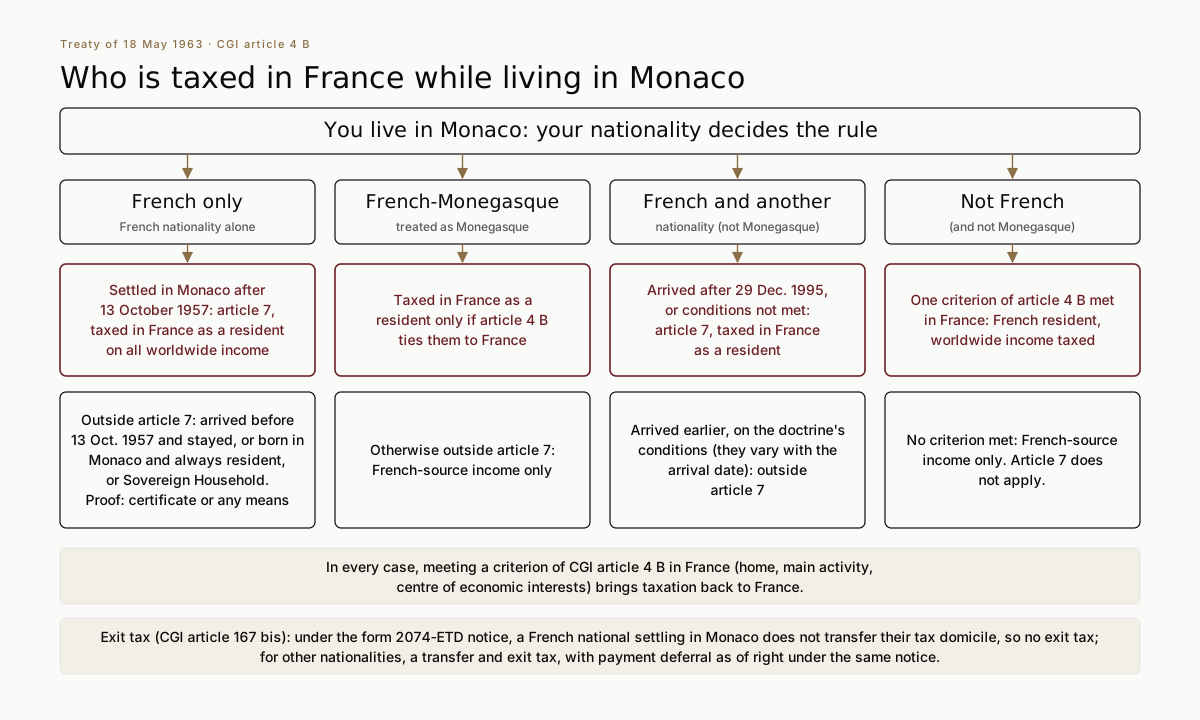
As a rule, no. Article 7(1) of the treaty of 18 May 1963 makes French nationals who move their domicile or residence to Monaco, or who cannot show five years of habitual residence in Monaco on 13 October 1962, liable to French income tax under the same conditions as if they were domiciled in France. They are therefore taxed in France on their worldwide income, Monegasque income included.
The exceptions are French nationals who arrived in Monaco before 13 October 1957 and stayed, those born there who have always lived there (Conseil d'État, 11 April 2014, No. 362237), members of the Sovereign Household, certain Monegasque civil servants, and some spouses and children covered by the exchange of letters of 26 May 2003. People who also hold Monegasque nationality are treated as Monegasque.
A person who is not French is outside Article 7, and the treaty contains no rule to settle their residence: France applies Article 4 B of the tax code (home or main place of stay, professional activity, centre of economic interests). For a French national, settling in Monaco is not a transfer of tax domicile out of France (notice to form 2074-ETD; for one caught by Article 7 it follows from the treaty), so there is no exit tax; for other nationalities there is one, with payment deferral as of right according to the notice to form 2074-ETD.
France-Monaco tax treaty of 18 May 1963, Article 7, and exchange of letters of 26 May 2003, text published on impots.gouv.fr; BOI-INT-CVB-MCO-10 of 2 June 2021.
What the treaty does not say. Article 7 covers only persons of French nationality. For a British, Italian, American or Swiss national settled in Monaco, the 1963 treaty contains no rule to settle residence between France and Monaco. Tax domicile is judged under Article 4 B of the French tax code: a person is domiciled in France if their home or main place of stay is there, if they carry on their main professional activity there, or if their centre of economic interests is there. One criterion is enough.
What France may tax. If no criterion is met, the person is taxed in France, in principle, on French-source income only, under the non-resident regime. If one is met, they are taxed on worldwide income like any resident, whatever their address in Monaco. Since Monaco does not tax the income of individuals, no treaty neutralises the French classification. The Conseil d'État held that a French national in Monaco cannot complain, under Article 14 of the European Convention on Human Rights, of being treated differently from foreign nationals in Monaco (CE, 11 April 2014, No. 362237).
Evidence. The Monegasque certificate of domicile was designed for French nationals (Article 22(3)). A foreign national may produce one, for example to a French pension fund to avoid withholding tax on a pension, but it does not by itself settle their tax domicile under Article 4 B. They prove residence in Monaco with a body of evidence: title deed or long lease of a home in Monaco, residence card, a count of days of presence, the children's school, the place where the activity is carried out, the location of bank accounts and insurance. The proof is made against the tax authorities, who look first at where the family home and the work are: a flat in Monaco and a family villa in Beausoleil or Cap-d'Ail do not weigh the same. For a retiree of foreign nationality receiving a French pension, the guidelines do not require five years of residence in Monaco on 13 October 1962 (BOI-INT-CVB-MCO-10, para. 340).
A French national with another nationality. They remain French for Article 7. Only the administrative guidelines, with their date conditions, place them outside the rule; the diagram at the foot of the page sets out the situations.
The 1963 treaty is short. The tax authorities apply it with their guidelines and the Conseil d'État reads it strictly. These five decisions come up in the firm's files.
Income tax and high-income contributions. A French national caught by Article 7 is taxed in France on income from all sources, French, Monegasque or foreign, from the year of arrival, without the special rules for the year of departure (Article 167 of the French tax code). The exceptional contribution on high incomes applies, and the tax authorities have stated that the differential contribution on high incomes applies as well (BOI-IR-CDHR-10, 30 June 2026, para. 40). The real estate capital gains exemption reserved for non-residents is not available.
IFI. Article 7(3), introduced by the 2003 protocol, makes French nationals who settled in Monaco on or after 1 January 1989 liable to the wealth tax as French residents: all their real estate within the scope of the IFI is covered, including in Monaco. Those who settled before that date are taxable only on assets located in France. The Court of Cassation held the protocol valid as applied retroactively (Cass. com., 26 October 2010, No. 09-15.044), and the European Court of Human Rights upheld that application (ECtHR, 15 January 2015, applications No. 36918/11 and others).
Social levies. Article 7 covers income tax only. CSG and CRDS therefore cannot be based on it (CE, opinion, 10 November 2004, No. 268852), but they remain due if the taxpayer is domiciled in France within the meaning of Article 4 B of the French tax code (CE, 11 June 2014, No. 358301). Otherwise, only French-source income subject to them for non-residents bears them: a gain on a property located in France is taxed to income tax under Article 150 U of the French tax code and subject to social levies (CE, 21 June 2021, No. 439354).
Other treaties do not apply as they would to a resident. According to the tax authorities, a French national in Monaco taxed in France is not a French resident for the purposes of treaties with third countries. For investment income from those countries, a tax credit equal to the foreign withholding tax is granted, capped at the French tax. This calls for case-by-case analysis, as case law has sometimes allowed another treaty to be invoked (CAA Versailles, 2 July 2015, No. 13VE02420).
Monaco does not tax the income of individuals resident there. The 1963 treaty draws the consequence for French nationals: save for exceptions, settling in the Principality changes nothing to their French income tax. The exceptions exist, but they turn on old dates, birth in Monaco, marriage or dual nationality, and each requires continuous residence that the tax authorities check.
Article 7 also creates hybrid situations. A French national in Monaco is taxed as a French resident for income tax, but not for social levies, which follow domestic law, nor for the application of France's other tax treaties. Errors, and sometimes legitimate savings, are found in these gaps.
Employees, executives, retirees or investors: taxed in France on all their income, unless an exception is established.
Outside Article 7 if they have always lived there, provided they prove it, in particular with the certificate of domicile.
French-Monegasque nationals treated as Monegasque; other dual nationals subject to very strict date conditions.
Taxed in France on their Monegasque salary; CSG and CRDS depend on their affiliation to Monegasque social security.
Profits tax where at least 25% of turnover is generated outside Monaco, or for royalty companies.
Fees, commissions and royalties paid to Monaco: deductible only if their genuineness is proven.
The same move to Monaco, read by nationality: Article 7 covers French nationals, Article 4 B of the tax code judges the others.
For income tax, almost nothing: you remain taxable in France on your worldwide income, under the same conditions as before, from the year you arrive. If the net value of your taxable real estate exceeds the IFI threshold, you remain liable as a French resident, on assets in France and abroad. The change mainly concerns social levies, which depend on your domicile under Article 4 B of the French tax code.
Since the Conseil d'État decision of 11 April 2014, a French national who has lived in Monaco continuously since birth is outside Article 7 and taxable in France only on French-source income, unless domiciled in France under Article 4 B of the French tax code, for example because the main professional activity is there. This must be proven with the certificate of domicile or by any means, and a break in residence can change the outcome.
Only if you meet all the conditions of the administrative guidelines: no French domicile criterion under Article 4 B, dual nationality already held on arrival in Monaco, arrival before 29 December 1995, continuous residence since, foreign nationality retained and supporting documents filed by 31 December 1996. Further conditions depend on the arrival date: between 8 July 1978 and 12 July 1991, arriving from a country other than France; between 13 July 1991 and 29 December 1995, also having acquired the foreign nationality before French nationality. A French-Monegasque national is treated differently, as Monegasque.
In France, your State of domicile: Monaco does not tax salaries. As regards CSG and CRDS, following the judgments of the Court of Justice of the European Communities of 15 February 2000, the French authorities accepted that they are not due on the salary of a cross-border worker covered by Monegasque social security and that amounts wrongly paid may be refunded (ministerial answer Bourg-Broc, National Assembly, 17 July 2000, No. 45535). Your actual affiliation is checked on the documents.
Yes. Even if not domiciled in France under Article 4 B, the gain is taxed to income tax under Article 150 U of the French tax code by virtue of Article 7, and social levies apply (CE, 21 June 2021, No. 439354). The non-resident exemption does not apply. For a French national outside Article 7, the non-resident regime applies, with any exemptions it offers.
Yes, if you keep in France your home or main place of stay, a main professional activity or the centre of your economic interests (Article 4 B of the tax code). Article 7 of the treaty does not cover you, and the treaty contains no rule to settle your residence: only French domestic law decides. If no criterion is met, you are taxed in France on French-source income only. You prove residence with a body of evidence (home, presence, activity, family), not with the certificate of domicile alone.
Not for a French national: the notice to form 2074-ETD states that a person of French nationality settling in Monaco does not transfer their tax domicile out of France, and one caught by Article 7 remains taxable in France on all their income. For a person of another nationality who was domiciled in France for at least six of the last ten years and holds more than EUR 800,000 of securities or at least 50% of a company, the exit tax applies, with payment deferral as of right according to the notice to form 2074-ETD, then cancellation of the tax on latent gains if the securities are kept for two years (five years above EUR 2.57 million).
No: estates fall under a separate treaty, that of 1 April 1950, which has its own domicile rules. See our page on France-Monaco estates.









The tax treaty atlas: text, articles and amendments, with the country preselected.
Voir la page GuideThe 1950 treaty: five-year domicile, real estate, company shares.
Voir la page PracticeFrench-source income, real estate and filing obligations.
Voir la page OfficeThe Côte d'Azur office, from Saint-Tropez to Monaco.
Voir la pageConfidential first conversation. The firm reviews your situation under Article 7, French domestic law and the documents to gather, together with your Monegasque advisers.
© BENSAID Avocats. The information on this site does not constitute legal advice. Source: tax treaty between France and the Principality of Monaco of 18 May 1963 as amended, and exchange of letters of 26 May 2003, published on impots.gouv.fr; BOI-INT-CVB-MCO-10 and BOI-INT-CVB-MCO-20 of 2 June 2021; BOI-IR-CDHR-10 of 30 June 2026.
No slot suits you? Describe your situation and the firm will call you back.