— 05 · Lease or sale
Will a real-estate finance lease still be a letting after 1 January 2027?
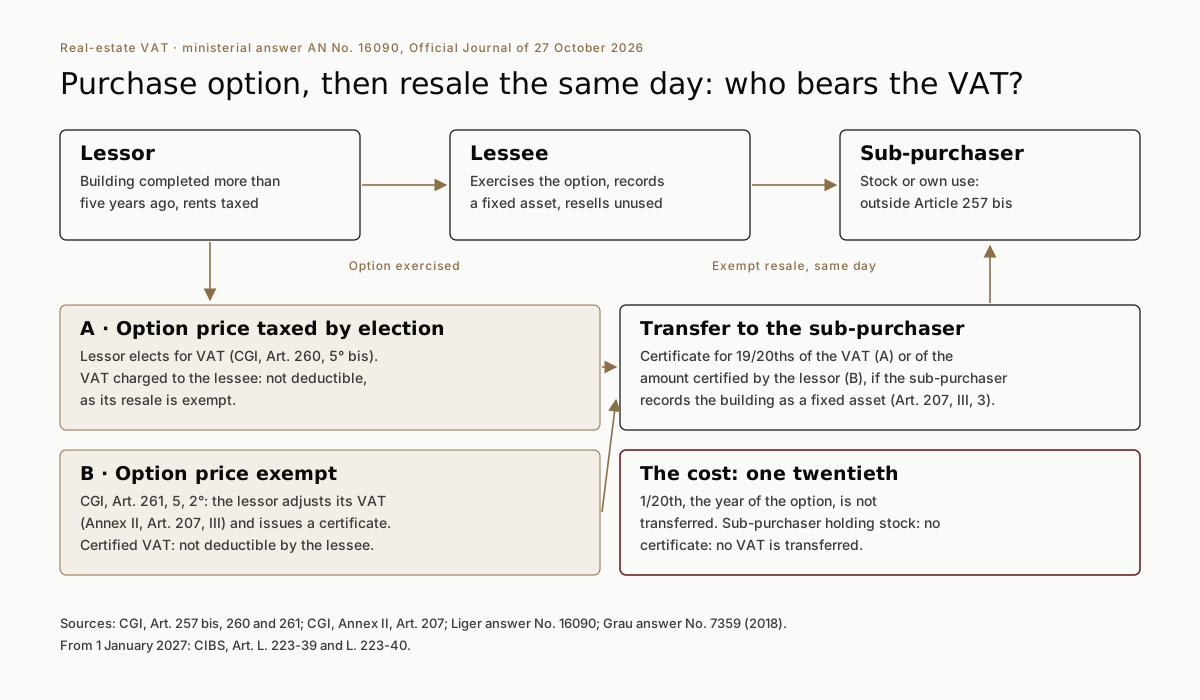
The whole reasoning of the ministerial answer assumes that the finance lease is a letting, followed by a sale when the option is exercised. In the CGI, treating the handover of the asset as an immediate supply applies only to tangible movable property let under a contract with a clause providing that ownership is normally acquired by the holder at the latest on payment of the last instalment (CGI, Art. 256, II, 3°, c).
Article L. 211-36 of the CIBS, applicable from 1 January 2027, is drafted more broadly: "Where a transfer of ownership is deferred until full payment of the consideration, the supply of goods is deemed to take place when the goods are physically handed over. Such a deferral includes the acquisition of ownership upon payment of the last instalment of a contract making the asset available, where that acquisition results automatically from the terms of the contract or from the absence of an economically rational alternative choice" (Ordinance No. 2026-671 of 27 July 2026, annex; unofficial translation). The text does not distinguish movable from immovable property. Where the option price is far below the expected value of the building at the end of the term, the financial terms of the contract as a whole may make exercising the option the only economically rational decision. The tax authorities could then argue that the building was supplied when it was physically handed over to the lessee, not when the option was exercised; the rules for supplies of buildings would apply at that date. The assessment is global: the ratio between the option price and the rents paid is not enough on its own.
Administrative guidance takes the opposite view. Since 8 July 2026, the BOFiP states that the handover of an asset, "whether movable tangible property or immovable property", under a finance lease or a lease with a purchase option "is not regarded as a supply of goods". These contracts, in particular those governed by Articles L. 313-7 et seq. of the Monetary and Financial Code, are a letting with a "mere option to purchase", the transaction being a letting followed, where applicable, by a supply when the option is exercised (BOI-TVA-CHAMP-10-10-40-10, § 100).
This guidance can still be relied on after the recodification. Section III of Article 46 of Ordinance No. 2025-1247 of 17 December 2025, as inserted by the Ordinance of 27 July 2026, provides that, for the purposes of Articles L. 64 B, L. 80 A and L. 80 B of the Tax Procedures Code, the authorities' interpretation of CGI provisions transferred into the CIBS constitutes an interpretation of the corresponding CIBS provisions (text). Article L. 80 A bars any reassessment based on an interpretation different from the one the authorities had published and not withdrawn at the date of the transactions. The authorities drew the consequences on 7 October 2026: all their guidance not withdrawn or lapsed before 1 January 2027 remains binding from that date (BOI-RES-TVA-000253, § 2.1). A theoretical reservation remains: Section III of Article 46 covers the interpretation of provisions transferred from the CGI, and the second sentence of Article L. 211-36 had no counterpart in the CGI for buildings.
- Review the contract. Automatic acquisition at the end of the term, an obligation to purchase or a penalty for not exercising the option move the lease away from the "mere option to purchase" described in the guidance.
- Document the option price. Keep what justifies it (residual value, expected value of the building at the end of the term, term, rents) and what shows that exercising the option remains a real choice for the lessee.
- Secure significant transactions. The authorities have not yet commented on Article L. 211-36: where the building is to be handed over to the lessee on or after 1 January 2027, a ruling requested before the handover remains the safest protection.