
Moving back to France: tax on your return and the inbound expatriate regime
Returning to France after several years abroad brings back taxation on worldwide income, but it also opens up advantages: the inbound expatriate (impatrié) regime of article 155 B, a real estate wealth tax limited to French assets for five years, and the cancellation of exit tax on shares still held. The conditions must be met, starting with five years of non-residence, and foreign accounts must be reported.
How are you taxed when you move back to France?
As soon as you meet one of the tests of article 4 B of the French Tax Code (home, main professional activity or centre of economic interests in France), you become French tax-resident again and taxable in France on your worldwide income, subject to tax treaties. In the year of return, only income received after you settle in France falls within worldwide taxation.
If you are recruited from abroad by a company established in France and were not tax-resident in France during the five preceding calendar years, the inbound expatriate regime (article 155 B) exempts from income tax the expatriation premium, or a flat 30% of remuneration, and 50% of certain foreign-source income, until the end of the eighth year following the start of your duties. The same five-year condition limits the real estate wealth tax (IFI) to your French real estate for five years (article 964). Finally, exit tax deferred on shares you still hold is cancelled automatically on your return (article 167 bis, VII, 2).
French Tax Code art. 155 B; art. 964; art. 167 bis. Checked on 6 October 2026.
- Residence
- French again as soon as one test of article 4 B is met, subject to the applicable treaty
- Inbound regime
- Article 155 B: expatriation premium or flat 30%, and 50% of certain foreign income exempt from income tax
- Key condition
- No French tax residence in the five calendar years preceding the start of duties
- Duration
- Until 31 December of the eighth year following the start of duties
- Wealth tax (IFI)
- French real estate only, for five years (article 964)
- Exit tax
- Automatic cancellation on return for shares still held (article 167 bis, VII, 2)
Becoming French tax-resident again
Your return is assessed under the tests of article 4 B: it is enough for your home, your main professional activity or your centre of economic interests to be in France again. The date matters: it starts worldwide taxation and, for exit tax, triggers the cancellation. Where your former country of residence still treats you as resident for the year of return, the tax treaty decides; check the relevant treaty in the firm’s tax treaty atlas, for instance Switzerland or the United Kingdom.
In the year of return, the tax return distinguishes the period of non-residence, when only French-source income is taxable in France, from the period of residence. Timing should be planned: a bonus, a share sale or a dividend received before or after you settle in France are not treated alike. The tests are explained on our page tax residence in France.
The inbound expatriate regime of article 155 B
The regime covers employees and assimilated executives called from abroad to take up a position in a company established in France: direct recruitment abroad by the French company, or mobility within a group. It is open to French nationals coming home; nationality is irrelevant. It does not cover a sole trader or a person returning without a position in France.
- Prior non-residence: no French tax residence during the five calendar years preceding the year in which duties start;
- Duration: until 31 December of the eighth calendar year following the start of duties, for as long as you are French-resident through your home or main activity; the regime survives a change of position within the company or group;
- Expatriation premium exempt from income tax for its actual amount, provided it is set out separately in the employment or corporate office contract, or an amendment, signed before duties start, or, by election, a flat 30% of net remuneration (net of social contributions and the deductible part of CSG, before the 10% allowance); taxable remuneration may not fall below that paid for similar duties in the company;
- Days worked abroad in the direct and exclusive interest of the employer: the related remuneration is exempt, capped by election at 50% of total remuneration for all exemptions, or at 20% of taxable remuneration for that portion alone;
- Foreign-source passive income exempt from income tax at 50%: dividends and interest paid by a person established outside France, certain intellectual property income, gains on securities whose custodian or issuing company is established outside France, provided the State concerned has a treaty with France containing an administrative assistance clause; losses are then taken into account at 50% only.
The regime concerns income tax: social levies remain due under the ordinary rules. It cannot be combined with the regime for employees posted abroad (article 81 A). For an executive returning to run the family group, qualifying as an employee “called from abroad” must be evidenced: contract or office signed before the return, company established in France, effective duties.
Wealth tax for returning residents: five years on French assets only
A French resident is in principle liable to the real estate wealth tax (IFI) on real estate located in France and abroad, above €1,300,000. Article 964 provides an exception for a person who was not French tax-resident during the five calendar years preceding the year of settlement: only real estate located in France, and shares of companies in proportion to their French real estate, is taxable, until 31 December of the fifth year following the year of settlement.
This regime is separate from article 155 B: it requires neither a job nor recruitment from abroad. A retiree returning after seven years in Portugal benefits from it; an executive returning after three years in London does not. See our page on wealth tax and international tax treaties.
Exit tax cancelled on your return
If you left France and reported a latent gain under exit tax, your return cancels the tax on the shares you still hold. Article 167 bis provides that the tax on latent gains is cancelled automatically, or refunded if it was paid, at the end of the two-year or five-year period, or when the taxpayer transfers his or her tax residence back to France if that happens earlier, for shares still in his or her estate (VII, 2).
- Deferred gains (contribution and disposal in particular): you are put back in the position you would have been in had you never left France, for the shares still held (VII, 3);
- Earn-out receivables: the tax is cancelled for the portion of the receivable still held on return, net of earn-out payments already received (VII, 4);
- Formality: in the year following the return, the taxpayer reports the event and claims the cancellation or refund, within the deadline for the income tax return (IX, 3).
Shares sold while abroad do not benefit from this cancellation: the sale ended the deferral and made the tax payable, and returning does not erase it, subject to the adjustments of section VIII where the gain actually realised is lower than the gain recorded on departure or in case of a loss. Details in our exit tax page.
Foreign accounts, policies and trusts to report
Once resident again, you must report every year, with your income tax return and on form 3916-3916 bis, the accounts opened, held, used or closed abroad (article 1649 A) and life insurance and capitalisation contracts taken out with foreign insurers (article 1649 AA). Failure is penalised by a fine of €1,500 per account or contract, raised to €10,000 where the State concerned has no agreement with France giving access to banking information (articles 1736 and 1766), and extends to ten years the period in which the authorities may reassess the related income; for accounts only, that extension does not apply if their total balances never exceeded €50,000 during the year. Trusts are subject to a separate obligation (article 1649 AB), which falls in principle on the trustee and whose breach carries a €20,000 fine (article 1736, IV bis).
Accounts kept in your former country of residence, whether a salary account, a pension account or a portfolio, are almost always concerned. See foreign accounts: obligations and penalties.
In court: three decisions
The inbound regime and the exit tax each have their case law. Three decisions shed light on a return: one on the line between direct recruitment and intra-group mobility, two on the exit tax whose effects a return erases. The decisions are in French; the references link to the official texts.
- Direct recruitment or group mobility. An employee of a banking group in the United Kingdom had ended his contract to sign a permanent contract with the group's French subsidiary, with no probationary period and full recognition of his seniority. For assignments that began before the 2019 Finance Act, the Council of State held that only people recruited directly abroad by a company established in France, not people moving between entities of the same group, could opt for the flat 30% exemption (CE, 22 December 2020, no. 427536). For assignments beginning on or after 16 November 2018 the text no longer contains that restriction; how the recruitment is characterised remains the first point the tax office examines.
- The exit tax on a departure to Switzerland. Article 167 bis, which taxes unrealised gains when the tax residence leaves France, does not infringe the freedom to leave the territory, and the 1966 France-Switzerland treaty, which reserves to the State of residence the taxation of gains on disposals, does not prevent that tax at departure (CE, 23 June 2016, no. 378008). That tax, or its deferral, is what a return cancels.
- Where the deferral and the relief come from. The Court of Justice held that the immediate taxation of unrealised gains of a taxpayer settling in another Member State infringes freedom of establishment (CJEU, 11 March 2004, case C-9/02). The current regime of article 167 bis, with its deferral and its relief, was re-established in 2011 with that case law in mind.
See our exit tax page, which comments on the departure regime, and the treaty atlas for the France-Switzerland treaty.
Worked example: an executive returning from Geneva
Assumptions. A French executive, based in Geneva since 2018, is recruited directly from Switzerland by a company established in Paris and takes up duties on 1 March 2027. He was not French tax-resident in 2022, 2023, 2024, 2025 and 2026. Annual net remuneration: €300,000, with no expatriation premium in the contract. He keeps a portfolio held in Switzerland paying €100,000 of dividends a year. Full-year calculation, with the flat tax applied to dividends.
| Full year | Without the regime | With article 155 B |
|---|---|---|
| Remuneration subject to income tax | €300,000 | €210,000 (flat 30% exempt) |
| Dividends subject to income tax (12.8%) | €100,000 | €50,000 |
| Income tax on dividends, before treaty tax credit | €12,800 | €6,400 |
| Social levies on dividends (18.6%) | €18,600 | €18,600 |
| Wealth tax on a chalet in Switzerland | due if above the threshold with other assets | outside the base until 31 December 2032 (article 964) |
The flat rate removes €90,000 a year from taxable remuneration, provided the remaining €210,000 is not below the pay for similar duties in the company; the saving then depends on the household’s marginal rate. The regime runs until 31 December 2035. Had he returned in 2024, he would also have met the condition, not having been French-resident from 2019 to 2023; returning in 2022, he would not, since he was still French-resident in 2017. The dividends are counted gross. Swiss withholding tax, limited by the France-Switzerland treaty, gives a French tax credit capped at the corresponding French tax, which may absorb all or part of the income tax shown; the reduced 7.5% rate (solidarity levy only) applies only to people covered by a mandatory Swiss or European Economic Area scheme because they work there, which is not the case of an executive employed in Paris, who falls under the French scheme. Indicative calculation, excluding family quotient and the high-income contribution.
Preparing your return with the firm
The firm prepares the return several months ahead: residence date and treaty position, check of the five years of non-residence, drafting of the expatriation clause and choice between actual premium and flat rate, timing of sales and distributions, exit tax cancellation, inventory of foreign accounts and policies. From Geneva and Paris, it handles returns from Switzerland in particular; see tax lawyer in Geneva.

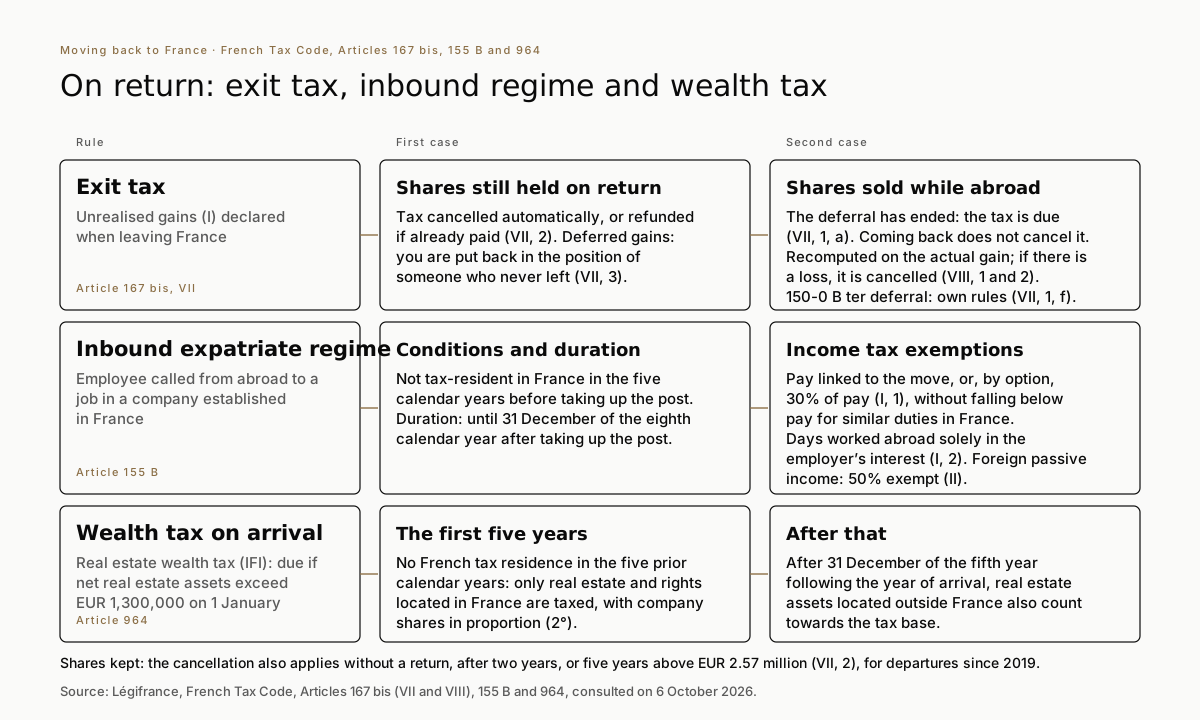
Moving back to France at a glance
Exit tax, inbound expatriate regime and wealth tax: what is at stake on return, article by article.
Moving back to France: your questions
Can a French national returning to France use the inbound expatriate regime?
Yes, nationality is irrelevant. You must be called from abroad by a company established in France, through direct recruitment or group mobility, and must not have been French tax-resident during the five calendar years preceding the year in which your duties start.
How long does the inbound expatriate regime last?
Until 31 December of the eighth calendar year following the year in which duties start, for as long as you remain French tax-resident through your home or main activity.
Which income is 50% exempt for an inbound expatriate?
Dividends and interest paid by a person established outside France, certain intellectual property income and gains on securities whose custodian or company is established outside France, where the State concerned has a treaty with France containing an administrative assistance clause. The exemption applies to income tax, not to social levies.
Is my exit tax cancelled if I move back to France?
For shares still held on the date of return, yes: the tax on latent gains is cancelled automatically, or refunded if paid (article 167 bis, VII, 2). The event must be reported and the cancellation claimed in the year following the return.
Do I pay wealth tax on my foreign property when I return?
Not for five years if you were not French tax-resident during the five calendar years before your return: only your French real estate is then taxable, until 31 December of the fifth year following your settlement (article 964).
Must I report accounts left abroad?
Yes, every year, with your income tax return and on form 3916-3916 bis: foreign bank accounts and foreign life insurance or capitalisation contracts. The fine is €1,500 per unreported account or contract, €10,000 where the State does not exchange banking information with France. Trusts are subject to a separate return.









Residence and international mobility
Moving back to France on the right terms
A confidential first discussion to set the residence date, check access to the inbound regime and the limited wealth tax, and organise the exit tax cancellation.
Sources
- French Tax Code (CGI), articles 4 B, 155 B, 167 bis, 964, 1649 A, 1649 AA, 1649 AB, 1736 and 1766 (Légifrance, consulted on 6 October 2026)
- BOI-RSA-GEO-40-10-10 and BOI-RSA-GEO-40-10-20 (11 August 2025), inbound expatriate regime
- Finance Act for 2019 (Law no. 2018-1317 of 28 December 2018), art. 6 (flat 30% extended to duties starting from 16 November 2018)
Cette note présente l'état du droit à sa date de publication et ne constitue pas un avis juridique. Chaque situation appelle un examen particulier.
This page presents the tax aspects of returning to France for information purposes; each situation requires specific analysis. Law in force on 6 October 2026.