
Swiss investor or foreign family office: does your stake in a French company fall under foreign investment screening?
French foreign investment screening is not limited to funds and industrial groups. A Swiss individual, a French national living in Geneva, a family holding company, a trust or a foundation may need the authorisation of the French Minister for the Economy before investing in a French company.
Does a Swiss investor or a foreign family office need authorisation to invest in a French company?
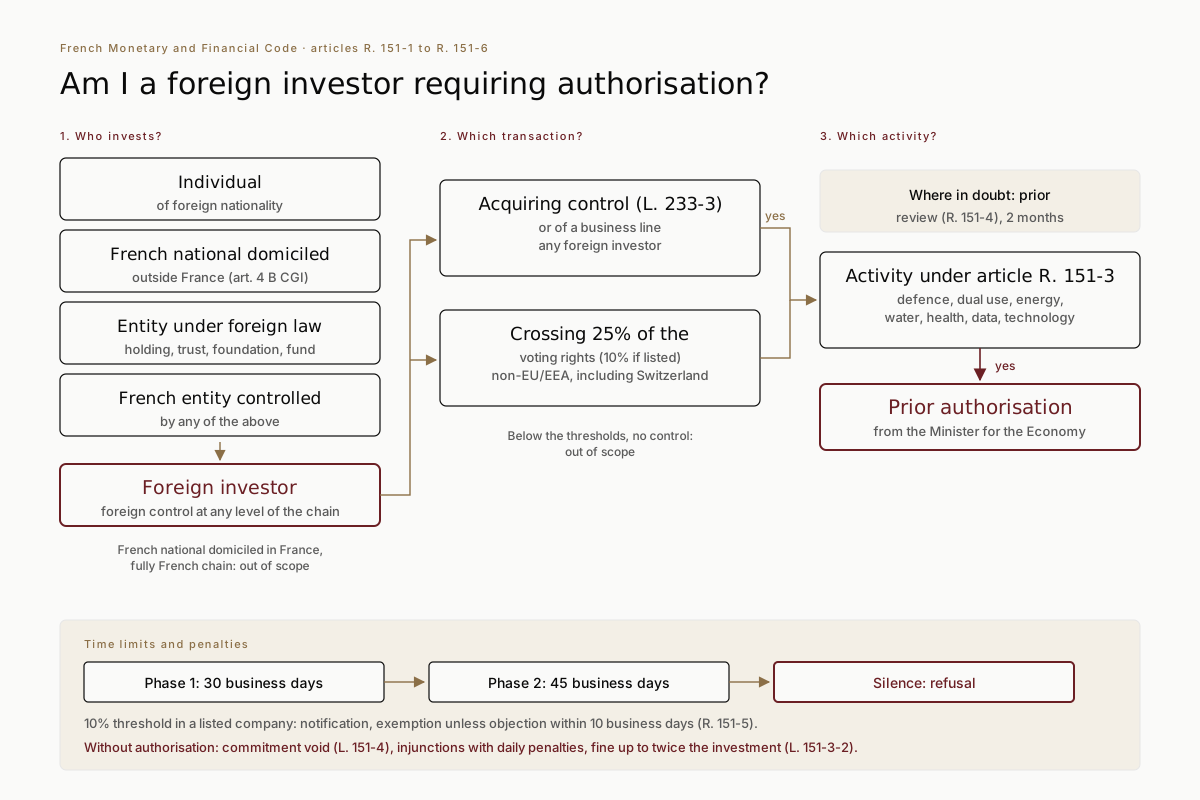
Yes, where three conditions are met together: the investor is foreign within the meaning of article R. 151-1 of the French Monetary and Financial Code, which includes a French national domiciled outside France and a French holding company controlled from abroad; the transaction gives it control of the company or of a business line or, for an investor outside the European Union and the European Economic Area such as a Swiss investor, takes it above 25% of the voting rights (10% in a listed company); and the company carries on a sensitive activity listed in article R. 151-3. Without prior authorisation, the commitment is void and the investor is exposed to injunctions and a financial penalty.
CMF art. R. 151-1, R. 151-2 (version of 17 August 2026), R. 151-3, L. 151-3-1, L. 151-3-2 and L. 151-4; guidelines of the French Treasury (Direction générale du Trésor), version of 29 July 2025. Texts read on 26 October 2026.
- Who
- Foreign individual, French national domiciled outside France, entity governed by foreign law, French entity controlled by any of them
- Transactions
- Acquiring control, acquiring a business line, crossing 25% of the voting rights (10% in a listed company) for non-EU and non-EEA investors
- Activities
- List in article R. 151-3: defence, dual use, energy, water, health, data, press, critical technologies
- Time limits
- 30 business days, then 45 business days if a further review is opened; silence means refusal
- Penalty
- Up to twice the investment, 10% of the turnover of the business carrying on the sensitive activity, EUR 5 million (legal person) or EUR 1 million (individual), whichever is highest
Who is a foreign investor under the French Monetary and Financial Code?
Article R. 151-1 sets out four categories: any individual of foreign nationality; any French national who is not domiciled in France within the meaning of article 4 B of the French Tax Code; any entity governed by foreign law; and any entity governed by French law controlled by one of the above. All persons and entities in the same chain of control are investors, control being assessed under article L. 233-3 of the French Commercial Code or, failing that, under article L. 430-1, III (decisive influence).
The French Treasury guidelines (version of 29 July 2025) state that a dual national holding French nationality is not a foreign investor unless tax-domiciled outside France; that domicile is assessed at the date of the transaction, a later move abroad not triggering a new review unless it is intended to circumvent the rules; and that entities governed by foreign law include trusts, foundations and investment vehicles, with or without legal personality.
Which transactions trigger screening, and from which threshold?
Article R. 151-2, in its version in force since 17 August 2026, covers acquiring control of an entity governed by French law or of an establishment registered with the French trade and companies register, acquiring all or part of a business line, and crossing, directly or indirectly, alone or in concert, 25% of the voting rights of an entity governed by French law or 10% of a company listed on a regulated market. The two thresholds do not apply to nationals of an EU or EEA State (subject to an administrative assistance agreement with France) domiciled in one of those States, nor to entities whose entire chain of control falls within those States.
Since Switzerland rejected the European Economic Area in the popular vote of 6 December 1992, the guidelines confirm that threshold crossings by a Swiss investor are screened. Since 17 August 2026, the SIX Swiss Exchange is among the markets taken into account for the 10% threshold (article 5-1 of the order of 31 December 2019, introduced by the order of 30 July 2026).
In a family context, article L. 233-10 of the French Commercial Code presumes concert action between companies controlled by the same persons and between the fiduciary and the settlor-beneficiary of a fiducie; an agreement between relatives may also amount to concert action if it organises the acquisition, sale or exercise of voting rights to pursue a common policy. The guidelines list gifts among the possible transactions. Conversely, article R. 151-7 exempts an internal reorganisation from the request where the ultimate investor already controlled the target, subject to exceptions.
Does the target company carry on a sensitive activity?
Screening only applies if the company carries on, even occasionally, an activity listed in article R. 151-3. The list is broad: defence, dual-use goods, cryptology, gambling other than casinos; infrastructure and services essential to energy, water, transport, communications, public health, food security, news media or critical raw materials; research on the critical technologies set by ministerial order, including artificial intelligence, semiconductors and biotechnology. For a mid-sized industrial company, the sensitive activity may lie in a portfolio of contracts or a specific research programme; the analysis is made case by case.
Where in doubt, article R. 151-4 allows the company, or the investor with its consent, to ask the Minister whether the activity is covered; the answer is due within two months. According to the guidelines, this prior review request may be filed as soon as negotiations begin, and the Minister's silence does not amount to an exemption.
How does the authorisation request work, and how long should you allow?
The request is filed by the investor, or by a member of the chain of control on behalf of all (article R. 151-5). The file (article 1 of the order of 31 December 2019) includes the chart of the chain up to the persons who ultimately control it, with percentages of capital and voting rights, the identity of the decision-makers, the financing arrangements and a statement of no conviction over five years. For a family office, this is often the first complete transparency exercise.
The Minister has thirty business days to state whether the transaction is out of scope, authorised without conditions, or subject to a further review, then forty-five business days to decide; in both phases, silence means refusal (article R. 151-6). Crossing 10% in a listed company follows a notification procedure: unless the Minister objects, the exemption arises after ten business days. Authorisation may be subject to conditions, up to the sale of part of the shares (article R. 151-8). It may be refused if those conditions are insufficient, or where there is a serious presumption of offences listed in article R. 151-10, including money laundering and tax fraud; the origin of funds may be checked through international cooperation (article R. 151-17).
What happens to a transaction completed without authorisation?
Article L. 151-4 is plain: any commitment, agreement or contractual clause that directly or indirectly carries out a foreign investment requiring authorisation, without that authorisation, is void. The Minister also takes one or more of the measures in article L. 151-3-1: an injunction to file a request, to restore the previous situation at the investor's expense or to modify the investment, with a daily penalty of up to EUR 50,000 (article R. 151-14). As interim measures, the Minister may suspend voting rights, prohibit or limit dividends and appoint a trustee within the company. The investor first has fifteen days to submit observations, reduced in urgent cases to no less than five business days (article R. 151-12).
Article L. 151-3-2 adds a financial penalty capped at the highest of: twice the irregular investment, 10% of the annual turnover excluding VAT of the business carrying on the sensitive activity, EUR 5 million for a legal person, EUR 1 million for an individual. The guidelines state that voluntary regularisation cures the nullity but does not rule out the penalty, whose amount takes good faith into account. A penalty or a serious breach within five years may then justify refusing a later authorisation (article R. 151-10, 3°).
Three decisions that shed light on a private investor's position
Litigation is rare. In the databases consulted (Légifrance and ArianeWeb), the firm has found no court decision ruling on a penalty under article L. 151-3-2 or an injunction under article L. 151-3-1.
- Integrity and origin of funds. The Minister may take into account the conduct of the person on whose behalf the investment is made and the origin of the funds; absent any information on that origin despite repeated requests, and given serious doubts about that person's integrity, the deferral of the acquisition of 52% of a French company was lawful (CE, 15 April 1996, no. 160550, Pathé France Holding, published in the Lebon reports).
- A fund's transparency on its subscribers. For a transaction carried out by a fund, the applicant must identify the manager and the persons controlling it, not every subscriber; the authorisation, granted with commitments on the company's continuity, was not vitiated by a manifest error of assessment (CE, 3 April 2020, no. 422580, mentioned in the tables). The guidelines reserve the Minister's right to request the subscribers' identity.
- A regime that must be foreseeable. Following the Court of Justice judgment of 14 March 2000, the Conseil d'État held contrary to the free movement of capital an authorisation regime that did not specify the circumstances in which authorisation was required (CE, 8 December 2000, no. 181533, published in the Lebon reports). The current rules now list the activities concerned precisely, in article R. 151-3.
The answer depends on the whole ownership chain, and must be settled before signing
The rules make no distinction based on the investor's size: a family holding its stakes through a Swiss holding company, a trust or a foundation falls within the same definitions as a fund. The firm maps the ownership chain, analyses the transaction and the target's activity, prepares the prior review or authorisation request, and aligns it with the tax treatment of the investment, in particular under the France-Switzerland tax treaty.
Am I a foreign investor requiring authorisation?
Three successive questions: who invests, which transaction, which activity.
What families and family offices ask us
I am French and live in Geneva: am I a foreign investor?
Yes, if you are tax-domiciled in Switzerland rather than in France. Article R. 151-1 of the French Monetary and Financial Code covers French nationals who are not domiciled in France within the meaning of article 4 B of the French Tax Code. A stake taken from Switzerland in a French company carrying on a sensitive activity is therefore screened as soon as it confers control or crosses 25% of the voting rights, since Switzerland is not part of the European Economic Area.
Our family holding company is French: is it out of scope?
Not necessarily. An entity governed by French law and controlled by a foreign national, by a French national domiciled abroad or by an entity governed by foreign law is itself a foreign investor. It is enough for a foreign person or entity to control, directly or indirectly, one of the links in the chain, even if the top company is French.
What if the transaction has already been completed without authorisation?
First check whether the three conditions were met at the date of the transaction. If so, the French Treasury guidelines accept voluntary regularisation, which cures the nullity under article L. 151-4 without ruling out the financial penalty, whose amount takes good faith into account.












Investing in France from abroad
Foreign companies in France
Tax treatment of a foreign company holding assets or doing business in France.
Voir la page TreatyFrance-Switzerland tax treaty
Residence, dividends and capital gains between France and Switzerland.
Voir la page PracticeFrench fiducie
Management and security fiducie under French law, including for holding shares.
Voir la page Track recordOur transactions (in French)
Transactions handled by the firm, presented anonymously.
Voir la pageA French stake to secure before signing?
Confidential first conversation, reply within 24 business hours. The firm reviews the ownership chain, the transaction and the target's activity, and prepares the prior review or authorisation request where needed.
Sources
- French Monetary and Financial Code, articles L. 151-3, L. 151-3-1, L. 151-3-2, L. 151-4 and L. 151-5 (versions of 24 May 2019), R. 151-1 to R. 151-17 (including R. 151-2 in its version of 17 August 2026), read on 26 October 2026.
- Order of 31 December 2019 on foreign investment in France, articles 1, 5-1 (version of 17 August 2026) and 6.
- French Commercial Code, articles L. 233-3, L. 233-10 and L. 430-1.
- Direction générale du Trésor, Guidelines on the screening of foreign investment in France, version of 29 July 2025 (prior to the order of 30 July 2026 on regulated markets).
- CE, 15 April 1996, no. 160550; CE, 8 December 2000, no. 181533; CE, 3 April 2020, no. 422580.
Cette note présente l'état du droit à sa date de publication et ne constitue pas un avis juridique. Chaque situation appelle un examen particulier.
© BENSAID Avocats. The information on this website does not constitute legal advice. Sources: French Monetary and Financial Code, articles L. 151-3 to L. 151-7 and R. 151-1 to R. 151-17, order of 31 December 2019 as amended, French Treasury guidelines (29 July 2025).