Germans settled in France
Domiciled in France, they pass on all their assets under French duties, including their accounts and securities in Germany.

Since 3 April 2009, a treaty has allocated between France and Germany the right to tax inheritances and gifts. It does not remove dual jurisdiction: each State keeps the right to tax an heir domiciled there, provided it credits the other State's tax. The final outcome depends on the domicile of the deceased, that of the heirs and the nature of each asset.
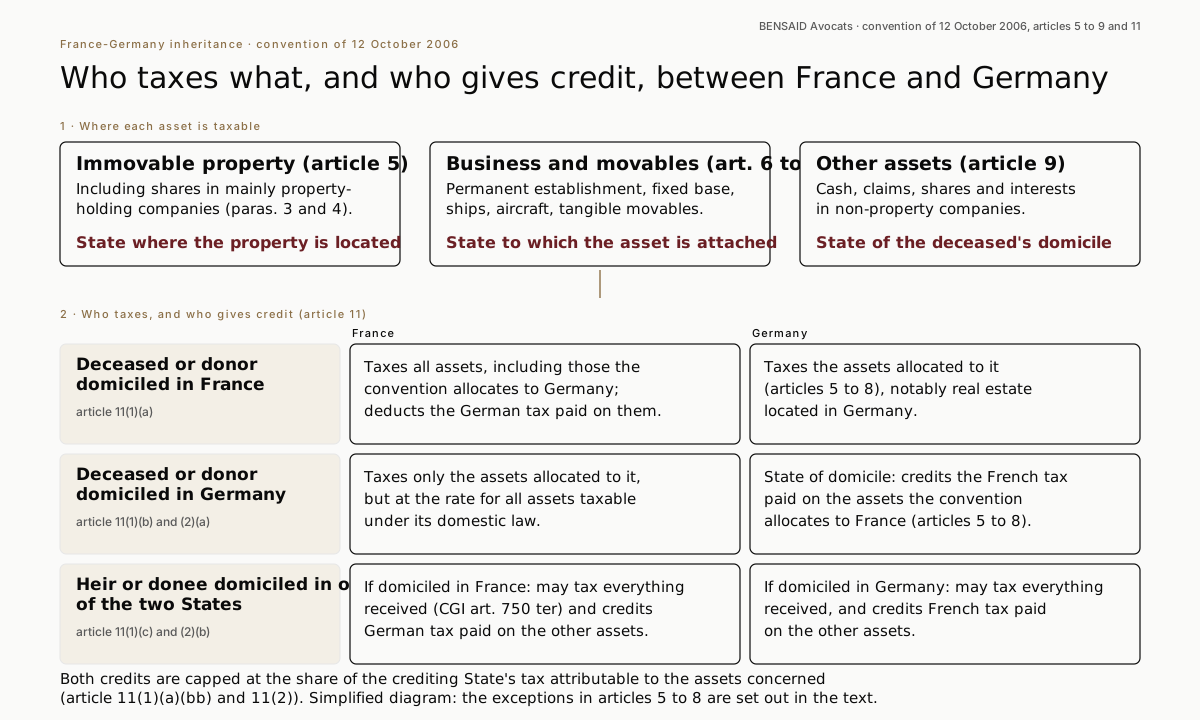
The treaty of 12 October 2006 applies to estates of persons who died, and gifts made, on or after 3 April 2009, where the deceased or donor was domiciled in France, in Germany or in both. Immovable property, including shares in real estate rich companies, is taxable in the State where it is located; assets of a permanent establishment, in the State of the establishment; tangible movables, where they are situated. In principle, bank accounts, receivables, securities and shares in non-real estate companies fall to the State of domicile of the deceased or donor (Articles 5 to 9).
The treaty nevertheless reserves to each State the right to tax all assets received by an heir or donee domiciled there, crediting the tax paid in the other State (Article 11). On the French side, German tax is credited up to the French tax on the same assets.
France-Germany treaty of 12 October 2006 on inheritance and gift taxes, Articles 1, 5 to 9 and 11, and Article 19 for entry into force, text published on impots.gouv.fr.
Debts (Article 10). Debts incurred to acquire, build, convert, repair or maintain immovable property are deducted from the value of that property; those of a permanent establishment or fixed base, from their value; those relating to ships, boats and aircraft or to tangible movables, from the value of those assets; other debts, from the Article 9 assets. If a debt exceeds the value of the assets against which it is set, the balance is deducted from other assets taxable in the same State, then from those taxable in the other State.
Deceased domiciled in France (Article 11(1)(a)). France taxes all assets, including those the treaty allocates to Germany, and deducts the German tax paid on the latter. The deduction is capped at the share of French tax attributable to those assets, computed at the average rate of the estate where the scale is progressive.
Deceased domiciled in Germany (Article 11(1)(b)). France taxes only the assets the treaty allocates to it, mainly property and real estate companies located in France, but at the rate corresponding to all the assets it could tax under its domestic law.
Heir or donee domiciled in France (Article 11(1)(c)). Even where the deceased was domiciled in Germany, France may tax all the assets received by that heir, in accordance with Article 750 ter of the French Tax Code, which targets heirs domiciled in France for at least six of the previous ten years. It then credits the German tax paid on those assets, except on those it already taxes as the State of location. Germany applies a similar mechanism to heirs domiciled there (Article 11(2)(b)), with its own credit cap and a specific rule for property held by controlled companies.
Mutual agreement (Article 13). In case of taxation not in accordance with the treaty, the competent authority of either State may be approached within three years of the first notification of the measure at issue. After 24 months without agreement, the two administrations may agree to arbitration (Article 14).
The 2006 treaty is one of the few recent French treaties on inheritance, and one of the few that also covers gifts, like the 1978 France-US treaty. It deals with property held through companies, the deduction of debts and the domicile of temporary expatriates.
The mechanism is credit. Where the deceased is domiciled in France, or an heir is domiciled there, France taxes and credits the German tax; Germany does the same for its residents. In practice, the family often bears the higher of the two taxes. In simple cases in the direct line, French duties, with a €100,000 allowance per child, frequently exceed German tax, with a €400,000 allowance, but the result depends on prior gifts, each country's own exemptions and the value retained: that is where planning comes in.
Domiciled in France, they pass on all their assets under French duties, including their accounts and securities in Germany.
Their property in France remains taxable in France; their French accounts and securities fall to Germany, except for an heir domiciled in France for at least six of the previous ten years.
A child domiciled in Germany who inherits from a parent domiciled in France is also taxable in Germany on what they receive.
An assignment of a few years does not necessarily move the domicile for estate purposes: the treaty contains a five-out-of-seven-years rule.
The three situations of Article 11 of the 2006 convention, read with the allocation of assets in Articles 5 to 9.
Yes, for the house: immovable property is taxable in the State where it is located (Article 5). France applies the rate corresponding to all the assets it could tax. Germany, as State of domicile, taxes the whole estate and credits the French duties paid on the house.
In principle, no. Shares in a company whose assets consist of more than half of property located in France are treated as immovable property located in France, including through intermediate companies (Article 5(3)). And where the family holds more than half of the company, the property is deemed part of the estate (Article 5(4)). As a rule, the SCI therefore does not move taxation out of France; only property used in the company's own business is left out of the calculation.
Yes, if you were domiciled in France for at least six of the ten years preceding the inheritance: France may then tax everything you receive (Article 11(1)(c) and Article 750 ter of the Tax Code). It credits the German tax paid on those assets. As French duties are often higher, a balance may remain payable in France.
Yes, unlike most French inheritance treaties. A gift made by a person domiciled in France or Germany follows, for the most part, the same allocation and credit rules as an estate; a few rules, such as the one on movables in transit, apply only to estates. The look-back period differs: fifteen years in France, ten years in Germany.
Probably both, and the treaty decides. As a German national who left no more than five years ago without a home in Germany, you are still regarded as domiciled there (protocol, point 2). If you no longer have a home in Germany and were domiciled in France for less than five years out of seven with the clear intention of not staying, Article 4(3) allocates you to Germany; otherwise, the permanent home and vital interests tests apply. Your property in France remains taxable in France in all cases.
They are allocated. A loan that financed a property is deducted from that property in the State where it is located; other debts are deducted from the assets taxable in the State of domicile; any unabsorbed excess passes from one State to the other (Article 10).
No. It covers taxes on income and wealth, as well as the former business and land taxes; inheritance and gifts are governed by the 2006 treaty, which refers to it only for non-discrimination. We cover it on our France-Germany tax treaty page.









The tax treaty atlas: text, articles and amendments, with the country preselected.
Voir la page GuideThe 1959 treaty and the 2015 protocol: cross-border workers, pensions, dividends.
Voir la page GuideLife insurance in a transmission across several countries.
Voir la page PracticeFrench-source income, withholding taxes, filing obligations.
Voir la pageConfidential first conversation. The firm reviews the French side and the application of the 2006 treaty, working with the German notary and Steuerberater.
© BENSAID Avocats. The information on this site does not constitute legal advice. Sources: France-Germany treaty of 12 October 2006 on inheritance and gift taxes and its protocol, published on impots.gouv.fr; BOI-INT-CVB-DEU-20; French Tax Code, Articles 750 ter, 777 and 779.
No slot suits you? Describe your situation and the firm will call you back.