If the shares do not come from a contribution-disposal
The bill changes nothing for your transfer. The Dutreil pact continues to apply under the current conditions, resulting from the reform of early 2026.

The 2027 finance bill leaves the Dutreil pact untouched. It targets instead a mechanism often combined with family successions: the deferred capital gain on a contribution of shares to a holding company, from which the donor is currently exempt when giving the holding's shares, and which is wiped out on death. If the bill is passed as drafted, that gain would become taxable on the transfer, for all transfers made from 1 October 2026.
No. The 2027 finance bill, filed on 1 October 2026, does not amend article 787 B of the French Tax Code (CGI): the 75% exemption on the value of shares transferred under a Dutreil pact is kept, and the Government restates its commitment to preserve the regime. The firm set out the issue in its op-ed published by Le Monde on 15 September 2026 (in French).
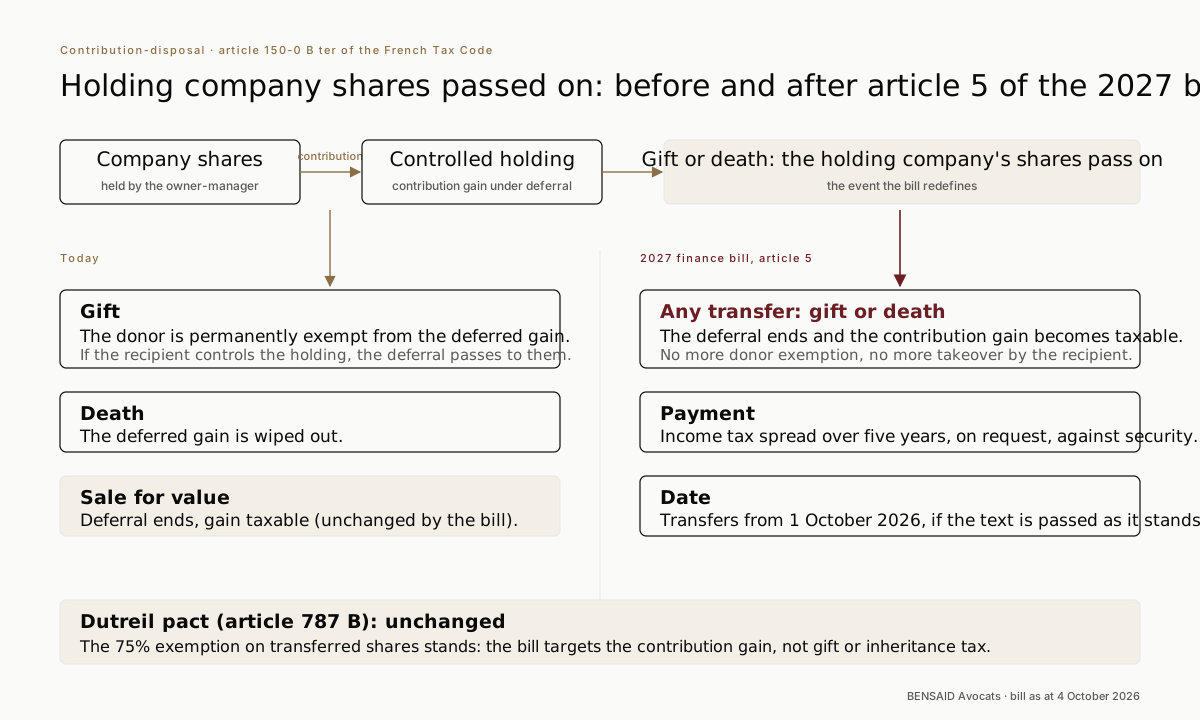
What changes is contribution-disposal (article 150-0 B ter CGI). Today, a gift of holding company shares received in exchange for a contribution permanently exempts the donor from the deferred gain on the shares given; if the recipient controls the holding, they take over the deferral. On death, the gain is also exempt. Article 5 of the bill ends this mechanism: any transfer, by gift or on death, would make the deferred gain immediately taxable.
The measure would cover transfers made from 1 October 2026. Payment over five years would be possible, against guarantees. The bill still has to be debated in Parliament before the end of the year.
French finance bill for 2027, no. 3210 (National Assembly, 1 October 2026), article 5; CGI art. 150-0 B ter (Légifrance); BOI-RPPM-PVBMI-30-10-60-30 (BOFiP); CGI art. 787 B and 200 A. Checked on 4 October 2026.
Contribution-disposal means contributing one's shares to a holding company one controls: the capital gain arising on the contribution is not taxed at once but placed under a tax deferral (article 150-0 B ter CGI). Today, the deferral ends when the holding's shares are sold for consideration, or when the holding sells the contributed shares within three years without sufficient reinvestment.
Transfers for no consideration currently enjoy a favourable regime. On a gift, the donor is permanently exempt from the deferred gain on the shares given. If the recipient does not control the holding, that is the end of it. If they do, they take over the deferral in their own name: the gain becomes taxable if they sell the shares within six years (eleven years where funds were used for reinvestment), or if another terminating event occurs, such as a breach of the reinvestment condition or a move abroad. On death, the gain is also exempt. Practitioners call this the "purge" (BOI-RPPM-PVBMI-30-10-60-30).
Article 5 of the bill abolishes this regime. The words "sale for consideration" are replaced by the word "transfer" among the events that end the deferral, including for shares in interposed companies and chains of successive contributions, and paragraph II of article 150-0 B ter, which organised the takeover by the recipient, is repealed. Any transfer of the shares received for the contribution, by gift or on death, would therefore make the deferred gain payable, income tax and social charges. For a contribution made since 2018, income tax is in principle 12.8% (article 200 A, 2 ter, CGI), unless the progressive scale was elected in the year of the contribution. On a gift, the tax is owed by the donor; on death, the payment arrangements remain to be specified.
In return, the bill creates a staggered payment (new article 1681 G CGI): on a request made no later than the payment deadline, the income tax on that gain, and only the income tax (not social charges), may be paid over the following five years, provided the taxpayer is up to date with their tax obligations and provides guarantees. The late-payment surcharge is then capped, for each instalment, at the amount of statutory interest. The plan may be terminated if guarantees become insufficient or an instalment is missed.
The measure would apply to transfers made from 1 October 2026, that is even before the law is passed. The text may still change during the debates, on its scope as on its start date.
The Dutreil pact and contribution-disposal are two separate regimes. The question is simple: do the shares you are about to transfer carry a deferred contribution gain?
The bill changes nothing for your transfer. The Dutreil pact continues to apply under the current conditions, resulting from the reform of early 2026.
This is the usual pattern: contribution of the operating company's shares to a family holding, then a gift of the holding's shares under a Dutreil pact. Where the holding meets the pact's conditions (notably as an active holding company), the Dutreil pact reduces gift duties, but it has no effect on the tax due on the contribution gain: if the bill is passed, the gift would trigger that tax in the donor's name. It should be quantified before signing.
Giving before the end of the year would not avoid the measure: it would cover transfers made from 1 October 2026. The timing of a pact should therefore be decided on the merits of the file, following the bill's progress in Parliament.
The deferred gain is declared in the year of the contribution. The exact amount, the contribution date and the applicable rate appear in the income tax returns and the contribution agreement: these are the documents needed to measure what is at stake.
The firm advises families and business owners on preparing Dutreil pacts and transfers of holding companies: identifying deferred gains, quantifying the tax on transfer under current law and under the bill, choosing the timing.
We are following the parliamentary debates on article 5 and will update this page at each stage, until the finance law is passed.
The same path, shares contributed to a holding company and then passed on, read under the current rules and under the bill.
No. The 2027 finance bill does not amend article 787 B CGI. The 75% exemption on the value of the shares and the holding commitments remain those resulting from the reform in force since February 2026.
It is the permanent exemption of the gain deferred on a contribution to a holding company, when the holding's shares are transferred for no consideration. Today, the donor is permanently exempt on the shares given, and the gain is also exempt on death. Only a recipient who controls the holding takes over the deferral, taxable if they sell the shares within six years (eleven years where funds were used for reinvestment) or on another terminating event. The 2027 finance bill abolishes this mechanism.
Only if the shares transferred were received in exchange for a contribution under a tax deferral (article 150-0 B ter). In that case, if the bill is passed as drafted, the gift would make the contribution gain taxable in the donor's name, on top of gift duties, reduced by the pact where the holding meets its conditions. Otherwise, nothing changes.
No, not for this reason: the measure would cover transfers made from 1 October 2026. A gift made before the end of the year would therefore be caught, if the bill is passed with that date; only transfers made before 1 October 2026 are outside its scope.
In part, according to the bill: on a request made no later than the payment deadline, the income tax on the gain whose deferral ends on the transfer may be paid over five years; social charges are not covered. The taxpayer must be up to date with their tax obligations and provide guarantees; the late-payment surcharge is then capped, for each instalment, at the amount of statutory interest.









Mechanism, reinvestment condition and abuse-of-law risk.
Voir la page Holding companiesThe condition that often decides whether a holding qualifies for the Dutreil pact.
Voir la page Family buy-outVariants of the structure, including a holding company funded by a contribution-disposal, and the 2027 budget.
Voir la page Estate planningGifts, successions and family business transfers.
Voir la page© BENSAID Avocats — The information on this site does not constitute legal advice and cannot replace a personalised tax analysis. It concerns a bill under discussion, which may be amended before it is passed. Status: French finance bill for 2027 filed on 1 October 2026; page checked on 4 October 2026.
No slot suits you? Describe your situation and the firm will call you back.