Venice treaty of 5 October 1989 · in force since 1992

France-Italy tax treaty: residence, pensions and the tax credit

The 1989 treaty determines which State taxes each item of income between France and Italy, and how double taxation is relieved. Several of its clauses depart from the usual model: social security pensions taxable in both countries, 25% shareholdings taxable in the company's State, a dedicated regime for cross-border workers.

Paris · Geneva · Marseille · Cannes · Lisbon

How does the France-Italy tax treaty prevent double taxation?

The treaty signed in Venice on 5 October 1989, applicable to income from 1992, first determines the State of residence (Article 4), then allocates to each State the right to tax each category of income. For a French resident, Italian-source income taxable in Italy is also included in the French tax base, and France grants a tax credit (Article 24).

The credit takes two forms. For dividends, interest, royalties, directors' fees, artistes' income and the gains referred to in point 8 of the protocol, it equals the Italian tax, capped at the French tax. For other income (salaries, pensions, rents, business profits), it equals the corresponding French tax: the Italian income is not taxed a second time, but it counts towards the rate applied to other income.

The tax authority most often challenges two points: residence, notably of someone who moves to Italy (Article 4), and how a pension is taxed, private, social security and public pensions following three different rules (Articles 18 and 19). A diagram below sets them side by side.

France-Italy tax treaty of 5 October 1989, Articles 4 and 24, and protocol, text published on impots.gouv.fr.

— In brief
Text
Treaty of 5 October 1989 and its protocol, in force on 1 May 1992
Taxes covered
Income tax, corporate tax, CSG and CRDS; IRPEF, IRES and IRAP on the Italian side
Method
Tax credit, set against French tax
Frequent disputes
Residence (Article 4) and pensions (Articles 18 and 19)
Watch point
Mutual agreement procedure to be requested within six months of the second taxation
— The treaty, article by article

The rules that come up in our files

  • Residence (Article 4). France first applies its domestic criteria, notably Article 4 B of the French tax code. The treaty then decides only if the person is regarded as resident of both France and Italy under domestic law and Article 4, paragraph 1, of the treaty; they are then attached, in order, to the State of their permanent home, then their centre of vital interests, habitual abode and nationality; failing that, the two administrations settle the question by mutual agreement. The Italian Article 24-bis option is a relevant factual element but does not, on its own, bind the French authority or court. The Conseil d'État held that being subject to tax in Italy solely on account of an Italian pension does not make a person an Italian resident (CE 24 May 2006, no. 280942).
  • Taxes covered (Article 2). By an exchange of letters of 7 and 28 July 1998, France and Italy confirmed that the treaty covers, on the French side, CSG, CRDS and the surtaxes on corporate tax, and on the Italian side IRAP. The exceptional contribution on high incomes (CEHR) has been held to be analogous to income tax, and therefore covered. Coverage does not mean exemption: the Montreuil administrative court had relieved an Italian resident of the contribution on French dividends (19 September 2024, no. 2215513); the Paris administrative court of appeal set that judgment aside, holding that Article 10 does not restrict the method of collection and allows France to tax under its own law, including by assessment (8 July 2026, no. 24PA05224).
  • Dividends (Article 10). The State of the paying company may withhold at most 15% of the gross amount, or 5% where the beneficial owner is a company subject to corporate tax that has held at least 10% of the capital for at least twelve months before the distribution decision.
  • Interest and royalties (Articles 11 and 12). Withholding capped at 10% on interest, with exemptions (credit sales of equipment or goods, public-sector interest, interbank loans to the extent provided in the protocol). Royalties are capped at 5%, and copyright royalties on literary, artistic or scientific works are exempt at source, except software, films and recordings.
  • Real-estate gains (Article 13 and protocol, point 8 a). Taxable in the State where the property is located. The same applies to gains on shares of companies owning real estate in that State, where its law treats them as real-estate gains; property used by the company for its own industrial, commercial, agricultural or professional activity is disregarded.
  • Substantial shareholdings (protocol, point 8 b). A rare clause: gains on the sale of a holding giving, alone or with related persons, a right to at least 25% of the profits of a company resident in one State are taxable in that State, under its domestic law. The treaty therefore leaves France free to tax, under its domestic law, an Italian resident's sale of such a stake in a French company. Other gains on shares are taxable only in the seller's State of residence.
  • Salaries (Article 15). Taxable where the employment is exercised, unless a short assignment meets three cumulative conditions: no more than 183 days in total in the tax year, an employer not resident in the State of work, and remuneration not borne by a permanent establishment there. Days are counted on a physical presence basis, including weekends and holidays spent there.
  • Cross-border workers (Article 15, paragraph 4). Employees who live in the frontier zone of one State and work in the frontier zone of the other are taxable only in their State of residence. The zones are, in France, Haute-Savoie, Savoie, Hautes-Alpes, Alpes-de-Haute-Provence, Alpes-Maritimes and Corse-du-Sud; in Italy, Aosta Valley, Piedmont, Liguria and Sardinia. The French administration requires a normally daily return home, and the status is evidenced to the administration of the State of work, in particular by an employer certificate and a certificate from the tax office of the place of residence.
  • Directors (Article 16). Directors' and board members' remuneration is taxable in the State of residence of the company, without exclusivity: the director's State of residence may also tax it and must then relieve double taxation. The pay of an Italian-resident manager of a French SARL is thus taxable in France, whatever their shareholding.
— Before the courts

Three decisions on residence, pensions and dividends

Between France and Italy, the tax authority challenges the residence of the person who leaves, and how an Italian pension enters French tax. These decisions set the method. Estates, which fall under a separate treaty, have their own decision on the page France-Italy estates.

  • An Italian retiree living in France remains a French resident. An Italian national whose main home is in France and who does not show that his centre of vital interests is in Italy is a French resident, even if the Italian State pays him a pension taxable in Italy. That pension, which Article 19, paragraph 2, reserves to Italy when it is public, still enters French taxable income, with a credit equal to the corresponding French tax: a court that left it out of the base commits an error of law (CE, 24 May 2006, no. 280942).
  • An athlete's departure does not by itself make him resident in Italy. A professional footballer who receives fees from French sources, holds shares in French companies and in real estate investment companies and shows no assets in Italy, while owning many properties in France, kept his centre of vital interests, hence his tax residence, in France, despite much larger Italian income (CAA Lyon, 26 October 2006, no. 01LY02689).
  • Dividends paid to an Italian resident remain taxable in France. Article 10 does not limit how the tax is collected: France may tax by assessment roll the dividends that a French company pays to an Italian resident, as it does for a French resident (CAA Paris, 8 July 2026, no. 24PA05224, which sets aside the Montreuil administrative court judgment of 19 September 2024).
— Pensions: three different regimes

The same pension is not taxed in the same place depending on its origin

Private pensions (Article 18, paragraph 1). Pensions paid in respect of past private-sector employment, other than social security, are taxable only in the recipient's State of residence.

Social security pensions (Article 18, paragraph 2). The treaty allocates their taxation to the State whose social security legislation applies, without removing the right of the State of residence to tax them under its domestic law, double taxation then being relieved under Article 24. The French government confirmed that social security pensions for past private employment are taxable in both France and Italy (ministerial answer Meyer, National Assembly, 10 January 2023, no. 3879). For a French resident, an INPS pension is therefore taxed in Italy and reported in France, which grants a credit equal to the corresponding French tax. On the French side, the general scheme, special schemes and mandatory Agirc-Arrco supplementary schemes are covered; the list was settled by an exchange of letters of 20 December 2000.

Public pensions (Article 19, paragraph 2). Paid for services rendered to a State or public authority, they are taxable only in that State, unless the recipient is resident in the other State and a national of it without being a national of the paying State. Even when taxable only in Italy, an Italian public pension received by a French resident is included in French taxable income, with a credit equal to the corresponding French tax: it counts towards the rate (CE 24 May 2006).

— Moving to Italy: the Article 24-bis regime

The Italian option does not settle the residence question in France

Article 24-bis of the TUIR allows a person who was not an Italian tax resident for at least nine of the previous ten tax periods to replace Italian tax on foreign-source income with an annual substitute tax. For persons who transfer their tax residence to Italy on or after 1 January 2026, the substitute tax is EUR 300,000 a year; for transfers made after Decree-Law no. 113/2024 entered into force, on 10 August 2024, and before 1 January 2026, it was EUR 200,000 a year. Certain gains on qualifying shareholdings realised in the first five periods remain under the ordinary regime; the regime is revocable and lasts for at most fifteen periods. We detail the regime on our page Italian lump-sum regime.

For France, the option has no effect in itself. The departure is enforceable against the French tax authority only if the taxpayer ceases to be a French resident under Article 4 B of the French tax code and, if still resident in both States, under Article 4 of the treaty: permanent home, centre of vital interests, habitual abode, nationality. The court looks at the facts, and a taxpayer whose Italian income is much larger can remain a French resident (CAA Lyon, 26 October 2006, no. 01LY02689).

If residence in Italy is established, the treaty keeps applying: France retains the right to tax the French-source income it allocates to France, such as income from real estate located in France or dividends, within the Article 10 withholding limit. The French exit tax of Article 167 bis, assessed at departure, is a separate question, covered on our page French exit tax.

— The tax credit in practice

What a French resident's return must show

  • Two separate calculations. For dividends, interest, royalties, directors' fees, artistes' income and the gains in point 8 of the protocol, the credit equals the Italian tax actually paid under the treaty, capped at the corresponding French tax; any excess is neither carried forward nor refunded. For other income, the credit equals the corresponding French tax.
  • Income that genuinely falls within Italian tax. The credit equal to French tax is due whatever the amount of Italian tax, but the income must be taxable in Italy under Italian law. The Paris administrative court refused the credit to a seconded employee who could not show that their salary had been subject to tax in Italy (TA Paris, 4 November 2009, no. 05-13465): keep evidence of the Italian treatment.
  • No additional effective-rate rule. The Article 24 mechanism stands in for the effective-rate rule; the Douai administrative court of appeal held that it excludes Article 197 C of the French tax code (CAA Douai, 6 April 2004, no. 99DA01494).
  • Italian losses do not count. Only positive income is taken into account for the French computation.
  • No double exemption (protocol, point 15). An exemption provided by the treaty applies only if and to the extent that the income is taxable in the other State under its law.
  • Mutual agreement procedure (Article 26). In case of double taxation, the request is made by simple letter to the administration of the State of residence, within six months of the notification or withholding of the second tax.
— What to understand

A 1989 treaty with unusual clauses

The 1989 treaty has never been thoroughly renegotiated. It keeps rules that more recent treaties have dropped, and that is often where a case is decided: an Italian social security pension received in France, the sale of a stake in an Italian company, an employee who crosses the border every day.

Applying it is also demanding. The French credit requires the income to be taxable in Italy under Italian law, and the mutual agreement procedure, the only route to settle a conflict between the two administrations, must be requested within a six-month window few taxpayers know about.

— Who is concerned

Six situations where the treaty changes the outcome

Italians living in France

French tax residents who often keep property, accounts, a pension or shares in a family company in Italy.

French nationals moving to Italy

A move to Milan, Rome or Tuscany, sometimes under the Article 24-bis lump-sum regime: residence must be established under the treaty.

Retirees between the two countries

Private, social security and public pensions follow three different rules.

Cross-border workers in the Alps and on the Riviera

A special regime applies to employees who live and work in the frontier zones.

Shareholders and investors

Dividends, interest, sales of shareholdings, real-estate rich companies.

Executives and seconded employees

Directors' remuneration, short assignments, the 183-day rule.

— Diagram

Where a pension is taxed, depending on its origin

Private, social security or public pension: the applicable provision, the State that taxes and the role of the other State.
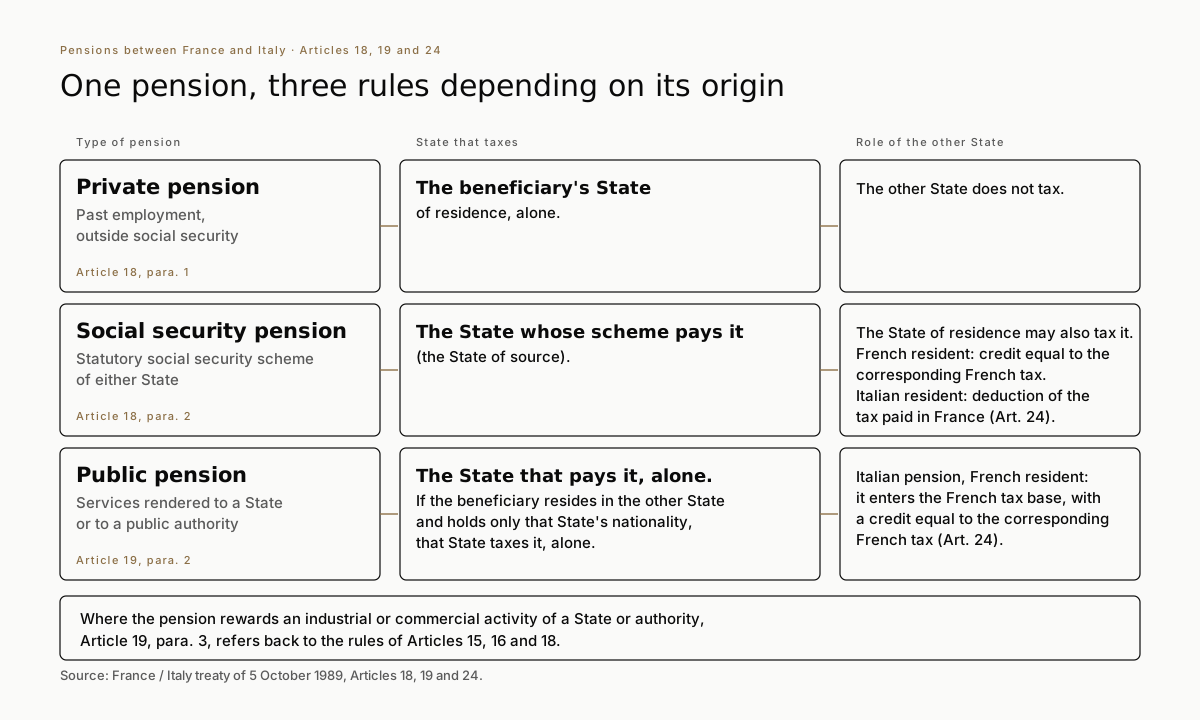
Diagram of pensions between France and Italy: a private pension is taxable only in the State of residence (Article 18, paragraph 1); a social security pension in the State whose scheme pays it, the State of residence also being able to tax it with double taxation relieved under Article 24 (Article 18, paragraph 2); a public pension only in the State that pays it, unless the recipient resides in the other State and holds only its nationality (Article 19, paragraph 2).
The three pension regimes of the treaty of 5 October 1989. An Italian public pension received by a French resident enters the French base, with a credit equal to the corresponding French tax (Article 24; CE, 24 May 2006). If the pension rewards an industrial or commercial activity of a State, Article 19, paragraph 3, refers back to Articles 15, 16 and 18.
— Frequently asked questions

What we are asked about the France-Italy treaty

I live in France and receive an INPS pension: where am I taxed?

In both countries. An Italian social security pension is taxable in Italy under Article 18, paragraph 2, and France, as State of residence, includes it in your taxable income. It grants a credit equal to the French tax on that pension: you do not pay twice, but the pension raises the rate applied to your other income.

Does my supplementary pension from a private Italian employer follow the same rule?

Not necessarily. A private pension paid for past employment, other than social security, is taxable only in the State of residence, so in France if you live there. It all depends on how the paying scheme qualifies, which must be checked on the documents.

I live in the Alpes-Maritimes and work in Monaco or Italy: am I a cross-border worker?

The treaty's cross-border regime covers employees who live in the frontier zone of one State and work in the frontier zone of the other, normally returning home every day. Living in the Alpes-Maritimes and working in Liguria or Piedmont may qualify; Monaco falls under a different treaty, covered on our page on the France-Monaco tax treaty.

I am a French resident selling my shares in an Italian family company: who taxes the gain?

If you hold, alone or with related persons, a stake giving a right to at least 25% of the company's profits, point 8 b of the protocol allows Italy to tax the gain under its domestic law; France also taxes it and grants a credit equal to the Italian tax paid under the treaty, capped at the French tax. Below that threshold, and outside real-estate rich companies, only France taxes.

Is CSG due on my Italian income?

CSG and CRDS have been taxes covered by the treaty since the 1998 exchange of letters, which allows its allocation and credit rules to be invoked. Their treatment nevertheless depends on the income, its base and your State of residence, and a separate question arises: your affiliation to a social security scheme under EU rules. The analysis is made item by item.

Does the treaty cover estates?

No: estates and gifts are governed by a separate treaty of 20 December 1990. See our page on France-Italy estates.


Cité par

A situation between France and Italy to secure?

Confidential first conversation. The firm handles the French side and the application of the treaty, working with your commercialista or Italian adviser.