British nationals living in France
Retirees in the Dordogne, Provence or Paris receiving a UK State Pension or an occupational pension.

The 2008 treaty determines which State taxes each item of income between France and the United Kingdom, and how double taxation is relieved. Brexit did not amend it, but the UK reform of 6 April 2025 abolished the remittance basis that its Article 29 was written for, and EU rules now apply only through the exit agreements.
The treaty signed in London on 19 June 2008, applicable from 2010, first determines the State of residence (Article 4), then allocates to each State the right to tax each category of income. Interest, royalties, private pensions and most gains on shares are taxable only in the State of residence; income from immovable property and gains on it may also be taxed in the State where the property is located.
For a French resident, UK income is included in the French tax base and France grants a tax credit (Article 24). For dividends, gains on property, directors' fees and artistes' income in particular, the credit equals the UK tax paid, capped at the French tax; for other income, it equals the corresponding French tax, so that the UK income only counts towards the rate.
France-UK tax treaty of 19 June 2008, Articles 4, 6, 11 to 14, 18 and 24, consolidated version with the multilateral convention published on impots.gouv.fr.
A treaty is read together with the decisions that have applied it. The first four were rendered under the 1968 treaty, whose Article 3, paragraph 1, is worded much like Article 4, paragraph 1, of the 2008 treaty; the last concerns the 2008 treaty. The decisions are in French.
Until 5 April 2025. A UK resident who was not domiciled in the UK could claim the remittance basis: foreign income and gains were taxed in the UK only when remitted. The French Conseil d'État held that this claim does not cause the loss of treaty residence, the court seeing it not as an exemption but as taxation deferred until remittance (CE, 27 July 2012, nos. 337656 and 337810, decided under the 1968 treaty). To avoid double non-taxation, Article 29 limits the treaty benefit granted by France to the portion of income actually taxed in the UK. The limitation does not apply to business profits (Article 7) or dividends (Article 11); it targets in particular French-source interest, royalties, capital gains on securities and pensions.
Since 6 April 2025. The remittance basis has been abolished: every UK resident is in principle taxed on worldwide income and gains as they arise. New arrivals who have not been UK resident for at least ten consecutive tax years may, during their first four years of residence, claim exemption from UK tax on their eligible foreign income and gains, whether remitted or not; a claim forfeits the income tax personal allowance and the capital gains tax annual exempt amount. Income and gains that arose before 6 April 2025 under the remittance basis remain taxable if remitted; a temporary facility allows them to be designated at 12% for 2025-26 and 2026-27, then 15% for 2027-28.
The treaty after the reform. The treaty has not been amended. Article 29 still applies to amounts that arose under the remittance basis. How the new four-year exemption interacts with the treaty, whether under the residence definition in Article 4 or the purpose of Article 29, has not, to our knowledge, been addressed by the French tax authorities. Article 29 targets taxation limited to amounts remitted, which the new exemption is not, but the question remains open for French income exempted in the UK on that basis. In practice, the French paying agent may require a certificate from HMRC, and a refund of tax withheld at the domestic rate must be claimed within the time limit specific to withholding taxes, to be checked case by case.
The former ISF and the IFI. Article 29, paragraph 3, exempted from the French wealth tax (ISF) for five years the assets located outside France of a British national who became French resident. The ISF was replaced in 2018 by the real estate wealth tax (IFI), and Article 964 of the French tax code itself provides that a person who was not domiciled in France during the five preceding calendar years is taxed only on French real estate assets until 31 December of the fifth year following arrival.
A UK resident sells a flat in France. France taxes the gain (Article 14, paragraph 1) by a 19% levy (Article 244 bis A of the French tax code), after taper relief for the holding period, and the UK, as State of residence, relieves double taxation. As the UK is outside the European Union, an accredited French tax representative is in principle required, subject to exemptions, notably where the price does not exceed €150,000. French social levies are added. Since Brexit, the exemption from CSG and CRDS no longer flows from the EU coordination regulation; it is maintained by the Withdrawal Agreement and the Trade and Cooperation Agreement for persons affiliated to UK social security, who are nationals or lawful residents of France, the UK or an EU State, and not affiliated to a compulsory French scheme. They pay only the 7.5% solidarity levy; otherwise the rate is 17.2%, the rate that still applies to real estate gains.
Worked example. Gross gain of €60,000 on a property held for ten years. Income tax taper: 5 × 6% = 30%, a base of €42,000 and tax of €7,980. Social levy taper: 5 × 1.65% = 8.25%, a base of €55,050: €4,128.75 at 7.5%, €9,468.60 at 17.2%. Meeting the affiliation conditions is worth €5,339.85 here; a UK resident who wrongly paid 17.2% may claim a refund within the time limit for claims.
A French resident sells a property in the UK. Non-residents have been liable to capital gains tax on UK residential property since 6 April 2015, and on all other UK land and indirect disposals since 6 April 2019; the disposal must be reported to HMRC within 60 days, even where no tax is due. France also taxes the gain under its real estate gains rules, and grants a credit equal to the UK tax, capped at the corresponding French tax (Article 24, paragraph 3).
The 2008 treaty replaced the 1968 treaty and largely follows the OECD model: interest, royalties and private pensions taxed only in the State of residence, a capped withholding tax on dividends, a tax credit to relieve double taxation. It was supplemented by the BEPS multilateral convention, in force for France on 1 January 2019, which adds a general anti-abuse clause and allows the mutual agreement procedure to be opened with either State.
Since 1 January 2021, the United Kingdom has been a third State: French regimes reserved for the European Union no longer apply, unless maintained by the exit agreements. Since 6 April 2025, the United Kingdom no longer uses domicile as a basis of taxation. Article 29 of the treaty, written for the remittance basis, now applies to a regime that only survives for past years.
Retirees in the Dordogne, Provence or Paris receiving a UK State Pension or an occupational pension.
Employees, executives and entrepreneurs, sometimes eligible for the UK four-year regime for new arrivals.
Rents and gains taxable in the State where the property is located, then in the State of residence with a tax credit.
Salary taxable where the work is physically performed, unless a short assignment meets three conditions.
Unremitted pre-6 April 2025 income and gains, the temporary repatriation facility, interaction with Article 29.
Dividends, interest, property-rich companies, trusts and partnerships.
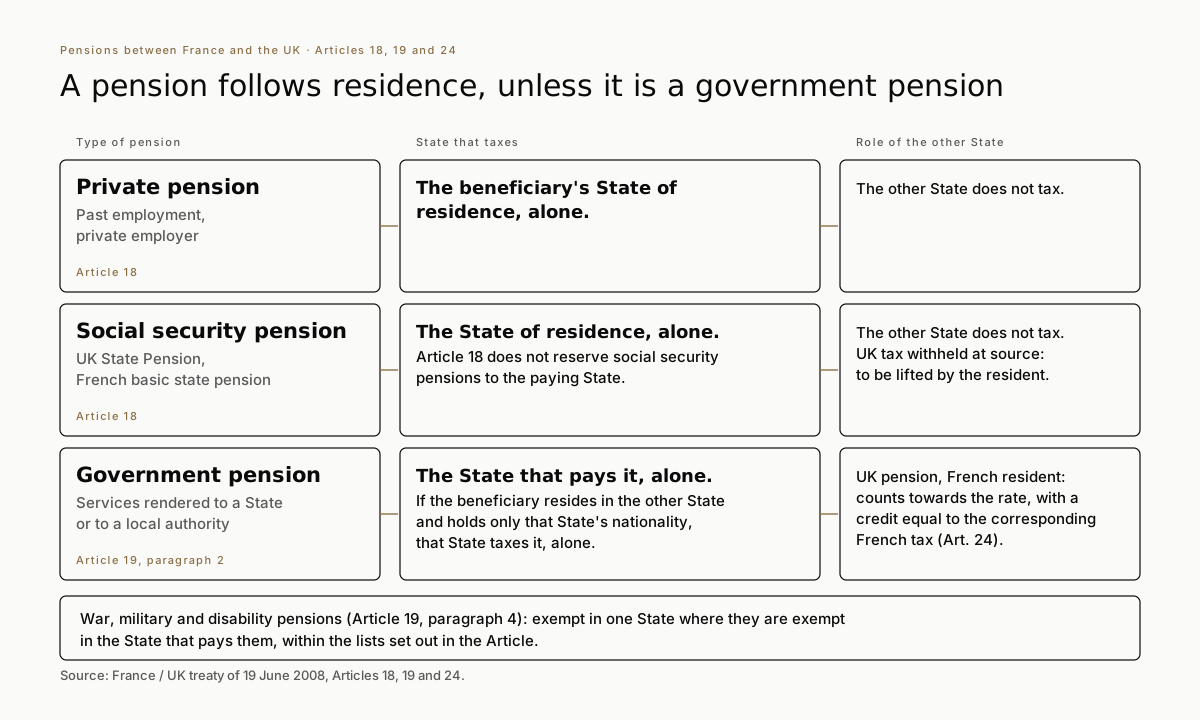
The three categories of pension met by a resident of France or of the United Kingdom, and the State that taxes each.
No. The treaty of 19 June 2008, modified by the BEPS multilateral convention, covers income tax and capital gains. Estates fall under a separate convention of 21 June 1963, which we cover on our page France-UK estate tax. No treaty covers gifts.
In France only. Article 18 reserves pensions paid for past employment, including social security pensions, to the State of residence. If HMRC withholds tax, form France-Individual allows you to stop it or claim it back. Only a government pension, for a former civil servant for instance, follows a different rule (Article 19).
France, for the days worked in France, since you reside and work there. Days physically worked in the UK are taxable there, because the 183-day exception does not apply when the employer is British; France then counts them towards the rate, with a credit equal to the corresponding French tax. There is no specific France-UK remote working agreement, and social security contributions follow different rules.
It still applies, but Article 29 limits the benefit France grants on French-source interest, royalties, gains and pensions to the portion taxed in the UK. For years up to 5 April 2025, the question was whether the income was remitted; since then, the remittance basis has been abolished and the four-year exemption for new arrivals raises a question the French authorities have not yet settled. A year-by-year analysis is needed.
The rent is taxable in France (Article 6), under the progressive scale with the minimum rate for non-residents set by Article 197 A of the French tax code, unless the average rate computed on your worldwide income is lower. French social levies are 7.5% if you meet the UK social security affiliation conditions, and 17.2% otherwise. The UK also taxes the rent and gives credit for the French tax.
It can in two cases. The exit tax of Article 167 bis of the French tax code applies on departure to unrealised gains on shares if you were domiciled in France for at least six of the previous ten years and your shares exceed €800,000 or represent at least 50% of a company's profits; deferral of payment is automatic or subject to a request with guarantees depending on whether the new State meets the recovery assistance conditions of that article, the UK appears on the list published by the tax authorities for transfers made in 2024, a list to be checked for the year of departure. In addition, Article 14, paragraph 6, of the treaty preserves France's right to tax, within the limits of its domestic law, certain gains of a person who was resident there during the six tax years preceding the disposal. We cover the exit tax on our page exit tax.









The tax treaty atlas: text, articles and amendments, with the country preselected.
Voir la page HubOverview of situations between France and the United Kingdom.
Voir la page GuideThe 1963 convention, situs of assets and the tax credit.
Voir la page GuideReporting obligations of a British national resident in France.
Voir la pageConfidential first conversation. The firm analyses the French side and the application of the treaty, working with your UK adviser.
© BENSAID Avocats. The information on this site does not constitute legal advice. Sources: France-UK tax treaty of 19 June 2008 and its protocol, consolidated version with the multilateral convention published on impots.gouv.fr; BOI-INT-CVB-GBR-10; HMRC guidance published on gov.uk (6 April 2025 reform, non-resident capital gains on UK property); brexit.gouv.fr (social levies).
No slot suits you? Describe your situation and the firm will call you back.