Cross-border workers from Lorraine
French-resident employees working in Luxembourg: the 34-day threshold of work outside the Grand Duchy decides which State taxes.

The 2018 treaty replaced the 1958 treaty and changed how France treats the Luxembourg income of its residents. It also sets the 34-day threshold for cross-border workers, allocates social security pensions to the paying State and frames Luxembourg holding companies with a general anti-abuse clause.
The treaty signed in Paris on 20 March 2018, in force since 19 August 2019, applies in France to income from 2020 onwards. It determines the State of residence (Article 4), then allocates the right to tax each category of income: salaries in the State where the work is performed, social security pensions in the paying State, interest in the State of residence, real estate and real estate companies in the State where the property is located.
For a French resident, income taxable in Luxembourg remains included in the French tax base, and France grants a tax credit (Article 22, as amended on 10 October 2019). For salaries, pensions and rents, the credit equals the corresponding French tax: the Luxembourg income is not taxed a second time, but it counts towards the rate applied to other income. For dividends, royalties, real estate gains and directors' fees, it equals the Luxembourg tax, capped at the French tax.
France-Luxembourg tax treaty of 20 March 2018, Articles 4 and 22, consolidated version published on impots.gouv.fr; BOI-INT-CVB-LUX-30.
The principle (Article 14). A salary is taxable in the State where the employment is exercised. A French resident employed in Luxembourg is therefore taxed in Luxembourg for days worked in Luxembourg, and in France for days worked in France, including remote work.
The tolerance (protocol, point 3). An employee who, in a given year, physically works in the State of residence or in a third State for no more than 34 days is deemed to have exercised the employment in Luxembourg for the whole year. The threshold, initially 29 days, was raised to 34 days by the amending instrument of 7 November 2022, applicable to tax periods beginning on or after 1 January 2023; it also extends the rule to public sector employees. Published by decree no. 2025-382 of 28 April 2025 (in force since 4 March 2025), the instrument applies to tax periods open from 1 January 2023. Under its Article 4 it remains in force until the end of the year following the year it entered into force: 31 December 2026 is a first expiry date, not an end date, because the instrument is then renewed if no new amending instrument is concluded; the two States were to meet before the end of 2024 to decide what applies from 2025.
The count. Any part of a day worked outside Luxembourg counts as a full day, training included. Leave, weekends, non-working public holidays, sick leave and force majeure do not count. The threshold is reduced pro rata for part-time work or a partial year, rounded down to the whole number of days, and it is assessed globally where several contracts follow one another in the year (mutual agreement between the competent authorities, applied to the 34-day threshold).
Exceeding the threshold. On the 35th day, the tolerance is lost for the whole year. From the first day, France taxes the share of remuneration relating to days worked in France and, subject to the treaties applicable with third States, days worked in those States. Remuneration relating to days worked in Luxembourg remains taken into account in France, with a tax credit equal to the corresponding French tax if it is actually taxed in Luxembourg in accordance with the treaty (BOI-INT-CVB-LUX-20-20210223). Overtime is taxable where it is performed, and sickness or maternity benefits paid by social security fall under Article 17. The burden of proof lies with the employee: employer certificate, time records, travel tickets, assignment orders.
Social security follows other thresholds. Coverage is governed by EU Regulation 883/2004 and the European framework agreement on cross-border telework, with their own thresholds: complying with the 34 tax days does not settle the social security question, and vice versa.
The French tax authorities most often challenge residence, permanent establishment and beneficial ownership. Most of these decisions were made under the 1958 treaty; they inform how the 2018 treaty reads on the same concepts.
Example 1, cross-border worker above 34 days. A Thionville resident employed in Luxembourg earns EUR 66,000 for 220 working days in 2025, including 44 days of remote work from home. The 34-day threshold is exceeded: France taxes, from the first day, the French share of the salary, i.e. 66,000 × 44 / 220 = EUR 13,200. The remaining EUR 52,800, relating to days worked in Luxembourg, remain taken into account in France with, if actually taxed in Luxembourg in accordance with the treaty, a credit equal to the corresponding French tax: they are not taxed a second time, but they raise the rate applied to the EUR 13,200 and to the household's other income. The Luxembourg taxation of the French share must be corrected in parallel.
Example 2, dividend from a Luxembourg company. A French resident receives EUR 10,000 of dividends from a Luxembourg company; Luxembourg withholds 15%, i.e. EUR 1,500. In France, the dividend bears income tax at the flat rate of 12.8%, i.e. EUR 1,280. The credit equal to the Luxembourg tax is capped at this corresponding French tax: EUR 1,280 is credited, and the EUR 220 excess can be neither carried forward nor refunded. The calculation covers income tax only: the treatment of social levies depends on the recipient's situation, in particular social security coverage.
Example 3, CNAP pensioner. A former cross-border worker, resident in France, receives a Luxembourg social security pension of EUR 18,000 a year. It is taxable only in Luxembourg (Article 17, paragraph 2), but it appears on the French return with a credit equal to the corresponding French tax: it bears no French tax, but it raises the rate applied to the French pension.
The 1958 treaty simply exempted most Luxembourg income of French residents. The 2018 treaty brings it back into the French tax base with a tax credit. For income received from 2020 to 2023, the French tax authorities allowed income previously exempt (salaries, public remuneration, social security pensions, rents) to remain under the former exemption method; published guidance does not extend this concession beyond income received up to 31 December 2023 (BOI-INT-CVB-LUX-30, § 5).
The treaty also incorporates the OECD measures against base erosion: a principal purpose test (Article 28), the beneficial ownership requirement, a broader permanent establishment definition, and an express reservation of French anti-abuse rules (Articles 123 bis, 155 A, 209 B and 238 A of the French tax code, among others). A Luxembourg holding company without substance no longer secures treaty benefits.
French-resident employees working in Luxembourg: the 34-day threshold of work outside the Grand Duchy decides which State taxes.
Luxembourg social security pension, French pension, public pensions: three different rules.
SOPARFI, SPF, dividends from French subsidiaries: beneficial ownership, substance and anti-abuse clause.
French property held by a Luxembourg company, or the reverse: rents, gains and shares in property-rich companies.
Directors' fees and executive salaries, with the risk of a place of effective management located in France.
Leaving France, selling a 25% shareholding within five years, assets left in France and the real estate wealth tax.
A French resident employed in Luxembourg: the salary follows the 34-day threshold of work outside the Grand Duchy.
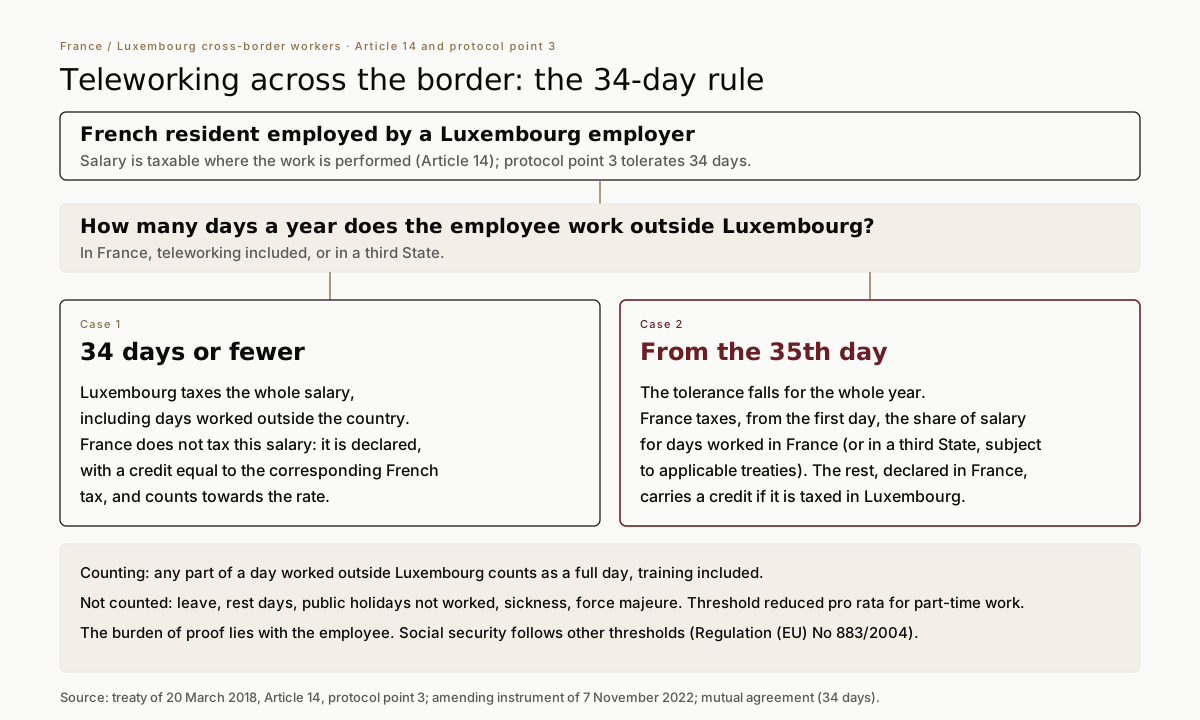
34 days a year, from 2023 income (amending instrument of 7 November 2022). These are days of actual work outside Luxembourg, in France or in a third State; any part of a day counts as a day, while leave and sick days do not. Beyond that, France taxes from the first day the remuneration relating to days worked in France (and, subject to applicable treaties, in third States); remuneration for days worked in Luxembourg carries a tax credit if it is actually taxed there.
The salary taxable in Luxembourg is reported in France, which grants a credit equal to the corresponding French tax: it is not taxed a second time, but it counts towards the rate applied to the household's other income. The concession that allowed the former exemption method covers, according to published guidance, only income received up to 2023.
The Luxembourg social security pension (CNAP) is taxable only in Luxembourg; you report it in France for rate purposes, with no French tax on that pension. An occupational pension paid for past employment is taxable only in France, your State of residence. A Luxembourg public pension remains taxable in Luxembourg, unless you hold only French nationality.
It can receive dividends from a French subsidiary held at 5% or more for 365 days without withholding tax, if it is their beneficial owner and if the arrangement does not have that benefit as a principal purpose (Article 28). It does not shield a French-resident shareholder: French rules (Articles 123 bis and 209 B, then the wealth holding company tax for financial years ending on or after 31 December 2026) still apply, and a company managed from France is resident in France.
Yes. The gain on property located in France is taxable in France (Article 13, paragraph 1), under the rules for non-residents; Luxembourg exempts it, applying the progression rule where relevant. The same applies to the sale of shares in a company deriving more than 50% of its value from French property.
No. There is no France-Luxembourg treaty on inheritance and gift tax: each State applies its own law, as explained on our page on France-Luxembourg estate tax. A Luxembourg life insurance policy is subject, on payout, to French rules determined by the domicile of the insured and the beneficiaries; see our analysis of CAA circular 26/1.









The tax treaty atlas: text, articles and amendments, with the country preselected.
Voir la page GuideNo treaty: Article 750 ter of the French tax code, the EU Regulation and the Article 784 A credit.
Voir la page AnalysisCAA circular 26/1 and its effects for French-resident policyholders.
Voir la page HubFrench obligations of taxpayers established outside France.
Voir la pageConfidential first conversation. The firm handles the French side and the application of the treaty, together with your Luxembourg adviser.
© BENSAID Avocats. The information on this site does not constitute legal advice. Source: France-Luxembourg tax treaty of 20 March 2018 and its protocol, amended on 10 October 2019 and 7 November 2022, consolidated version published on impots.gouv.fr; mutual agreement on the 34-day threshold; BOI-INT-CVB-LUX.
No slot suits you? Describe your situation and the firm will call you back.