
Selling your business, then moving to Switzerland: in what order?
Selling your company and settling in Geneva or elsewhere in Switzerland: depending on whether the sale comes before or after your tax domicile moves, or whether a contribution to a holding company comes first, the applicable rule, the tax and the payment timetable all change.
Should you sell your business before or after moving to Switzerland?
If you sell while you are still resident in France, the gain is taxed there as for any resident: 12.8% income tax (or the progressive scale on election), 18.6% social levies in 2026 and, where applicable, the contribution on high incomes. If you leave first, the exit tax (French Tax Code, Art. 167 bis) taxes the unrealised gain on departure; for Switzerland, deferral of payment is not automatic, and the sale ends it.
Leaving, then selling within two or five years, therefore removes from French tax only the value created after departure, which the France-Switzerland treaty allocates to the seller's State of residence for shares in a company that is not real-estate rich (Article 15(5)); tax on unrealised gains is wiped out where the shares are kept beyond that period, and also on a return to France or on death.
French Tax Code, Art. 167 bis; Art. 150-0 A, 200 A and 223 sexies; Social Security Code, Art. L. 136-8; France-Switzerland tax treaty of 9 September 1966, Art. 4 and 15. Checked on 26 October 2026.
- Sell before leaving
- Taxed in France as a resident: 12.8% + 18.6% in 2026, CEHR and CDHR high-income contributions, EUR 500,000 allowance for retiring managers under conditions
- Leave before selling
- Exit tax on the unrealised gain at departure; deferral on request only, with security; the sale ends the deferral
- Holding contribution
- Article 150-0 B ter deferral, taxable on departure, deferred on request for Switzerland
- Year of departure
- Two periods: resident until the day of the move, non-resident afterwards, if Swiss residence is genuine
Selling before you leave: resident taxation, known in advance and paid out of the price
A sale completed before the move of tax domicile follows the ordinary rules (French Tax Code, Art. 150-0 A): 12.8% income tax, unless the overall election for the progressive scale is made (Art. 200 A), and 18.6% social levies on 2026 income: CSG raised to 10.6% (Social Security Code, Art. L. 136-8), CRDS of 0.5% and the solidarity levy of 7.5% (Art. 235 ter).
The exceptional contribution on high incomes is added: 3% of reference taxable income between EUR 250,000 and 500,000 for a single person (EUR 500,000 and 1,000,000 for a couple), 4% above (Art. 223 sexies). The differential contribution of Article 224 also guarantees, above EUR 250,000 or 500,000 of income, taxation of at least 20%, income tax and the exceptional contribution included; exceptional income is taken into account, under conditions, for only a quarter of its amount (see our French page CDHR).
A manager who retires may deduct, for income tax only, a fixed allowance of EUR 500,000 (EUR 600,000 where the buyer receives young farmer installation aid) (Art. 150-0 D ter; BOI-RPPM-PVBMI-20-40, § 10). The main conditions, which are cumulative: sale of all the shares or of more than 50% of the voting rights, effective and normally remunerated management functions and a holding of at least 25% for five years, ceasing functions and retiring within two years before or after the sale, shares held for at least one year, an SME subject to corporate tax carrying on an eligible activity, or a holding company of such companies, and, on a sale to a company, no interest of the seller in it for three years; the statute sets out the details.
Leaving before you sell: the exit tax freezes the French gain at departure
Scope. A taxpayer domiciled in France for at least six of the ten years before departure is taxed on unrealised gains on shares representing at least 50% of a company's profits or worth more than EUR 800,000 (Art. 167 bis, I), at the rates applicable to a sale. An earn-out receivable is taxed on departure at its market value.
Payment. Automatic deferral is reserved for the European Union and for States bound to France by recovery assistance comparable to Directive 2010/24/EU (IV). The France-Switzerland treaty only provides for the service of recovery documents (Article 28 bis), and Switzerland is not on the list in the 2074-ETD notice. Deferral must therefore be requested, with a representative in France and security equal to 12.8% of gross gains provided before departure (V); the 2074-ETD return is filed no later than ninety days before the move, then again the following year with the income tax return. See our French page exit tax and departure to Switzerland.
A sale after settling in Switzerland. Except for an exchange or contribution under Articles 150-0 B or 150-0 B ter, it ends the deferral (VII, 1, a): French tax becomes due, capped at the gain actually realised if lower than the gain at departure (VIII). Except for real-estate rich companies (Article 15(2)), the gain arising after departure belongs to Switzerland (Article 15(5)), whose federal law does not tax capital gains realised on private assets (DBG/LIFD, Art. 16(3)), provided the shares are private assets.
What follows. If the buyer is already there, the unrealised gain at departure is almost equal to the sale gain: leaving a few months before signing only saves the value created between the two dates, at the cost of security and of a departure the tax authorities will examine. Tax on unrealised gains is relieved where the shares are kept for two years, or five years above EUR 2.57 million, and also on a return to France or on death (VII, 2): this branch is mainly worthwhile if the sale is distant or uncertain.
The manager's allowance remains available, the move then being treated as a sale, if you claimed your pension rights before the move and sell the shares within two years of retiring (I, 3).
Contributing to a holding company first: the deferral becomes taxable on departure
Contributing the shares to a company you control defers the gain; if the holding company sells them within three years, it must reinvest at least 70% of the proceeds in eligible activities within three years of the sale (Art. 150-0 B ter).
Moving your tax domicile ends the deferral (I, 4°): the gain becomes taxable on departure (Art. 167 bis, II), to income tax at 12.8% for contributions made since 2018, unless the progressive scale was elected for the year of the contribution (Art. 200 A, 2 ter), social levies following their own rules. For Switzerland, payment is deferred only on request and against security, until the holding shares or interposed companies' shares are sold, redeemed, repaid or cancelled or, under the conditions of Article 150-0 B ter, the contributed shares (VII, 1, f); the two- or five-year relief does not apply. Details are on our French page contribution and sale.
The year of departure splits in two, provided the date holds
As a resident you are taxable in France on worldwide income; as a non-resident, only on French-source income (Art. 4 A). Your home or principal place of stay, your principal professional activity or the centre of your economic interests are each enough to remain domiciled in France, unless the treaty makes you a resident of Switzerland (Art. 4 B).
On a permanent move, French tax liability ends at the end of the day of transfer (treaty, Article 4(4)). Two situations put this split at risk: a manager who keeps his or her functions in the French company until the sale may remain domiciled in France on account of professional activity and economic interests, and a person taxable in Switzerland only on a lump-sum basis derived from the rental value of his or her residences is not a resident for treaty purposes (Article 4(6)(b)), the former 1972 administrative tolerance applying only to income for 2012 and earlier years (BOI-INT-CVB-CHE-10-10, § 70). See our French guide to Swiss lump-sum taxation.
From 2026 income, Article 29 bis of the treaty (protocol of 27 June 2023) also allows a treaty benefit to be denied where obtaining it was one of the principal purposes of an arrangement, unless granting it is in accordance with the object and purpose of the treaty.
Four decisions that set the order of operations
- The treaty does not prevent taxation on departure. Taxpayers who left for Switzerland in 1998 remained French residents until the end of the day of transfer: Article 15 did not prevent taxation on departure. A purchase offer accepted before departure established the deliberate understatement of the declared value (Conseil d'État, 21 November 2012, No. 347223, former Article 167 bis).
- Deferral on request for Switzerland is lawful. An express request, a representative in France and security do not breach the Agreement on the Free Movement of Persons of 21 June 1999; EU case law on freedom of establishment does not transpose automatically to Switzerland (Conseil d'État, 12 July 2013, No. 359314, challenge to the implementing decree).
- A home in Switzerland is not enough while you still run the French company. Having settled in Switzerland in June, a manager who remained chairman of his French company until the November sale was still domiciled in France; taxed in Switzerland on expenditure set at a multiple of his rent, he was not a Swiss resident for treaty purposes, and the gain was taxable in France (Conseil d'État, 18 September 2023, No. 469789, ruling on the merits after setting aside the appeal judgment).
- The manager's allowance is read within a four-year window. Ceasing all functions and retiring must occur between two years before and two years after the sale; being managing director (directeur général) of an SAS is enough, without any power to represent the company towards third parties (Conseil d'État, 21 October 2020, No. 437598).
Five markers before setting the dates
- Selling before departure: resident taxation, on a real price, paid out of the price.
- Leaving, then selling within two or five years, only removes from French tax the value created after departure.
- For Switzerland, exit tax deferral must be requested, with a representative and 12.8% security provided before departure.
- A prior contribution to a holding company does not survive departure: the deferral becomes taxable on the move.
- Departure must be proven: functions relinquished, Swiss regime chosen with full knowledge, date documented.
The timetable decides which State taxes the gain
The treaty allows gains on shares, other than real-estate companies and permanent establishments, to be taxed only in the seller's State of residence (Article 15(5)). France answers with the exit tax, assessed on the day before the tax domicile moves, while you are still resident (Art. 167 bis, III).
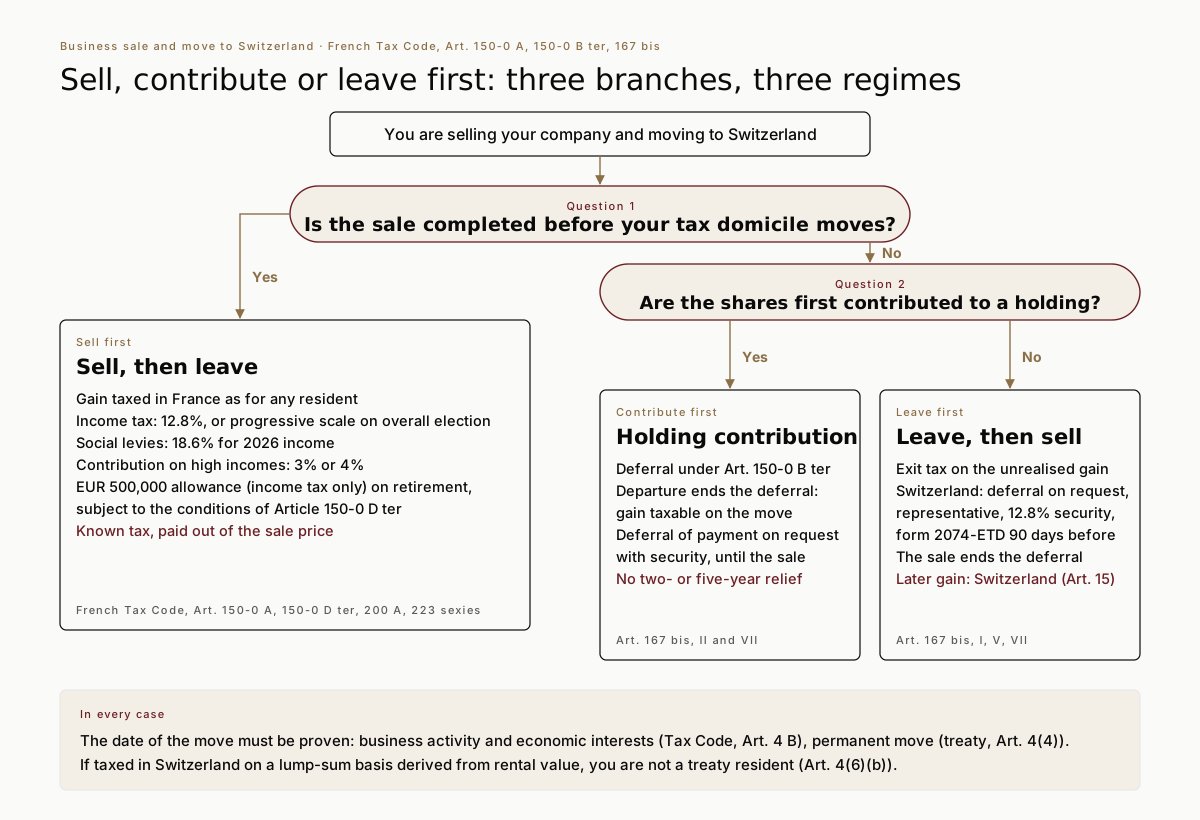
The tree comes down to three questions, in this order: will the sale be completed before departure? If not, will the shares first be contributed to a holding company? And will the date of departure and Swiss residence withstand scrutiny by the tax authorities?
The decision tree: sell, leave or contribute first
Three questions, asked in order, and the tax consequence of each branch.
What we are asked before a sale and a move
Should I sign the sale of my business before moving to Switzerland?
Where the buyer is found and the price agreed, this is usually the safest order: leaving first does not remove French tax, since the exit tax freezes the gain at departure and the sale ends the deferral. Selling first gives a known tax bill, with no security to provide.
Is exit tax deferral automatic for Switzerland?
No. It is automatic only for the European Union and for States bound to France by recovery assistance comparable to Directive 2010/24/EU, which is not the case of Switzerland. You must request it, appoint a representative in France and provide, before departure, security equal to 12.8% of the gains (Art. 167 bis, V).
Is the EUR 500,000 allowance for retiring managers still available if I move to Switzerland?
Yes, if its conditions are met. Before departure, it applies under Article 150-0 D ter. After departure, it applies to the unrealised gain if you retired before the move and sell the shares within two years of retiring (Art. 167 bis, I, 3). It reduces income tax, not social levies.











Selling and moving to Switzerland
Read the treaty article by article
The tax treaty atlas, with Switzerland preselected.
Voir la page Exit taxExit tax in France
Scope, calculation, deferral and relief, for all destinations.
Voir la page TreatyFrance-Switzerland tax treaty
Residence, capital gains, lump-sum taxpayers and case law.
Voir la page ResidenceTax residence in France
The criteria of French tax domicile and the date of the move.
Voir la page GenevaFrench-Swiss practice
The firm's Geneva office and cross-border advice.
Voir la page Exit tax (FR)Exit tax and departure to Switzerland
Deferral request, representative, security and relief (in French).
Voir la pagePreparing the sale of your company and your move to Switzerland?
Confidential first conversation, reply within 24 business hours. The firm models each branch, sets the timetable with your deal advisers and coordinates the Swiss side from Geneva.
© BENSAID Avocats. The information on this site does not constitute legal advice. Sources: French Tax Code, Art. 4 A, 4 B, 150-0 A, 150-0 B ter, 150-0 D ter, 167 bis, 200 A, 223 sexies, 224 and 235 ter; Social Security Code, Art. L. 136-8; Ordinance No. 96-50 of 24 January 1996, Art. 19; France-Switzerland tax treaty of 9 September 1966 as amended, Art. 4, 15, 28 bis and 29 bis; 2074-ETD notice; Swiss DBG/LIFD, Art. 16. Law as at 26 October 2026.