
Contribution and sale, then leaving France: does the tax deferral survive the move abroad?
You have contributed your shares to a holding company you control and are considering moving abroad. Departure ends the deferral, but the tax may remain suspended for years, under rules that are not those of the unrealised gain.
Does the contribution-disposal tax deferral survive leaving France?
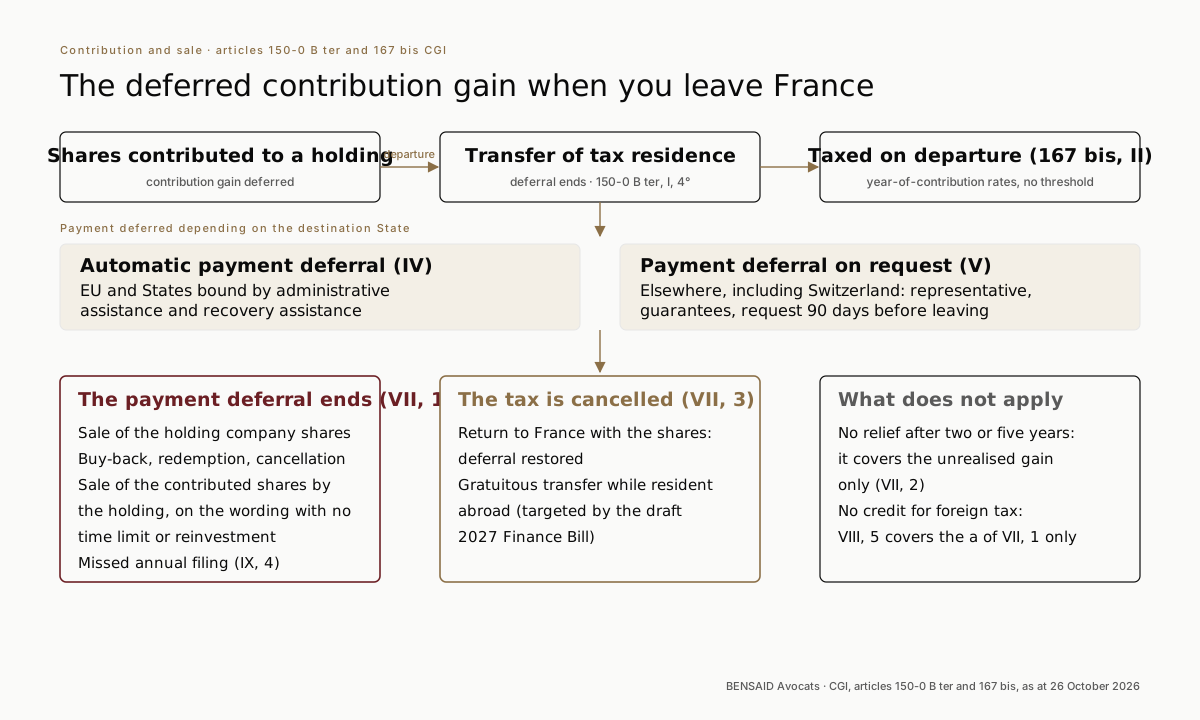
Not in its original form. Transferring your tax residence out of France ends the deferral (article 150-0 B ter, I, 4°) and makes the contribution gain taxable under the exit tax (article 167 bis, II), with no threshold and at the rates of the year of the contribution. Payment is nevertheless suspended: automatically for a move to the European Union or to a State bound to France by the required assistance agreements, on request and against guarantees elsewhere, Switzerland included.
This payment deferral is never cancelled by the passage of time. It ends if you sell the holding company shares or if the holding company sells the contributed shares (article 167 bis, VII, 1, f); it is wiped out if you return to France with the shares or transfer them for no consideration (VII, 3).
CGI art. 150-0 B ter; CGI art. 167 bis; BOI-RPPM-PVBMI-30-10-60-20 and BOI-RPPM-PVBMI-50-30. Checked on 26 October 2026.
- On departure
- Deferral ends (150-0 B ter, I, 4°); gain taxable under the exit tax, with no threshold (167 bis, II)
- Rates
- Those of the year of the contribution: 12.8% income tax for a contribution made since 2018, unless the progressive scale was elected
- Deferral
- Automatic (European Union, treaty States) or on request with guarantees elsewhere, Switzerland included
- End
- Sale of the holding company shares, sale of the contributed shares by the holding company, buy-back or cancellation (VII, 1, f)
- Cancellation
- Return to France with the shares, gratuitous transfer; no relief after two or five years
The payment deferral depends on the State you move to
The deferral is automatic for a move to a European Union State, or to a State bound to France by an administrative assistance agreement and a recovery assistance agreement of a scope similar to Directive 2010/24/EU, provided it is not a non-cooperative State (167 bis, IV). Elsewhere, Switzerland included, it must be requested (V): declaration of the gain, a representative established in France, guarantees provided before departure, and a form filed no later than ninety days before the transfer (Annex III, art. 41 tervicies A).
Guarantees are in principle 12.8% of the gains; for the contribution gain, they are computed at the rate of the year of the contribution (V). The payment deferral suspends the limitation period for collection (VI) and requires an annual return as long as a deferred gain is concerned (IX, 2); failure to file makes the tax due (IX, 4), unless the situation is regularised within thirty days of a formal notice (Annex III, art. 41 tervicies E). See our pages on the French exit tax and, in French, form 2074-ETD and exit tax and Switzerland.
After departure, the sale of the company by the holding company ends the payment deferral
For the contribution gain, the payment deferral ends on "the sale for consideration, the buy-back, the redemption or the cancellation of the securities or rights received in exchange for the contribution or of the securities or rights contributed or of the shares or rights in the interposed companies or groupings in accordance with article 150-0 B ter" (167 bis, VII, 1, f). In practice:
- You sell the holding company shares, or the company buys them back or cancels them: the suspended tax becomes due for the shares concerned.
- The holding company sells the contributed shares. In France, a sale more than three years after the contribution, or within three years with reinvestment of at least 70% for sales made since 21 February 2026 (50% before), leaves the deferral in place (BOI-RPPM-PVBMI-30-10-60-20, § 50). Paragraph f repeats neither that period nor that reinvestment: on its wording, any sale of the contributed shares after departure ends the payment deferral. A reading that aligns f with I, 2° of article 150-0 B ter can be argued, but neither the tax authorities, whose exit tax guidance dates from 2012 and 2013, nor the courts have adopted it: before a sale, a tax ruling is prudent. Article 5 of the draft 2027 Finance Bill, as tabled on 1 October 2026, rewrites paragraph f by reference to the events in 1° to 3° of I of article 150-0 B ter: if passed, the three-year period and the reinvestment rule would also apply after departure.
- You contribute the holding company shares to a new company: for unrealised gains, paragraph a of VII, 1 excludes from the notion of sale contributions governed by articles 150-0 B and 150-0 B ter; paragraph f contains no such reservation.
If the holding company sold the contributed shares before departure, the reinvestment condition is read strictly, as the Lyon administrative court of appeal held under the former 50% within two years threshold (see contribution-disposal before the courts); the fate of a reinvestment still in progress on the day of departure is not settled by article 167 bis and should be secured before leaving.
Two events cancel the tax; no time limit does
The relief after two years, or five years above 2.57 million euros, applies only to the unrealised gain (167 bis, VII, 2): the tax on the contribution gain remains suspended with no end date.
It disappears in two cases (VII, 3). If you return to France with the shares, you are put back in the position you would have been in had you not left, deferral included (BOI-RPPM-PVBMI-50-30, § 130 to 150). If you transfer the shares for no consideration while resident abroad, the corresponding fraction of the tax is cancelled. Article 5 of the draft 2027 Finance Bill, as tabled, removes this relief and makes a gratuitous transfer an event that ends the payment deferral of the tax on the contribution gain, for transfers made from 1 October 2026; it is under discussion in Parliament (see our 2027 budget tracker).
According to the tax authorities, a donee who took over the deferral and leaves before the end of the six- or eleven-year period is taxed under article 167 bis, with relief if the donee still holds the shares at the end of that period (BOI-RPPM-PVBMI-30-10-60-30, § 220 to 240).
The tax treaty does not prevent the tax assessed on departure
Treaties generally reserve gains on shares to the seller's State of residence (article 13 of the OECD model; article 15, paragraph 5, of the France-Switzerland treaty). According to the Paris administrative court of appeal, which so held in 2026 for a move to Luxembourg, deferred gain included, the exit tax escapes this because it is assessed on the day before departure, when you are still a French resident. The judgment is unpublished and the tax authorities do not comment on this interaction; they only state that, in the event of dual residence, departure is assessed under the treaty (BOI-RPPM-PVBMI-50-10-30, § 1). The date of treaty residence must therefore be checked case by case.
The risk lies further down the line: foreign tax paid on a later sale can only be credited against the tax on unrealised gains (167 bis, VIII, 5, which refers only to paragraph a of VII, 1). If your new State taxes the sale of the holding company shares, double taxation of the contribution gain is possible; it is measured country by country in the tax treaty atlas.
Three decisions that set the framework
- EU law. Taxing unrealised and deferred gains on a move to another Member State restricts freedom of establishment, but the restriction is justified by the need to preserve France's taxing powers, since collection is neither immediate nor conditional on guarantees; as the tax is governed by EU law, legitimate expectations require discharge for departures between 3 March and 11 May 2011 (Conseil d'État, 9th and 10th chambers, 5 February 2025, no. 476399).
- Treaty and no relief for the deferred gain. For a move to Luxembourg, the court set the treaty aside, the tax being assessed on the day before the transfer, and held that keeping the tax on the deferred gain beyond the relief period for the unrealised gain breaches neither Directive 2009/133/EC nor freedom of establishment (Paris administrative court of appeal, 2nd chamber, 4 February 2026, no. 24PA03156, unpublished).
- Limitation period. Taxpayers who moved to Switzerland in 1998 stopped reporting their deferred gain under payment deferral in 2003; absent a formal notice, the tax had not become due again and collection in 2016 was not time-barred (Conseil d'État, 9th and 10th chambers, 15 December 2025, no. 495783, pre-2005 regime; the formal notice now appears in article 41 tervicies E of Annex III).
On departure, the deferral becomes an assessed tax whose payment is suspended
The deferral ends "if this event occurs earlier, when the taxpayer transfers his tax domicile out of France under the conditions laid down in article 167 bis" (150-0 B ter, I, 4°). If the deferral has already ended in France, for instance for lack of reinvestment, the tax is due under the ordinary rules and the exit tax has nothing left to catch.
Otherwise, article 167 bis, II, makes the deferred gain "also taxable" on the transfer, without the six-year residence condition and without the 50% or 800,000 euro thresholds that apply to the unrealised gain (BOI-RPPM-PVBMI-50-30, § 1 and 20). The tax follows the rates of the year of the contribution (167 bis, II bis, 1 bis, and 200 A, 2 ter): 12.8% income tax for a contribution made since 2018, unless the progressive scale was elected for the year of the contribution, and, according to the tax authorities, social levies at the rate of that same year (BOI-RPPM-PVBMI-30-10-60-20, § 360), the Lyon administrative court of appeal having applied in 2026, for a 2016 contribution, the rate of the year in which the deferral ended. Departure is deemed to occur on the day before the unlimited tax liability in France ends (167 bis, III).
See also our pages contribution-disposal and article 150-0 B ter and, in French, exit tax for holding company owners.
The deferred contribution gain, from departure to the end of the payment deferral
What happens on departure, what ends the payment deferral and what cancels the tax.
Contribution and sale, then leaving France: your questions
I am moving to Switzerland with a holding company created through a contribution-disposal: must I pay the tax immediately?
No, if you request the payment deferral before leaving. For Switzerland it is not automatic: a request no later than ninety days before departure, a representative in France and guarantees computed, for the contribution gain, at the income tax rate of the year of the contribution. Otherwise, the tax is due.
Can my holding company sell the operating company after I leave without consequences?
As a rule, no. On the wording of article 167 bis, VII, 1, f, the sale of the contributed shares ends the payment deferral of the tax on the contribution gain, even more than three years after the contribution and even if the holding company reinvests the proceeds. A more favourable reading can be argued, but it has been confirmed neither by the tax authorities nor by the courts: a tax ruling before the sale is prudent. The draft 2027 Finance Bill, if passed as tabled, would align this case with the rule that applies in France.
Does the tax on the contribution gain disappear after five years abroad?
No. The relief after two or five years covers only unrealised gains. The tax on the contribution gain remains suspended; only your return to France with the shares, or their transfer for no consideration while you are resident abroad, cancels it, the second case being removed by the draft 2027 Finance Bill as tabled.











Contribution-disposal and exit tax
The article 150-0 B ter deferral
Control, 70% reinvestment, gifts of shares, 2027 budget.
Voir la page GuideThe French exit tax
Scope, thresholds, destinations, relief.
Voir la page Business owner (FR)Exit tax for holding company owners
Unrealised gain, deferral and earn-out, with a worked example (in French).
Voir la page Switzerland (FR)Exit tax and moving to Switzerland
Payment deferral on request, guarantees, tax representative (in French).
Voir la page ToolTax treaty atlas
Read each treaty article by article.
Voir la pageLeave without losing control of the contribution gain
Confidential initial consultation, reply within 24 business hours: inventory of deferrals, timing between sale and departure, payment deferral and guarantees, tax ruling if needed.
Sources
- Article 150-0 B ter of the French Tax Code, version in force since 21 February 2026 (Légifrance, consulted on 26 October 2026)
- Article 167 bis of the French Tax Code, version in force since 1 January 2024, and article 200 A, 2 ter
- Annex III to the French Tax Code, articles 41 tervicies A and 41 tervicies E
- BOI-RPPM-PVBMI-30-10-60-20 (27 August 2026), BOI-RPPM-PVBMI-30-10-60-30 (10 August 2026), BOI-RPPM-PVBMI-50 (2012), BOI-RPPM-PVBMI-50-10-30 (2013) and BOI-RPPM-PVBMI-50-30 (2012)
- France-Switzerland tax treaty of 9 September 1966, article 15
- Draft 2027 Finance Bill, no. 3210, tabled at the National Assembly on 1 October 2026, article 5 (text as tabled, under discussion)
- Conseil d'État, 5 February 2025, no. 476399; Conseil d'État, 15 December 2025, no. 495783; Paris administrative court of appeal, 4 February 2026, no. 24PA03156; Lyon administrative court of appeal, 30 June 2026, no. 24LY02184
Cette note présente l'état du droit à sa date de publication et ne constitue pas un avis juridique. Chaque situation appelle un examen particulier.
© BENSAID Avocats. The information on this page is provided for documentary purposes and does not constitute legal or tax advice; each situation calls for its own analysis. Law in force on 26 October 2026; the developments on the draft 2027 Finance Bill concern a text under discussion.