Expertise — Tax audits & litigation

Tax reassessment: how to respond?

In 2023, the tax authorities assessed 15.2 billion euros in taxes and penalties, including more than 2 billion for VAT alone. The rectification proposal opens a 30-day period (extendable by 30 days) during which the defence is built: negotiation, challenge, request for a stay of payment. The involvement of a tax lawyer from the moment of notification is decisive: choice of arguments, protection of procedural safeguards, preservation of procedural deadlines.

Paris · Geneva · Marseille · Cannes · Lisbon
— 01

Understanding the tax reassessment

A tax reassessment is the procedure by which the tax authorities correct inaccuracies in a taxpayer's returns, resulting in additional tax assessments, penalties and late-payment interest that can reach 80%. It follows a tax audit: a desk audit, an accounting audit, or an examination of an individual's personal tax situation (ESFP).

Notification is made by registered letter containing a reasoned rectification proposal. The taxpayer then has a 30-day period to respond, extendable by a further 30 days upon simple request. This period is crucial: the quality and rigour of the response determine the outcome of the case.

The limitation periods are in principle three years (income tax, social levies, corporate income tax, real estate wealth tax, registration duties). They may be extended to six years for the real estate wealth tax in the event of a failure to file, and up to ten years where there are undeclared foreign assets or an undisclosed activity. Every defence begins with a review of these time limits and of the regularity of the procedure.

— 02

Response strategies in the face of a tax reassessment

01

Negotiating the reassessment

The negotiated route makes it possible to obtain a reduction of the reassessed amounts, or even a partial relief, by demonstrating the taxpayer's good faith and the legal soundness of the initial position.

  • Technical arguments on the contested legal grounds
  • Demonstration of good faith to set aside the 40% or 80% surcharge
  • Recourse to a negotiated settlement (LPF art. L. 247)
  • ~5,000 settlements concluded each year with the DGFIP
  • Hierarchical appeal & departmental commission if negotiation fails

02

Requesting payment terms

Where the reassessment is confirmed, it is possible to obtain instalment payments of the tax debt or a stay of payment pending the outcome of a formal tax claim.

  • Stay of payment as of right where a formal tax claim is filed (LPF art. L. 277)
  • Provision of security required above certain thresholds
  • Instalment plan negotiated with the public accountant
  • Suspension of collection penalties during the stay
  • Avoids protective seizures and third-party debt orders
03

Challenging the rectification proposal

The challenge is built in several stages: a reasoned response within 30 days, a hierarchical appeal, the departmental commission, then litigation before the courts.

  • Reasoned response within the 30-day period (extendable)
  • Referral to the departmental interlocutor in the event of persistent disagreement
  • Referral to the departmental commission for direct taxes and turnover taxes
  • Mandatory prior formal tax claim
  • Litigation before the administrative court / CAA / Conseil d'État (direct taxes) or the judicial court (registration duties, real estate wealth tax)
04

The tax lawyer, linchpin of the defence

The involvement of a tax lawyer from the first notification determines the quality of the defence: choice of arguments, preservation of deadlines, challenge of procedural irregularities.

  • Immediate audit of the regularity of the procedure
  • Challenge of procedural defects (taxpayer's charter, LPF art. L. 10)
  • Negotiation / litigation strategy tailored to the case
  • Representation before the administrative and judicial courts
  • Coordination with criminal tax aspects in the event of parallel proceedings
— 03

Implications, penalties and consequences of a tax reassessment

Three families of consequences to anticipate: financial, tax-related and criminal.

Why the response must be planned from the moment of notification

A poorly managed tax reassessment can lead to heavy financial consequences (additional assessments, penalties of up to 80%, late-payment interest of 0.20% per month), repercussions on business activity (cash flow, financing, reputation) and, in serious cases, criminal prosecution for tax fraud carrying up to a EUR 500,000 fine and 5 years' imprisonment. A strategy built from the first notification contains the impact.

Three families of consequences

Financial and operational repercussions

Additional tax assessments, late-payment interest of 0.20% per month, strain on cash flow, impact on the Banque de France rating and banking terms. For companies: risk to existing financing and to the confidence of business partners.

Tax penalties and administrative surcharges

10% for failure to file or late filing, 40% for deliberate breach, 80% for fraudulent conduct or abuse of law. Specific surcharges for undeclared foreign assets (up to EUR 1,500 per account, or more depending on the country).

Judicial consequences (tax fraud)

In the event of established fraud, the case is referred to the public prosecutor through the mechanism of the mandatory prior complaint or the reformed « verrou de Bercy ». Criminal penalties can reach a EUR 500,000 fine and 5 years' imprisonment, increased to EUR 3 million and 7 years for organised offences.

— 05

Lead counsel: François Ouairy

François Ouairy, partner in charge of the Paris office, assists individuals and companies at every stage of a tax reassessment: response to the rectification proposal, hierarchical appeal, departmental commission, stay of payment and litigation before the administrative and judicial courts. Recognised by Best Lawyers® 2026 in Tax Law and by Leaders League (VAT, real estate taxation & private wealth).

  • Rectification proposal
  • Hierarchical appeal
  • Departmental commission
  • Stay of payment (LPF art. L. 277)
  • Tax settlement (LPF art. L. 247)
  • Tax litigation (TA · CAA · CE)
  • Criminal tax law (tax fraud)
  • Best Lawyers® 2026
  • Leaders League
— 04

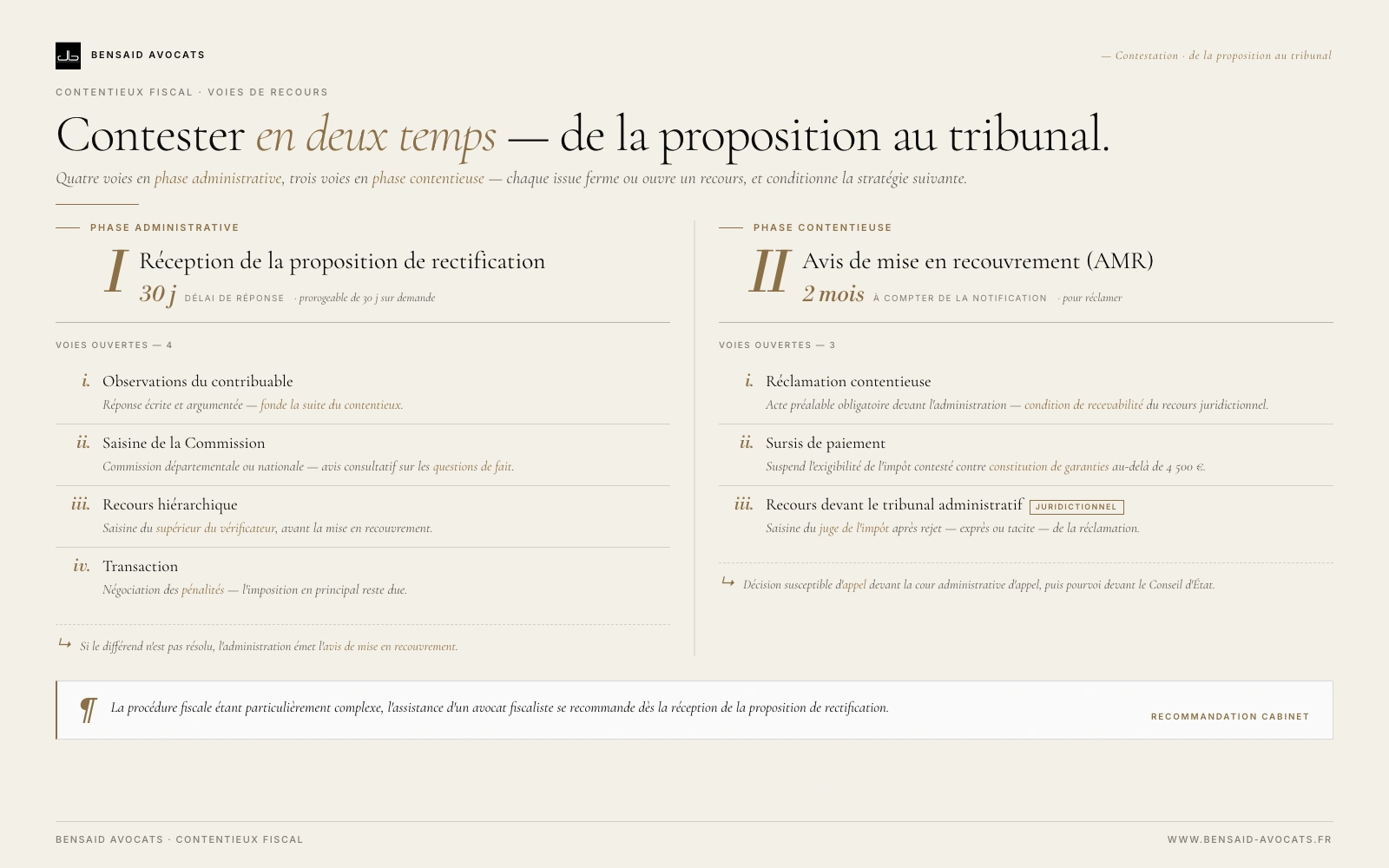
Tax reassessment diagram: the deadlines and stages to know

An overview of the timeline: rectification proposal, response period, hierarchical appeal, departmental commission, formal tax claim and court litigation.

Tax reassessment diagram: rectification proposal, 30-day period, hierarchical appeal, departmental commission, litigation
Deadlines and stages of the tax reassessment: rectification proposal, 30-day response period (extendable), hierarchical appeal, departmental commission, formal tax claim and competent courts.
— 06

Frequently asked questions: tax reassessment

What is a tax reassessment?

It is the procedure by which the tax authorities correct inaccuracies in a taxpayer's returns following a tax audit (desk audit, accounting audit or ESFP). It takes the form of a reasoned rectification proposal and results in additional tax assessments, penalties (10%, 40% or 80%) and late-payment interest.

How long do I have to respond to a rectification proposal?

30 days from receipt, extendable by a further 30 days upon simple written request. This deadline is mandatory: in the absence of a response, the taxpayer is deemed to have accepted the rectifications.

What are the limitation periods in tax matters?

In principle 3 years (income tax, corporate income tax, VAT, real estate wealth tax, social levies, registration duties). Extended to 6 years for the real estate wealth tax in the event of a failure to file, and to 10 years where there are undeclared foreign assets or an undisclosed activity.

Can a tax reassessment be challenged?

Yes. Several routes coexist: a reasoned response within 30 days, a hierarchical appeal, referral to the departmental interlocutor, referral to the departmental commission, then a formal tax claim and litigation before the administrative court or the judicial court.

Must the tax be paid while the challenge is pending?

No, if the taxpayer requests a stay of payment in the formal tax claim (LPF art. L. 277). The stay is granted as of right, subject to providing security above a certain threshold (EUR 4,500 in principle).

Why does a tax lawyer change the outcome of a reassessment?

The tax lawyer immediately audits the regularity of the procedure (taxpayer's charter, LPF art. L. 10, notification defects, limitation periods), builds the technical arguments, secures the procedural deadlines and negotiates with the tax authorities. Involvement from the moment of notification often makes it possible to avoid litigation or to reduce its burden significantly.

Cité par

Received a rectification proposal?

Describe the context (date of notification, taxes concerned, years at issue, reassessed amounts) so that the firm can assess the response strategy and arrange an initial discussion within 24 hours. The 30-day period runs from receipt: every day counts.

Jonathan Bensaid, avocat fondateur

Written by

Me Jonathan Bensaid, avocat fiscaliste, fondateur du cabinet Bensaid Avocats, inscrit aux Barreaux de Paris & Genève.